• TalkBass has been independent since 1998. Add your voice.
    Create a free account to reply to discussions, view embedded media, and browse with fewer display ads.
    Join freeLog in
    Want zero display ads or expanded classifieds tools? Compare plans.

What can I do to improve my B string?

Most of the sound is in the BASS, not the guts. How does the B sound when you play the bass unamplified? Because all the pickups and pre-amp can do is translate what's happening in the wood. And I believe most of it's the neck wood. A stiffer neck will give you a "better" B string most of the time, part of the reason Sadowsky basses cost more.

But to try to improve what you have, the first thing I would do is ditch the taper-core strings. After using two sets of Stainless Lakland strings on my 55-01, I tried a set of DR Hi-Beams in the same gauges with a NON-tapered B. MUCH better response and the string sounds like the other four strings. BTW, when Bass Player Magazine did their string survey a few years ago, they found that they consistently liked non-tapered B strings better. The article commented on that, as before they did the blind test on side-by-side instruments and recorded each set of strings, they thought they liked taper-core better.

John

 
Though it's probably; been said before I should throw my 2 cents in as well. If you like the Sadowsky tone more than the tone you get form your Fender, then you just might be better off getting a Sadowsky. "Sizzle" isn't something that Fender basses necessarily have a reputation for and the basses you'd be more likely to get that kind of sound from would definitely be the active ones (American Deluxe, FMT, Custom Classic, etc) and short of changing the electronics it would be tough to get that sound naturally. So if you're not getting what you want from your Custom Classic maybe a Sadowsky is what you want? IME it's a bit easier to get a Fender like tone from a Sadowsky than the reverse. And even though there isn't to a lot of overlap between the two that might just be what your looking for.

If your looking at Jazz basses you might want to give Lulls a try too. They can cop a Fender vibe much more easily than a Sadowky but the active preamp (an Aguilar OBP-3 for most I think) allows a whole wide range of tonal possibilities.

Again this all IME and IMO.
 
Sell me the bass! :D Just kidding (not really) CHANGE TO SAMARIUM COBALT PICKUPS. problem solved. The Noiseless Pickups have a weak B string output/tone. Just my experience. I also have had luck with Seymour Duncan Basslines in a Fender. Just switched out some in a MIM Jazz V with some passive SD's and wow, the B is deadly. Hope that helps.

 
First off the Fender Noiseless J pickups are not very single-coil sounding. That is maybe what you heard.

Take a look at Circle K strings. I am running their .136 B balanced set on my P5 and it made a huge difference in the B as well as the D and G strings compared to the Fenders (and the TI's and the LaBella's, and the Smith's,....) that I have tried on that bass so far.

Strings will help evenness of tone and tension. If you want sizzle, you will probably have to look at EQ or a preamp. Since you probably don't want to dive into the guts of your new bass, I would look at the Sadowsky outboard.
 
In my own experience with trying to improve low B performance on various basses, I've come to two general guidelines - nickel wound, and .125 or lighter. That's just what seems to have produced the best results for me. Easy and cheap to try. It may or may not get you the sizzle that you seek; imo, it'll probably get you the best that the bass has to offer.

/rick
 
I love it...

stflbn says "Larger diameter B-string helps a lot. In my opinion. Allows you to be a bit more aggressive with it before it starts to get flabby." ...

while RickC says the opposite when he says "In my own experience with trying to improve low B performance on various basses, I've come to two general guidelines - nickel wound, and .125 or lighter." (Emphasis added).

See, if you wait long enough on TB, you'll get EVERYTHING posted as the solution. Let's go back to lowphatbass' post. What EXACTLY are you seeking that you're not getting? That would help you get accurate and useful help.

John
 
Exactly.

Personally, I find buying used string sets here on Talkbass at a discount a GREAT way to try ideas like this out myself. Also depends greatly on your playing style, technique and preferred genre's of music. All 3 things can directly impact the effect a string can have.

A flabby B string is different to a Slapper, or an aggressive fingerstyle player, or very light touch fingerstyle player, or even a pick player. Then there's all the different genre's and tunings... blah blah blah.


In my experience a lighter string may work great for a light touch player or slapper, but a heavier b-string allows more digging in while retaining clarity.
 
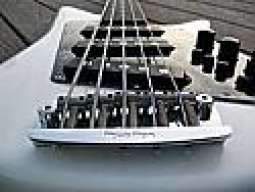
Here's some pics.... which might help.
download?fid=642221d25038a902fef423d09ad0a146&name=P1020992.jpg
IME, you've often got to break some "rules" when you set-up a Low B. Rarely can you just set-up a bass "symmetrically" with the B at the same string height as the G string.
It's hard to tell from this pic, but the B looks pretty low. It's all about how you want to use it, but I'm guessing I would need a fresh set of strings every week or so to get any slapping done on that thing.

edit:(PS, take the cardboard thingy off the control plate! You're killing me, LOL!)
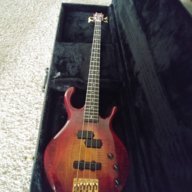
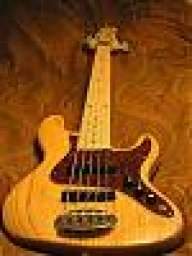
...o.k., maybe it's just an old pic!
 
IME, you've often got to break some "rules" when you set-up a Low B. Rarely can you just set-up a bass "symmetrically" with the B at the same string height as the G string.
It's hard to tell from this pic, but the B looks pretty low. It's all about how you want to use it, but I'm guessing I would need a fresh set of strings every week or so to get any slapping done on that thing.

edit:(PS, take the cardboard thingy off the control plate! You're killing me, LOL!)
...o.k., maybe it's just an old pic!

While I agree that it would be difficult to get the B string to follow the same radius as the rest of the strings, raising it would really only eliminate some fretbuzz and allow you to dig in a bit more. The closer the string is to the pickup the stronger it's likely to sound. And a new set of strings every week would be excessive for even the most active and aggressive bassist.
 
when i did use 5'ers i made sure i had an 18" speaker, be careful of overdrives settings they-ll make your b muddy. and this maybe and "far cry" but ive noticed basses with 2/4 tuner set-ups actually round your overall feel and sound out with a 5 string, for those that are understanding a headstock with B and E strings to one side and A,D,G on the other.
 
While I agree that it would be difficult to get the B string to follow the same radius as the rest of the strings, raising it would really only eliminate some fretbuzz and allow you to dig in a bit more.
Only eliminate some fretbuzz and allow you to dig in a bit more? That sounds like a lot to me.

The closer the string is to the pickup the stronger it's likely to sound.
Yes, good point. I think with the pick-ups adjusted correctly and the right amount bass knob you should be able to get an evenness with out having each string the same distance from the pups/pole pieces.


And a new set of strings every week would be excessive for even the most active and aggressive bassist.

That's my point. If I wanted to slap on that B string(which I very much do!!)I'd probably have to replace the string weekly to get the response I'd need.
.
 
Maybe JTE and I aren't as far apart as our posts would suggest. The Circle K .136 B string I recommended has a tapered core at the B and E saddles that is about the same diameter as the A string. It's quite a bit thicker than the core of the Fender strings but lighter than any non-tapered B. IMO the taper is key to getting any higher overtones out of it. Especially if they stay on for a while. However, I still think you need a thicker string to match tension with the higher strings. BTW I am not affiliated at all with this company, just a satisfied customer of a smaller maker.
 
I agree the B string diameter is a factor but IMHO only incrementally. Switching the pickups to something that has decent output on the B compared to the Noiseless which, IMHO, could be relabeled "B-less" .

Switch the pickups and use any B string your heart desires, you'll be 99% out of the woods.
 
from my experience I never heard an outstanding B string with Jazz pickups. It was just acceptable. The B on my StingRay and OLP bass rattle the walls because of the MM humbucker.

Aint never tried one stuffed with AERO TYPE I's I gather.

Anyway, I've had "punk" B strings right out of the box. Dr sent me a new one/ Some are better than others. The fellas are spot on, keep trying strings.

BTW, I saw no one asked, the sound quality of the B is being tested passive or active?
 
Hello All, I'm kinda new to this posting stuff so here goes:

I've spent a lot of time testing strings for the type of bass that you're using. Because the design is based around my instrument, my ideal string choice to get the piano like sound that I want, I use stainless steel strings. My gauge is .135tw, .110tw, .085, .065, .045 when using a five string bass. I can dig that your preference may vary but that's what works for me. Your particular bass has string trees for everything. It's fine to have it but you might consider a shim to raise the B/E tree to relieve the break on the string. I only have a tree for the middle three strings but there is no best way. I remember testing .145s for La Bella back in the early 80's. The eternal search for tone. Thanks for reading my thoughts on the issue. Hope it helps.
 
While I agree that it would be difficult to get the B string to follow the same radius as the rest of the strings, raising it would really only eliminate some fretbuzz and allow you to dig in a bit more. The closer the string is to the pickup the stronger it's likely to sound. And a new set of strings every week would be excessive for even the most active and aggressive bassist.


Not necessarily IME. There can be a point where the B is too close to the pickup to get optimum output. That is a very good reason to raise a B. And this is coming from a guy who sets his pickups very close to the strings. Very.
:cool:

IME most of the problems I've seen have come from trying to treat the B like any other string. That's ultimately a player issue.

The heaviest B I use on anything is a .125. I go as light as .120 on some basses and in both cases the B's sound great. The B on my MIA JD5 sounded great. Stock. No hardware changes, no preamp/pickup swap, nothing. It helps to go in knowing that you might have to figure out the optimal way to play the bass that's in your hands vs. trying to make it conform to how you play something else.

If you have the action too low on the B it can limit how aggressively you can play it. By the same token if you play too aggressively without controlling the string you can kill the sound anyway. If you work on developing your touch on the B, that in my experience pays the biggest dividend. You control it with both hands, something many don't seem to know.

In combination with refining your left hand muting, find out where the sweetspots are for your plucking hand. Closer to the bridge, the tighter the string. Pretty hard to unintentionally make a B flop when you keep that in mind... but it's easier to think the bass is the problem.

I almost cringe when people ask about an issue and the first things many mention is changing hardware. Here's an easy test, if you have access to other decent players locally: if no one can make your bass sound good, it might be the bass. If anyone else can... it might be you. And there's no shame in that, it just means you have work to do if you want to fix that hardware problem.

That's my advice for what it's worth.
:D