The pre amp affects the signal in such a way to reduce distortion???Also does the pre amp for guitar or bass make it possible to play either or instrument through the speakers or can you do that anyway?? I'm going to read up on pre amps. I've heard people talk about them a lot.

Enjoy the benefits of a premium membership!
Upgrade Account
-
TalkBass has been independent since 1998. Add your voice.
Create a free account to reply to discussions, view embedded media, and browse with fewer display ads.
Join free Log in
Want zero display ads or expanded classifieds tools? Compare plans.
You are using an out of date browser. It may not display this or other websites correctly.
You should upgrade or use an alternative browser.
You should upgrade or use an alternative browser.
What did I buy??
- Thread starter Fndrgrl
- Start date
More options
Who Replied?
The preamp with the peavey amp suggested was specifically towards bass, in most cases running a separate pre will make it easier to get musical distortion at a lower volume. This may or may not be what you're after. You will want to pick up a replacement speaker, or a pair (and sell the JBL to fund it if you like), that is specifically voiced to your style of guitar playing these really wont like playing a bass guitar or the watts needed to get good bass guitar volume. The suggestion to use a peavey MKIV was good if you wanted a cheap bass amp, but not really great for guitar. There are however a ton of really good guitar heads out of the 80's that can be had for a great deal and let you use what you have for now until you can replace it with what you really want later. I do especially like 80's peavey combos for guitar, I even prefer them to Marshall, but I am not very familiar with their heads.

There are different types of preamps. Speakers dictate the sound it can reproduce, not the instrument. But speakers that are not designed for very low frequencies can be damaged playing bass through it regardless of any preamp. Basically the speaker cone has to move further (called excursion) the lower the frequency which can tear the cone.Also does the pre amp for guitar or bass make it possible to play either or instrument through the speakers or can you do that anyway?? I'm going to read up on pre amps. I've heard people talk about them a lot.
Also the coil on the back of the speaker produces heat when moving and bass heats it to a high temperature which can burn that coil up. Either way, in those instances the speaker would then need to be replaced or repaired.
Using a speaker designed for low (bass) frequencies will not reproduce high frequencies well. That is why a high frequency driver or horn is often added on bass amps but the midrange can suffer, not working as well for guitar.
A preamp is fairly simple. Its basically a first stage amplifier. It takes a low voltage input and amplifies the signal for the next stage. That makes the signal strong enough for the next stage but also makes the (Music) signal louder than the noise level. Everything beyond that are additional features (tone controls, gain/distortion, delay, reverb, etc.) that manufacturers add in.
Using a preamp does not change the amplifier. If you use a bass amp for instance, a guitar preamp does not make that bass amp much more suited to guitar. Using a guitar amp and a bass preamp does not make it much more suited for guitar. Amps are "Voiced" for a particular instrument. The vintage Fender Bassman is one of the few slight exceptions. It has Bass Inputs & Normal (Guitar) inputs which is not just different preamp circuits but the amp circuit as well. While it has a very good clean guitar sound, it is not voiced for a high-gain sound guitar. Putting an overdrive pedal in front of a Bassman is not a common desirable sound. Most modern (since 1970's) amps are voiced for a particular instrument. And lastly note that people like myself that use a vintage bass amp for guitar use a different speaker/cabinet.
I like the ideaThe preamp with the peavey amp suggested was specifically towards bass, in most cases running a separate pre will make it easier to get musical distortion at a lower volume. This may or may not be what you're after. You will want to pick up a replacement speaker, or a pair (and sell the JBL to fund it if you like), that is specifically voiced to your style of guitar playing these really wont like playing a bass guitar or the watts needed to get good bass guitar volume. The suggestion to use a peavey MKIV was good if you wanted a cheap bass amp, but not really great for guitar. There are however a ton of really good guitar heads out of the 80's that can be had for a great deal and let you use what you have for now until you can replace it with what you really want later. I do especially like 80's peavey combos for guitar, I even prefer them to Marshall, but I am not very familiar with their heads.
I like the idea of using some kind of amp to play with until I get the aspirational pieces I want which is down the road. There are so many choices!! Also I agree that what type of music is important too!!I like the idea
Really a ton of choices. If you want a George Harrison vibe you'd be looking at much different choice than if you wanted a Stevie Ray sound. Lots of options to get in the middle or can get very tight into one style. Sometimes its just nice to throw something cheap at it and jam until you find what you're after.
When you say using a vintage bass amp for guitar use a different speaker/ cabinet that would mean for each type of guitar?? That makes sense. All of the above information makes sense when you think of the technical theory behind it. Your points are very well taken!! I appreciate the time and thought you put into your information!! People on this forum know their stuff!!There are different types of preamps. Speakers dictate the sound it can reproduce, not the instrument. But speakers that are not designed for very low frequencies can be damaged playing bass through it regardless of any preamp. Basically the speaker cone has to move further (called excursion) the lower the frequency which can tear the cone.
Also the coil on the back of the speaker produces heat when moving and bass heats it to a high temperature which can burn that coil up. Either way, in those instances the speaker would then need to be replaced or repaired.
Using a speaker designed for low (bass) frequencies will not reproduce high frequencies well. That is why a high frequency driver or horn is often added on bass amps but the midrange can suffer, not working as well for guitar.
A preamp is fairly simple. Its basically a first stage amplifier. It takes a low voltage input and amplifies the signal for the next stage. That makes the signal strong enough for the next stage but also makes the (Music) signal louder than the noise level. Everything beyond that are additional features (tone controls, gain/distortion, delay, reverb, etc.) that manufacturers add in.
Using a preamp does not change the amplifier. If you use a bass amp for instance, a guitar preamp does not make that bass amp much more suited to guitar. Using a guitar amp and a bass preamp does not make it much more suited for guitar. Amps are "Voiced" for a particular instrument. The vintage Fender Bassman is one of the few slight exceptions. It has Bass Inputs & Normal (Guitar) inputs which is not just different preamp circuits but the amp circuit as well. While it has a very good clean guitar sound, it is not voiced for a high-gain sound guitar. Putting an overdrive pedal in front of a Bassman is not a common desirable sound. Most modern (since 1970's) amps are voiced for a particular instrument. And lastly note that people like myself that use a vintage bass amp for guitar use a different speaker/cabinet.
Once you talked about speakers being voiced for different instruments I understood that very well. I asked that when I bought it at the sale. They honestly didn't know. I pointed to a basic speaker from a stereo and told them that one part was for base and one for midrange and one for treble.The front of a speaker had fallen off and I used it as an example.When you say using a vintage bass amp for guitar use a different speaker/ cabinet that would mean for each type of guitar?? That makes sense. All of the above information makes sense when you think of the technical theory behind it. Your points are very well taken!! I appreciate the time and thought you put into your information!! People on this forum know their stuff!!
I showed them that in that cabinet I wanted there were two speakers( I thought) of the same size which would eliminate the possibility of midrange and treble. I also told them it wasn't an amp and pointed out there was No place to plug an instrument in. One of the assistants got very very angry at that point. So I guess I wasn't too far out of the ballpark and had basic but limited understanding and vocabularity about the cabinet. I'm still thrilled with it. I'm certainly going to be more careful in the future. All the information I'm getting will help in my search!!

As I wrote before:When you say using a vintage bass amp for guitar use a different speaker/ cabinet that would mean for each type of guitar?? That makes sense. All of the above information makes sense when you think of the technical theory behind it. Your points are very well taken!! I appreciate the time and thought you put into your information!! People on this forum know their stuff!!
1) A speaker for guitar will not produce low frequencies (for bass) accurately or possibly without being damaged.
2) A speaker for bass will not produce high frequencies (for guitar) accurately.
Most stereo or TV speakers are 2-way, 3-way or 2.1 (speakers plus subwoofer) for a reason. Different drivers for different frequencies. Same applies to instrument amplification plus there are complications. Stereo & TV speakers are normally facing the person who generally is sitting in one location. A musician is generally moving around (especially on-stage) so at times they are off-axis from the center of the speakers. The speakers need to have a wider dispersion. Low frequencies fortunately are less directional as they get lower. That is why a subwoofer can reside almost anyplace in the room. But mid & high freqs are very directional. There has to be a compensation made for this.
This is also why Studio monitors & stereo speakers make awful instrument speakers.
All cone type Speakers (and pretty much everything in the world!) have a resonant frequency which will be listed in its specs. That is the natural frequency when struck. Tap various objects around you and notice each has a particular sound or frequency. With a speaker that is where it will ring out if that frequency is played through it. Not as desirable as it sound. But a speaker with a resonant frequency of say 70hz will not effect the sound of a guitar that does not go below 82hz (Low open E) but might the bass. This why a cabinet is designed with the particular speaker in mind to deaden the resonant speaker. Not every speaker will work with every cabinet. And not every speaker will work with every instrument.
And a speaker's frequency response is never perfectly flat. Each will color differently. Better speakers you can look up the manufacturers chart of it.
Amps also are just as varied. It was mentioned to get a cheap older Peavey head. I have a Peavey Bandit from the mid-80's. Its good for generic rock like AC/DC. The clean sounds suck big time! And its worse for metal. But you could get a Peavey 5150 (tho not exactly cheap) head and its fantastic for Van Halen of course and would work for some metal. But again the cleans are not clean. And for a lot of pop it won't work well at all. I just do not see how any person can tell another person what amp (or speaker) to get without a lot of information (music, playing style, etc.) and there is a reason why there are literally hundreds of different amps out there.

No, no - nothing wrong - the "lowner" reference was not directed at you - He was saying that you didn't. I hope you get it all working.I posted quite a bit as I was able. Sorry about whatever I did that was wrong. I thought I posted quite a bit. Sorry again!! Thanks for the feedback. Folks may not hear from me for a whole til I make further progress. Again thanks for all the good help fro. From very generous players!!!
Cheers T
As I wrote before:
1) A speaker for guitar will not produce low frequencies (for bass) accurately or possibly without being damaged.
2) A speaker for bass will not produce high frequencies (for guitar) accurately.
Most stereo or TV speakers are 2-way, 3-way or 2.1 (speakers plus subwoofer) for a reason. Different drivers for different frequencies. Same applies to instrument amplification plus there are complications. Stereo & TV speakers are normally facing the person who generally is sitting in one location. A musician is generally moving around (especially on-stage) so at times they are off-axis from the center of the speakers. The speakers need to have a wider dispersion. Low frequencies fortunately are less directional as they get lower. That is why a subwoofer can reside almost anyplace in the room. But mid & high freqs are very directional. There has to be a compensation made for this.
This is also why Studio monitors & stereo speakers make awful instrument speakers.
All cone type Speakers (and pretty much everything in the world!) have a resonant frequency which will be listed in its specs. That is the natural frequency when struck. Tap various objects around you and notice each has a particular sound or frequency. With a speaker that is where it will ring out if that frequency is played through it. Not as desirable as it sound. But a speaker with a resonant frequency of say 70hz will not effect the sound of a guitar that does not go below 82hz (Low open E) but might the bass. This why a cabinet is designed with the particular speaker in mind to deaden the resonant speaker. Not every speaker will work with every cabinet. And not every speaker will work with every instrument.
And a speaker's frequency response is never perfectly flat. Each will color differently. Better speakers you can look up the manufacturers chart of it.
Amps also are just as varied. It was mentioned to get a cheap older Peavey head. I have a Peavey Bandit from the mid-80's. Its good for generic rock like AC/DC. The clean sounds suck big time! And its worse for metal. But you could get a Peavey 5150 (tho not exactly cheap) head and its fantastic for Van Halen of course and would work for some metal. But again the cleans are not clean. And for a lot of pop it won't work well at all. I just do not see how any person can tell another person what amp (or speaker) to get without a lot of information (music, playing style, etc.) and there is a reason why there are literally hundreds of different amps out there.

Looks like a Fender 2-15" cabinet from around 1969. Heavy little sucker. Owned a couple. Has an awesome sound.Sorry for the poor quality photo. It is too heavy for me to lift but has a handle. Don't know how you could regularly take it to gigs. Its still in my SUV.
Thank you thank you thank you. Right now I've only got one 16 ohm JBL D131 that's original. Next I need an amp. Isn't she/he gorgeous??? I love a challenge and a project!! Thanks for your kind response!!Looks like a Fender 2-15" cabinet from around 1969. Heavy little sucker. 8Owned a couple. Has an awesome sound.

based on the average height of a backseat in an SUV I am gonna say 2 12's tooI, still, see this as a 2-12 cab with one handle on it, Yes, I have super powers.Until proven otherwise.
View attachment 3102378
Note the single handle at the top center of the cab; what looks, to some, as two other handles, I believe to be supports for the rear seat headrests.

You hit it 100% correct. I got a lot of feedback that agreed with you. There is some discussion as to whether its a Bass Man or a Bandmaster. Most agree its from the 60s or early 70s. I love it and think its a beauty. My goal is an amp to play either guitar or bass with. Ice heard a Bandmaster amp could do that. I've heard mixed reviews on how it sounds. There are so many variables to consider. I'm an amateur who won't be heard. I love to play. I'm having fun and appreciate the kind feedback!!based on the average height of a backseat in an SUV I am gonna say 2 12's too

I'm sorry I have not kept up with the entire thread,
Have you discovered what speakers are in the box?
Have you discovered what speakers are in the box?
I would be very careful hooking an amp up to it. I doubt something that old has original speakers. You need to know the load rating before you destroy your amp.You hit it 100% correct. I got a lot of feedback that agreed with you. There is some discussion as to whether its a Bass Man or a Bandmaster. Most agree its from the 60s or early 70s. I love it and think its a beauty. My goal is an amp to play either guitar or bass with. Ice heard a Bandmaster amp could do that. I've heard mixed reviews on how it sounds. There are so many variables to consider. I'm an amateur who won't be heard. I love to play. I'm having fun and appreciate the kind feedback!!
Is there any chance you could take your phone and get some clear pics? Maybe some of the back of the cabinet?
Fndrgrl, I found the perfect head (1968 Bandmaster) for your cabinet. I saw this yesterday when I visited the store, it is in very good condition and the price is very reasonable. This head along with your cabinet with pair of the Eminence Legend 12's I mentioned in an earlier thread, would be a KILLER rig for you!
Invalid Link Removed
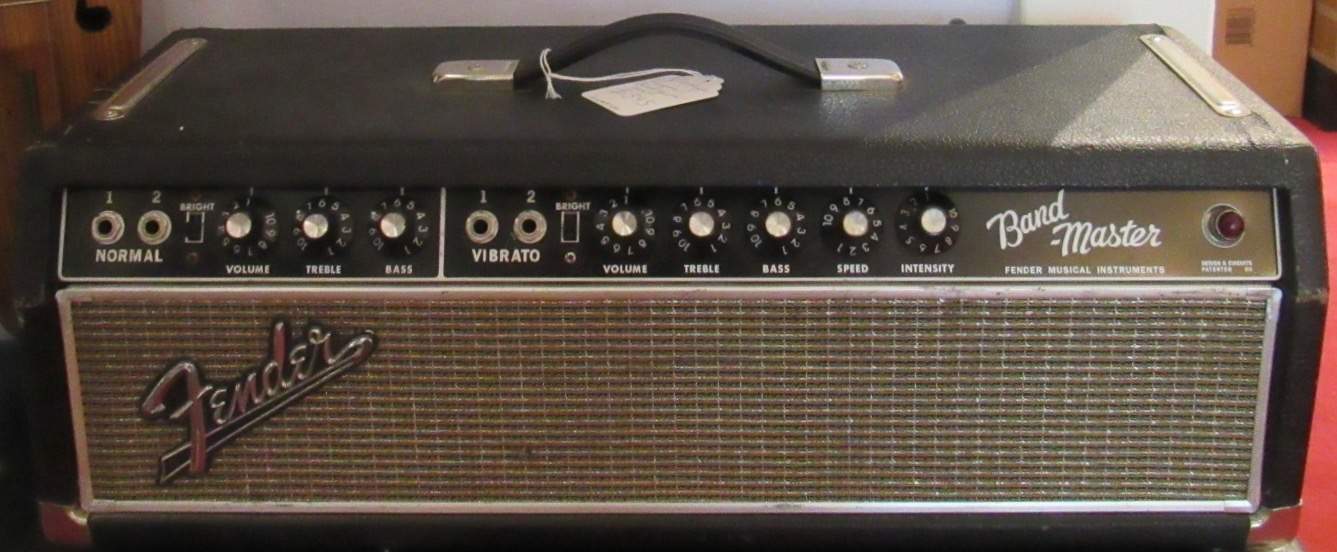
Invalid Link Removed
Last edited:
And for any bass people who may be looking for a Fullerton-built '62 Fender Precision AV Reissue, the same store has a REALLY nice sunburst 1982 version that is priced very reasonably for what it is.....(I have no afilliation with the store aside from being a happy customer). If I didn't already have too many basses, I would have bought it.
Invalid Link Removed
Invalid Link Removed


