Do you use any? If so, what of these fairly common ones do you use? Expand in the comments.

Enjoy the benefits of a premium membership!
Upgrade Account
-
TalkBass has been independent since 1998. Add your voice.
Create a free account to reply to discussions, view embedded media, and browse with fewer display ads.
Join free Log in
Want zero display ads or expanded classifieds tools? Compare plans.
You are using an out of date browser. It may not display this or other websites correctly.
You should upgrade or use an alternative browser.
You should upgrade or use an alternative browser.
What effects do you use?
- Thread starter Dlew919
- Start date
More options
Who Replied?

With the band? Fuzz. Sometimes octave.
At home? All of them.
At home? All of them.
My basic setup is compression, EQ and overdrive. For some songs/bands, I add octaver, envelope filter, chorus and reverb.
Of those options I only use compression. My most complicated pedalboard has tuner, compression, eq and amp/cabsim.


I rarely use compression on my part these days, but maybe the soundpeople will add some for me? I also use compression if I use a split signal, I compress the clean channel to match the dirty channel.
Overdrive is part of my tone, I like the edge and peak reduction it gives without sounding unnatural. I mainly set to an edge-of-breakup gain level, and use the more natural sounding types such as Sansamp.
I use fuzz and envelope filters for something totally over the top, something unlike a bass guitar. I used to use the EHX Bassballs that gives a bit of both, but ultimately wasn't fobd of its level discrepancy (no master volume control). An analogue octave pedal also gives a similar effect, while I also like a digital octave up to simulate an 8-string.
I mainly only use chorus as my periodic modulation, and others sound a bit weird on bass for me. I don't add reverb or delay to muddy up lower frequencies.
Overdrive is part of my tone, I like the edge and peak reduction it gives without sounding unnatural. I mainly set to an edge-of-breakup gain level, and use the more natural sounding types such as Sansamp.
I use fuzz and envelope filters for something totally over the top, something unlike a bass guitar. I used to use the EHX Bassballs that gives a bit of both, but ultimately wasn't fobd of its level discrepancy (no master volume control). An analogue octave pedal also gives a similar effect, while I also like a digital octave up to simulate an 8-string.
I mainly only use chorus as my periodic modulation, and others sound a bit weird on bass for me. I don't add reverb or delay to muddy up lower frequencies.

Compression and Overdrive/Distortion are my main effects. I have used reverb on a few songs, but not often.
I once had a phaser, but I couldn't find any use for it on bass with the music I play (mostly heavy metal and hard rock).
I once had a phaser, but I couldn't find any use for it on bass with the music I play (mostly heavy metal and hard rock).
Last edited:
a bitcrusher is probably sort of a fuzz? I picked other. my serious (i.e. not at home doing production or solo stuff) signal chain is tuner > eq > compressor > bitcrusher > soundgoodizer > preamp/amp/di.
I use an expression pedal with the bitcrusher. if I was feeling really fancy I’d add one of my two phasers to the chain but I don’t need the sauce atm.
I use an expression pedal with the bitcrusher. if I was feeling really fancy I’d add one of my two phasers to the chain but I don’t need the sauce atm.

HPF, compression, and a “character” preamp pedal but I have all the options available. I use the cheap stuff…most expensive was a $190 comp. Come to think of it, I have multiple comps accessible via dedicated pedals and built-ins….6 without counting a multi-FX.

This is an interesting question. My answer is rather complicated....and requires some lengthy history and explanation of how I use effects and what my goals are for certain situations.
When I first started playing, I was looking for a certain tone and was sold a compressor pedal and chorus pedal because that's what I was told would get me there....it didn't. This was also back before the internet existed, so researching was much more difficult. Eight years later I had sold both of those pedals because I didn't see the need for them since they weren't getting me where I wanted to be. I then bought a Zoom 506 multi-fx pedal to experiment with. I really didn't have much of a plan beyond tinkering with it but did end up actually using it on a few songs on an album that my band at the time recorded.
A few years later in around 2001, I started playing with a cover band and I decided the Zoom was fun for use at home, but I didn't really trust it's plastic shell to survive live work, so I ended up buying the HIGHLY recommended SansAMP BDDI (which I will point out FINALLY got me the tone I was hunting 11 years prior) and a BOSS GT-6B. This allowed me to build patches for certain songs that needed a different sound.
Since then, I have found that I mostly utilize fuzz, drive, distortion, chorus, octaver and reverb the most in the GT-6B. There are occasions when I utilize phaser, flanger and delay, but those are few and far between. This has been my primary pedal board since 2001. I have used it for live cover band work, church worship team work, original rock recording work and my all-around playing.

Since my exposure to the band Clatter 20 years ago, I fell in love with the idea of the bass player filling a double role as both the bass and a rhythm guitar. I began a board back then to do something similar to what Amy did, then, but ended up selling everything and setting the idea aside. When Royal Blood came along, that desire was rekindled and I had an major desire to chase that idea again.
I began assembling the board in small pieces. Along the way, I had the idea that maybe I could use this as a board for rhythm guitar (should I ever actually learn how to play the spindly little six-strings things), so the board grew beyond it's intended purpose. This board begins with an ABY splitter, with channel A running to the board above for my bass tone, and channel B runs to this board, which kicks the signal up an octave first, then through the remainder of the pedals, including the Harmonist that adds a 5th above, giving me a tone as if a rhythm guitarist is playing power chords to match my bass. It works as intended, but my current band did not seem to appreciate it like I thought they might. Oh well...I have plans to utilize it down the road for some personal recording work.
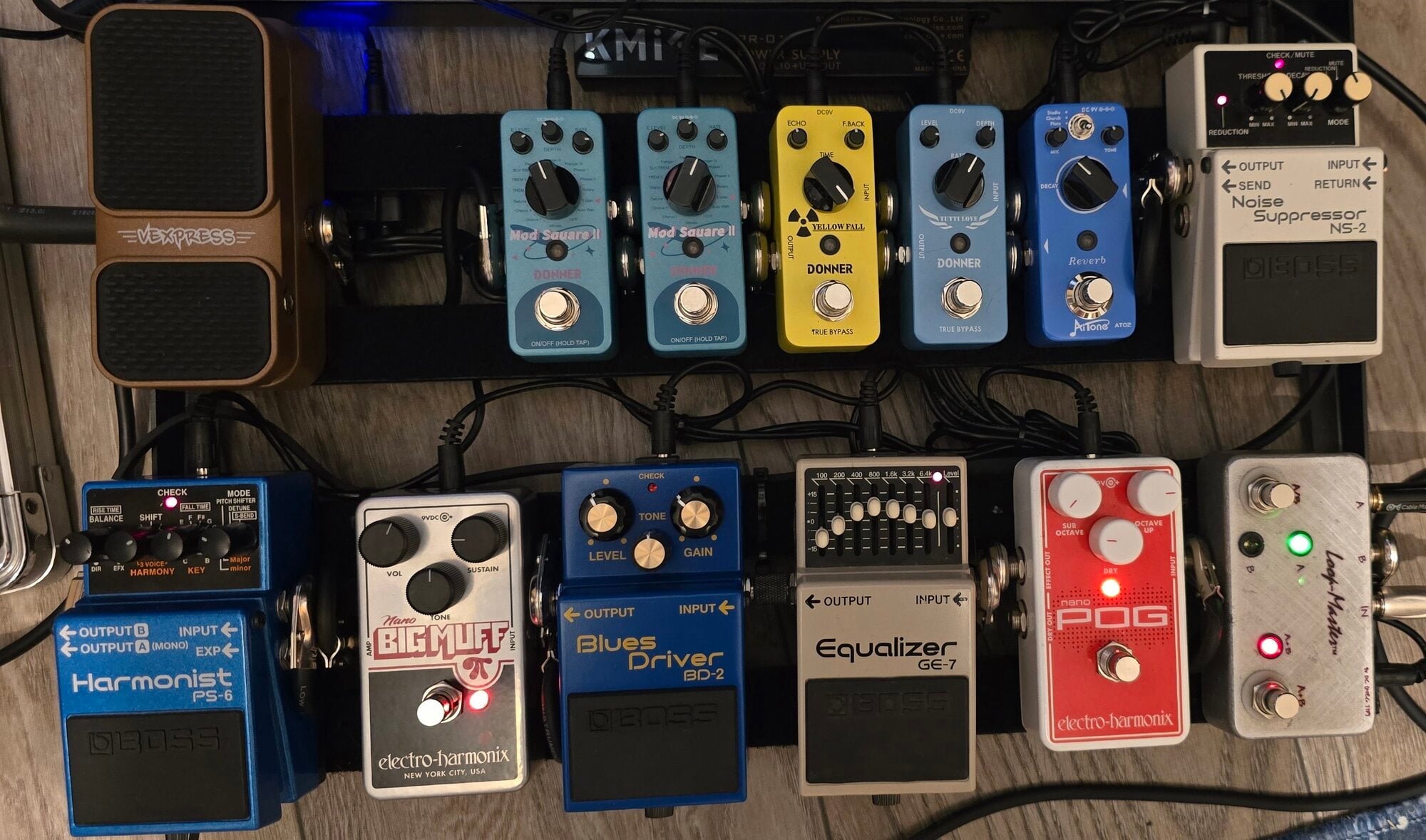
I have a couple of other boards I have built out that I really don't use much at all. I think I built them mostly because I could. One was intended to configure as a straightforward, compact "metal" board:

It works for me in that respect, but as I'm not playing with a metal group right now, it isn't seeing any action.
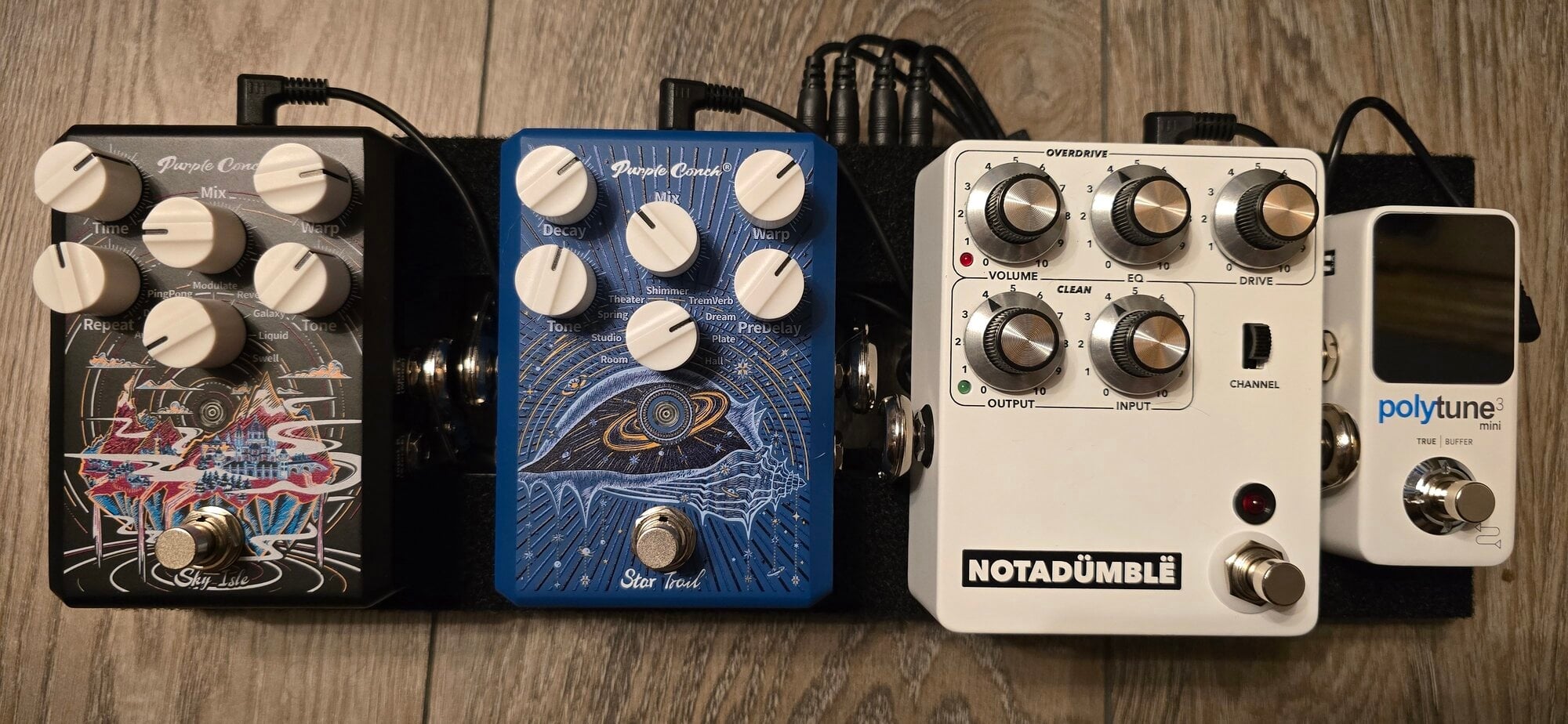
This one I built because I got most of the pedals for free, as well as the powered pedal board, so I raided my large stash of pedals I got for free through the Amazon Vine Voices program and just threw them on there for fun. I mixed and matched different pedals before landing on this configuration. I have ZERO idea what I would use it for, though. Seems to work decently for bass. Just wish the Notadumble pedal had a foot switchable normal/drive, instead of the slide switch. There are videos out there that show how to add one, and I might at some point, but not anytime soon.
All of that to say (or the TL;DR version): I use whatever I feel is appropriate for a given song/band/musical circumstance.
When I first started playing, I was looking for a certain tone and was sold a compressor pedal and chorus pedal because that's what I was told would get me there....it didn't. This was also back before the internet existed, so researching was much more difficult. Eight years later I had sold both of those pedals because I didn't see the need for them since they weren't getting me where I wanted to be. I then bought a Zoom 506 multi-fx pedal to experiment with. I really didn't have much of a plan beyond tinkering with it but did end up actually using it on a few songs on an album that my band at the time recorded.
A few years later in around 2001, I started playing with a cover band and I decided the Zoom was fun for use at home, but I didn't really trust it's plastic shell to survive live work, so I ended up buying the HIGHLY recommended SansAMP BDDI (which I will point out FINALLY got me the tone I was hunting 11 years prior) and a BOSS GT-6B. This allowed me to build patches for certain songs that needed a different sound.
Since then, I have found that I mostly utilize fuzz, drive, distortion, chorus, octaver and reverb the most in the GT-6B. There are occasions when I utilize phaser, flanger and delay, but those are few and far between. This has been my primary pedal board since 2001. I have used it for live cover band work, church worship team work, original rock recording work and my all-around playing.
Since my exposure to the band Clatter 20 years ago, I fell in love with the idea of the bass player filling a double role as both the bass and a rhythm guitar. I began a board back then to do something similar to what Amy did, then, but ended up selling everything and setting the idea aside. When Royal Blood came along, that desire was rekindled and I had an major desire to chase that idea again.
I began assembling the board in small pieces. Along the way, I had the idea that maybe I could use this as a board for rhythm guitar (should I ever actually learn how to play the spindly little six-strings things), so the board grew beyond it's intended purpose. This board begins with an ABY splitter, with channel A running to the board above for my bass tone, and channel B runs to this board, which kicks the signal up an octave first, then through the remainder of the pedals, including the Harmonist that adds a 5th above, giving me a tone as if a rhythm guitarist is playing power chords to match my bass. It works as intended, but my current band did not seem to appreciate it like I thought they might. Oh well...I have plans to utilize it down the road for some personal recording work.
I have a couple of other boards I have built out that I really don't use much at all. I think I built them mostly because I could. One was intended to configure as a straightforward, compact "metal" board:
It works for me in that respect, but as I'm not playing with a metal group right now, it isn't seeing any action.
This one I built because I got most of the pedals for free, as well as the powered pedal board, so I raided my large stash of pedals I got for free through the Amazon Vine Voices program and just threw them on there for fun. I mixed and matched different pedals before landing on this configuration. I have ZERO idea what I would use it for, though. Seems to work decently for bass. Just wish the Notadumble pedal had a foot switchable normal/drive, instead of the slide switch. There are videos out there that show how to add one, and I might at some point, but not anytime soon.
All of that to say (or the TL;DR version): I use whatever I feel is appropriate for a given song/band/musical circumstance.

I use a Lille bit of compression mainly because I can get a little (amen) dynamically disoriented.. lol.Do you use any? If so, what of these fairly common ones do you use? Expand in the comments.
Playing my fretless in the Jazz Combo, I only use chorus.
Recently, I bought a TC Plethora X1, which can be a lot of different pedal types. That got me into experimenting with ambient sounds and music. Off I went into a rabbit hole of gathering second hand pedals: TC Halal of Fame Reverb, TC Dark Matter Distortion, TC Triple Daly. Just this week In added a new MXR Compressor.
Further, I have two loopers: Boss RC2 and RC500.
Recently, I bought a TC Plethora X1, which can be a lot of different pedal types. That got me into experimenting with ambient sounds and music. Off I went into a rabbit hole of gathering second hand pedals: TC Halal of Fame Reverb, TC Dark Matter Distortion, TC Triple Daly. Just this week In added a new MXR Compressor.
Further, I have two loopers: Boss RC2 and RC500.