It was a short course, so we didn't really get much into the nitty-gritty of theory. We had some varied classes about different things - building walking lines, for example - but it was mostly a LOT of tips for us to take home and chew over later, when we had more time. I'm still getting stuff out of my notes from that week, a year later.
As far as the comments about jazz/funk, well... It's the role of the bass player, in my opinion, and in the opinion of a lot of bass teachers, to study and play that kind of stuff. If you want to sound like Billy Sheehan, frankly, study guitar players, because that's what he's doing, just on a bass (I've done Berklee's summer program for guitar, twice, also - I actually only switched to bass a few years ago; I was a professional guitarist & private classical & electric guitar teacher before that).
Bass, to me, is about supporting the melody instruments. It's a bridge between straight-out rhythm of percussion and the chord structuring you get from guitar or piano. The goal of the bass, I think, is to hold down the fort while the other, higher-pitched instruments go exploring. Its role in music is foundational, not ornamental. It takes a different personality to play bass than it does to play guitar or trumpet or instruments like that. This is not to say a bassist cannot both explore & hold down the fort - there are plenty of other musicians (keyboardists, jazz guitarists who comp & solo, bassists like Billy Sheehan) who do this, too - I'm just saying, you have to understand why bass is there in a band setting in the first place - to more-or-less add pitch to the drums and form the other half of the rhythm section - before you take it to the lead-guitar sonic space.
I'm a hell of a soloist on guitar (and on bass and piano, too). But when I'm playing bass in a band setting, I switch modes. My hearing shifts - I'm listening to the kick drum, the hi-hat, the snare, the ride, and I'm pacing those movements. My mind is tuned in to the rhythm and tuned out from that space where you're creating melodies. That's not my job, as the bassist. I'm not saying it can't be, but when I listen to Billy Sheehan playing with Steve Vai, and they're doubling parts, tapping etc... well, he's playing a 4-string guitar tuned down a couple of octaves, man, not bass

It just depends on what your goal is and where you find your voice. I found my voice in the low end, the supporting role, and have little desire to stray from that.




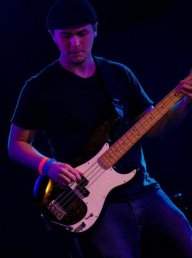
 )
)


