• TalkBass has been independent since 1998. Add your voice.
    Create a free account to reply to discussions, view embedded media, and browse with fewer display ads.
    Join freeLog in
    Want zero display ads or expanded classifieds tools? Compare plans.
What is a bass?

That's a Bass. One of the best sport fish around. Takes strings surprisingly well. :yawn::bag:
d1ce641d836af40590a7311e0f05ec23.jpg
 
From WIKI
Gregorian chant had a significant impact on the development of medieval and Invalid Link Removed. Modern staff notation developed directly from Gregorian neumes. The square notation that had been devised for plainchant was borrowed and adapted for other kinds of music. Certain groupings of neumes were used to indicate repeating rhythms called rhythmic modes. Rounded noteheads increasingly replaced the older squares and lozenges in the 15th and 16th centuries, although chantbooks conservatively maintained the square notation. By the 16th century, the fifth line added to the musical staff had become standard. The bass clef and the flat, natural, and sharp accidentals derived directly from Gregorian notation

I also heard Ralphe Armstrong in an interview say the bass was developed from the Gregorian chant and the Catholic church.
 
Another day, another "why P-bass" thread got me thinking about the definition of "bass". When I'm at my brother's house and fingering the four low strings on his acoustic guitar, I'm playing bass but I'm not playing a bass. That's pretty clear.

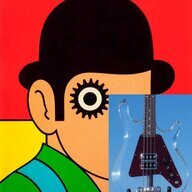
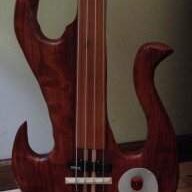
@el_Bajo_Verde posted a very helpful picture in the other thread of an ANSI standard bass and then another picture of one that pushes the boundaries. I'm not sure I'd recognize the Conklin as a bass without hearing it. I'm not even sure I could play it but it is beautiful in its own way.

View attachment 1069707

So the question stands. Where do we draw the line. I'm going with string diameter. My bandmate gave me a five-pack of Ernie's that are way thinner than anything I would consider bass strings. The pack languishes in a bag somewhere. I would think that they would sound like the unheralded baritone guitar. I dunno. Perhaps this is all a bunch of orange colored root veggies. You gotta have at least on string greater than .090" and none less than .035"
I would just like to add: "Meh."

This got me thinking "what bass stuff should I practice today?"
 
I'm not sure why it matters. Most definitions have been blurred or simply cast out in the last couple decades. Heck, many of us don't use punctuation, capitalized letters or proper spelling. Why do definitions matter?

Just play instruments and don't waste so much time or energy "contemplating" them. :D
 
To me a bass is a guitar shaped object that accompanies other instruments by playing lower notes underneath them. I don't care about string count or size, but the instrument has to be dedicated for this purpose - a guitar played through an octave pedal isn't a bass even if it's serving the same purpose
 
So the question stands. Where do we draw the line.

you draw the line at your role within the ensemble: if you have a a trio with two piccolos and one flute, the flute is the lower support instrument, although not necessarily bass....In order to be bass, the instrument needs to be in F Clef (Bass Clef) ranges and defined by its role: I two-handed tap on my Chapman Stick and my left hand can ( and does in a band context) hit all the notes any four string can ( and lower than your "E" also) if Im playing it in this fashion and thats its role....The 7-String Conklin is the same way: If the guy plays it as the support F-Clef instrument, hes playing bass, even if he is granted occaional solos that take him out of that F-Clef range (if he leaves the bass ranges to solo high in the treble ranges, at that point for the duration, there is no bass instrument if someone else ---like a keyboard player's left-hand --- isnt holding down the bottom....btw, this happens in classical music occasionally and is a nice dynamic)

The enigma of the Piccolo Bass is what it is: Its an instrument designed to be played higher than F-Clef but using the bass guitar format. Some folks, like myself, prefer the bass guitar format over other formats to make music, including the guitar format.....The Piccolo Bass IS a bass guitar, but it isnt a bass instrument, make sense?
 
Last edited:
As I understand it, and I may be wrong, the electric bass takes its name from the upright bass, or double bass, which then takes its name from the bass clef, or F clef. I suppose the proper name for a "bass" is an electric bass guitar, which means it is the bass clef version of an electric guitar.
I like this. In my mind an electric bass is fretless, and an electric bass guitar is fretted for the reasons you mention. Though we're speaking English, not music here - once I pick any one up and play it, THAT'S BASS.
 
  • Like
Reactions: Dark Red Moon
I like this. In my mind an electric bass is fretless, and an electric bass guitar is fretted for the reasons you mention. Though we're speaking English, not music here - once I pick any one up and play it, THAT'S BASS.
Technically, any bass with frets is a "precision" bass. The name stuck to a certain body shape and pickup style, but I believe that is the history of the name.
The OP is a little vague. All I'm trying to say is that we call it a bass because it plays in the bass clef. Who decided exactly where the different frequencies fell to be "treble" or "bass" is beyond my knowledge bass.
I do agree with them that the lines between the two are blurring. Baritone guitars are nothing new, but the latest 8 string guitars are invading traditional bass guitar territory. Something like the instrument they originally posted straddles the area between them, like a harp or a piano.
 
  • Like
Reactions: Dark Red Moon