Bass is a musical tone range, not really any instrument. If a mandolin can't play that range it ain't a bass. Grand Pianos do have bass range too, around an octave or two, or something, but it's still not called a bass. Synthesizers can produce huge amount of bass, but still aren't called bass. If you have an instrument which range are limited to the musical range bass, I supposed it's called something to reflect that note range it's capable of. You have baritone guitars too, tenor banjos, etc etc.

Enjoy the benefits of a premium membership!
Upgrade Account
-
TalkBass has been independent since 1998. Add your voice.
Create a free account to reply to discussions, view embedded media, and browse with fewer display ads.
Join free Log in
Want zero display ads or expanded classifieds tools? Compare plans.
You are using an out of date browser. It may not display this or other websites correctly.
You should upgrade or use an alternative browser.
You should upgrade or use an alternative browser.
What is a bass?
- Thread starter John B jr
- Start date
More options
Who Replied?
have you tried googling it?
okay here's what I found:
and that:
may the bass be with you
Wise(b)ass


So this confirms that "piccolo bass" is really just extra long scale four string guitar.You're not playing a bass or playing bass. Traditionally bass is determined by the frequency domain. The lowest 4 strings on a guitar are still a guitar., and an octave higher than a bass
The current "standard" 4-string bass is usually tuned E1 to G2, 41hz to 98hz. Guitar is E2 to E4 (82-329hz). While there is overlap, the bottom 4 strings on a guitar aren't really "bass".
Baritone guitar and tenor or soprano bass are somewhere in-between. Lots of overlap and gray areas. That said, it really is about the role the instrument plays and how the player approaches it.

I was already familiar with the quote, but sigged."I know it when I see it." ~ United States Supreme Court Justice Potter Stewart.
Kinda.

Giving this interesting topic a bit of thought, i come up with this:
If you take two acoustic guitars and make one player play a bassline like he would on a bass and the other player plays guitar over that, but with a capo on the 12th fret so he plays one octave up from the other guitar, you'd have the same scenario as in a classic bass and guitar one - only an octave higher. I would not call this playing a bass, though. I'd call this playing the lines of the bass on a guitar.
It has been said that lots of instruments are capable of playing the notes of the bass clef while not being called a bass.
On the other hand, there are extended range basses, or simply 5 strings strung with a high C and 24 frets that venture far into guitar territory concerning their tonal range, yet these are basses.
I think what makes or breaks the terminology is the intention of the builder of the instrument.
I'm having trouble with the Bass VI. To me, that thing is more of a baritone guitar, or a bass guitar (with a strong emphasis on the guitar term, while in the normal use of the term the emphasis is on the bass, the guitar part only specifies what kind of bass it is).
If the builder planned to make a stringed instrument that is intended to play the roll of the bass in an ensemble of other instruments, he will make a bass. If he adds things to increase the possibilities of said instrument, it will remain a bass for as long as the other possibilities said instrument offers do not outweigh the bass part grossly.
A bass with 11 strings remains a bass, even if it starts at the B string and has the major part of the tonal range of a guitar as well.
A three necked instrument with a bass neck, a 6 string guitar neck and a 12 string guitar neck is not a bass.
If you take two acoustic guitars and make one player play a bassline like he would on a bass and the other player plays guitar over that, but with a capo on the 12th fret so he plays one octave up from the other guitar, you'd have the same scenario as in a classic bass and guitar one - only an octave higher. I would not call this playing a bass, though. I'd call this playing the lines of the bass on a guitar.
It has been said that lots of instruments are capable of playing the notes of the bass clef while not being called a bass.
On the other hand, there are extended range basses, or simply 5 strings strung with a high C and 24 frets that venture far into guitar territory concerning their tonal range, yet these are basses.
I think what makes or breaks the terminology is the intention of the builder of the instrument.
I'm having trouble with the Bass VI. To me, that thing is more of a baritone guitar, or a bass guitar (with a strong emphasis on the guitar term, while in the normal use of the term the emphasis is on the bass, the guitar part only specifies what kind of bass it is).
If the builder planned to make a stringed instrument that is intended to play the roll of the bass in an ensemble of other instruments, he will make a bass. If he adds things to increase the possibilities of said instrument, it will remain a bass for as long as the other possibilities said instrument offers do not outweigh the bass part grossly.
A bass with 11 strings remains a bass, even if it starts at the B string and has the major part of the tonal range of a guitar as well.
A three necked instrument with a bass neck, a 6 string guitar neck and a 12 string guitar neck is not a bass.
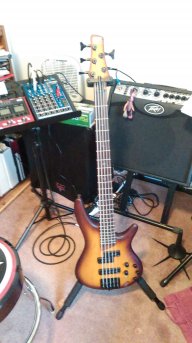

So this confirms that "piccolo bass" is really just extra long scale four string guitar.
If it is tuned in 4ths, then probably still "bass" - that's another "feature."
Not a black and white world we live/play in...
Arguing semantics is fun until it isn't. I think we passed "isn't" some pages ago

That's only ONE possible role for the bass.
I find that, in general the same people that want to define the bass also want to limit it.
Playing the high register on the bass doesn't make you a guitarist any more than playing the low register on the guitar makes you a bass player. If someone wants to play something that generally looks and sounds like a bass, and call themselves a bass player, I'm not going to argue with them. If they stray too far from the norm, I'm still not going to argue with them. If Jaco, Victor, Graham and others listened to TalkBass flat-earthers we'd all be playing root/5th, first 5 frets, half notes.
I don't disagree with your take. A bass ranged instrument can be played melodically, in a higher register, take the lead, solo, etc. Even an upright bass in traditional jazz takes a solo now and then. So yes, a bass ranged instrument can be used beyond the traditional bass function.
My point is that I try to think of bass less as a specific instrument and more as a role that needs to be played to make music work. For example, someone playing a piano alone, uses their left hand to perform the bass function most of the time. They may sometimes use their left hand to take the melody, but mostly it performs the bass function.
In most situations that I play in, I am specifically there to perform the bass function most of the time. However, not always. In fact, if the bass line is not too iconic, I'll expand upon the original (roots, fifths, etc.) to make the part more interesting and fun to play based on the chords and rhythm. In the last rock cover band I played in, the lead guitarist and I would often add in parts where we played some complicated riffs in unison - kind of adding in a little more of a prog-rock feel. I'm currently playing in a smaller group without a drummer where we do more coffeehouse music. I have to keep the time, but on one instrumental where we give our vocalist a break, we do take 5 and the guitarist, keys and I trade off playing the melody, which is a lot of fun.
I don't want to limit what a bassist (of all kinds) can do. It's more that there is an important role that needs to be played and the bass ranged instruments are well suited to play it.
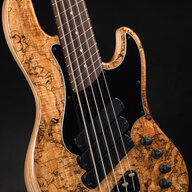
This is your answer OP. Your question presupposes that a "bass" = bass guitar in some form.Many things are bass. Stringed instruments are a small subgroup. Bass is any instrument that fulfills the lowest voice in an ensemble, including tuba, bass clarinet, synthesizer, tympani, voice, bass viol, electric bass, piano, etc.
Last edited:
A tuba, which you'll surely agree is a bass instrument, has no strings. Nor does a bassoon nor a trombone, all are denizens of the bass clef. Baritone sax commonly is notated on treble clef but that's just a convenience; it sounds and functions as a bass instrument. The cello is bass clef. An ordinary piano has a string diameter range exceeding that of the electric bass guitar at both low and high ends. No line can be drawn but with time on your hands you could try a Venn diagram.So the question stands. Where do we draw the line. I'm going with string diameter.
Seriously, this is a troll topic. If you're a luthier, the instrument is paramount but as a musician it's far more important to make jaw-dropping music than to be able to declare that you're playing a BASS. Too many of you are holding yourselves back musically with the time spent on these meaningless quibbles. You can hold down the low end with a wide range of instruments or with a lineup of PVC pipes cut to suitable lengths.
The MUSIC is what's important. Why is that seemingly impossible to "get?"
How does being tuned in 4ths make a difference? The EADG strings of a guitar are also turned in 4ths. And if you're playing 4 string guitar (which Max Cavalera, at least, does), then the other two are irrelevant.If it is tuned in 4ths, then probably still "bass" - that's another "feature."
Not a black and white world we live/play in...
Arguing semantics is fun until it isn't. I think we passed "isn't" some pages ago
How does being tuned in 4ths make a difference? The EADG strings of a guitar are also turned in 4ths. And if you're playing 4 string guitar (which Max Cavalera, at least, does), then the other two are irrelevant.
like I said, semantics at some point become a lot of tail chasing and there is no "right" answer. You can always find some exception, so typically people agree on a "standard" with the understanding that it is imperfect.
Indeed.like I said, semantics at some point become a lot of tail chasing and there is no "right" answer. You can always find some exception, so typically people agree on a "standard" with the understanding that it is imperfect.
Terms and definitions exist only as a shorthand to avoid having to describe every single thing from scratch. They're there to be useful and convenient. Start chasing the limits of them too much and they stop being that.
To be clear, I'll state from the outset that I agree with the gist of what you say.Indeed.
Terms and definitions exist only as a shorthand to avoid having to describe every single thing from scratch. They're there to be useful and convenient. Start chasing the limits of them too much and they stop being that.
"Terms" and "definitions" are literally (in their original Latin at least) "drawing lines to mark limits, ends". They are just words though, not descriptions, so they cannot possibly contain all that is and happens. OTOH they determine, or influence, depending on what version of linguistic relativity one defends, the way individuals categorise objects in their mind.
It's not the only factor though. Prejudices of various kinds also have their say in what differentiates snow from slush, azure from aqua, bass from guitar to one's eye. Case in point, a lot of players here and elsewhere clearly are negatively obsessed about all things guitar, and make every effort to have them and their instrument of choice be told apart from everything remotely related with the 6-string Spanish-tuned annoying little imp. "I play electric bass, not bass guitar; my instrument has evolved from the upright bass, not guitar; don't use a pick; don't play chords; avoid anything other than all-fourths tuning; if you want a six-string why don't you just play guitar?" I could go on. Overcompensators? Closet guitarists? The real, true failed guitarists? I don't know, I just play (and eat e-popcorn on TB).
"Bass guitar" and "guitar" are two points in a continuum, or, rather, overlapping segments of a straight line, or, perhaps more aptly, dialects of a language. They don't exist as razor-cut, self-evident categories per se, they're only defined by a set of dialectal features more or less arbitrarily chosen: the isoglosses of said features sometimes cut the map at around the same places, often not.
Let's take the bass VI (not the model but its ilk in general): tuned E to E, ultra-narrow spacing, 30" scale, guitar pickups, guitar hardware. Is it a guitar? Too long and wrong register. (Pernickety? Maybe. And maybe those two are pretty egregious points actually.) Is it a bass? Naaah, per the above, many could and do say. And yet, the spacing is the only thing inherently un-bassy about them: there are instruments with one or more of those features that are easily recognised and agreed upon being called basses. Abraham Laboriel's long-scale sixes (same tuning); Beatle basses anyone? They're shorties, with guitar tuners. Broncos? They're short scalers too, and have a Strat pickup, six polepieces and all.
Thin gauge? I can put as fat a bridge-cable E as I want on my VI, and use extra-light strings on my 34", and still have them sound like a bass in both cases.
And then, perhaps, "bass" is an intersection of "normal" features, or a set of weak constraints: one can violate one of them, or one other, or a couple, but go astray in too many directions and folks will resist using the label. Piccolo is OK, to many, on condition that it's 4 strings and wide spacing and no shorter than 30 inches; many strings are still OK, but make the lowest string an E1 at the highest; and so on. I'm just attempting an explanation, not being prescriptive. I tend to use terms liberally and incusively myself, and look at intent and function.
In case anyone wonders, the reasoning in the wall of text above is called nominalism. And by the way, please y'all: consider cutting the "semantics" cr@p, will ya? Semantics is a science (look it up), not pointless quibbling about shades of meaning instead of pursuing action, or getting to the point, or simply agreeing with the guy who cries "Semantics!" first. ("NEEEEERRRRDS!!") But I guess there are less semanticians than there are physicists to point out when a word carelessly thrown in enough times has become an empty buzzword. As in "it's just physics, man".
Last edited:

A tuba, which you'll surely agree is a bass instrument, has no strings. Nor does a bassoon nor a trombone, all are denizens of the bass clef. Baritone sax commonly is notated on treble clef but that's just a convenience; it sounds and functions as a bass instrument. The cello is bass clef. An ordinary piano has a string diameter range exceeding that of the electric bass guitar at both low and high ends. No line can be drawn but with time on your hands you could try a Venn diagram.
Seriously, this is a troll topic. If you're a luthier, the instrument is paramount but as a musician it's far more important to make jaw-dropping music than to be able to declare that you're playing a BASS. Too many of you are holding yourselves back musically with the time spent on these meaningless quibbles. You can hold down the low end with a wide range of instruments or with a lineup of PVC pipes cut to suitable lengths.
The MUSIC is what's important. Why is that seemingly impossible to "get?"
I never promised that it was going to be important. A chance to wax on about bass or being a bass player deep in the pocket, so deep you have to make an effort to not get drool all over your bass kind of bass player is a fun distraction for some of these folks. Others get to throw down a joke or post a meme. Still others pontificate on bass-ness as expected. In my quest to become a more organic player, reading all of these replies suits me just fine.
Thank you very much for your thoughts - except for the one where I'm asking a troll question. No harm done or intended. The fact is that @el murdoque 's answer made the effort worth it to me as did a number of others. Now, if I ran with your final thought, I'd be asking "What is music?" Oh, but I'd be trolling, right? Ok.

To be clear, I'll state from the outset that I agree with the gist of what you say.
"Terms" and "definitions" are literally (in their original Latin at least) "drawing lines to mark limits, ends". They are just words though, not descriptions, so they cannot possibly contain all that is and happens. OTOH they determine, or influence, depending on what version of linguistic relativity one defends, the way individuals categorise objects in their mind.
It's not the only factor though. Prejudices of various kinds also have their say in what differentiates snow from slush, azure from aqua, bass from guitar to one's eye. Case in point, a lot of players here and elsewhere clearly are negatively obsessed about all things guitar, and make every effort to have them and their instrument of choice be told apart from everything remotely related with the 6-string Spanish-tuned annoying little imp. "I play electric bass, not bass guitar; my instrument has evolved from the upright bass, not guitar; don't use a pick; don't play chords; avoid anything other than all-fourths tuning; if you want a six-string why don't you just play guitar?" I could go on. Overcompensators? Closet guitarists? The real, true failed guitarists? I don't know, I just play (and eat e-popcorn on TB).
"Bass guitar" and "guitar" are two points in a continuum, or, rather, overlapping segments of a straight line, or, perhaps more aptly, dialects of a language. They don't exist as razor-cut, self-evident categories per se, they're only defined by a set of dialectal features more or less arbitrarily chosen: the isoglosses of said features sometimes cut the map at around the same places, often not.
Let's take the bass VI (not the model but its ilk in general): tuned E to E, ultra-narrow spacing, 30" scale, guitar pickups, guitar hardware. Is it a guitar? Too long and wrong register. (Pernickety? Maybe. And maybe those two are pretty egregious points actually.) Is it a bass? Naaah, per the above, many could and do say. And yet, the spacing is the only thing inherently un-bassy about them: there are instruments with one or more of those features that are easily recognised and agreed upon being called basses. Abraham Laboriel's long-scale sixes (same tuning); Beatle basses anyone? They're shorties, with guitar tuners. Broncos? They're short scalers too, and have a Strat pickup, six polepieces and all.
And then, perhaps, "bass" is an intersection of "normal" features, or a set of weak constraints: one can violate one of them, or one other, or a couple, but go astray in too many directions and folks will resist using the label. Piccolo is OK, to many, on condition that it's 4 strings and wide spacing and no shorter than 30 inches; many strings are still OK, but make the lowest string an E1 at the highest; and so on. I'm just attempting an explanation, not being prescriptive. I tend to use terms liberally and incusively myself, and look at intent and function.
In case anyone wonders, the reasoning in the wall of text above is called nominalism. And by the way, please y'all: consider cutting the "semantics" cr@p, will ya? Semantics is a science (look it up), not pointless quibbling about shades of meaning instead of pursuing action, or getting to the point, or simply agreeing with the guy who cries "Semantics!" first. ("NEEEEERRRRDS!!") But I guess there are less semanticians than there are physicists to point out when a word carelessly thrown in enough times has become an empty buzzword. As in "it's just physics, man".
Wow. Not many replies where I have to go and look up the word, "isoglosses". (This laptop is slick though with the haptics feature such that I highlight the word and click a little deeper on the trackpad and the definition comes up. Found that by accident.) . "Props" on a very cerebral post.
Consider ourselves even: I'd never heard "haptics" before!Wow. Not many replies where I have to go and look up the word, "isoglosses". (This laptop is slick though with the haptics feature such that I highlight the word and click a little deeper on the trackpad and the definition comes up. Found that by accident.) . "Props" on a very cerebral post.
Now, if I ran with your final thought, I'd be asking "What is music?" Oh, but I'd be trolling, right? Ok.
I'd answer this with the same argument. If someone creates waves in the audible spectrum by whatever means possible with the intention of creating music, the result will be music. There is experimental minimal electric music where some people might argue whether that is music or not. From the top of my head, i can name an album called 'Pole II' where the plopping of a pole filter is the main source of beat and seemingly random noises chained and looped create something.
Or, now that i think of it: The incredible track called 4 33 by the recently deceased John Cage, where, as the title suggests, 4 minutes and 33 seconds of audio are recorded where not a single note is played. This is widely acknowledged as music. But the only thing associated with music is that this thing was 'composed' by a composer and there are musicians on stage, even if they don't really play. If you're really interested in that topic, read about this 'song'. It has launched a discussion about where the threshold is.

That's why it's a Synthesizer bass.I guess that kickass bass part done by Bernie Worrell and his Mini Moog on Parliament's "Flashlight" doesnt count as a bassline....silly me...........
Flashlight......red light.....neon light.........stop light....bad da ba de ba da bah.....
Latest posts
-
 Oh My - Overpricing and false advertising hits a new high (low?)
- Latest: WI Short Scaler
-

-

-

