• TalkBass has been independent since 1998. Add your voice.
    Create a free account to reply to discussions, view embedded media, and browse with fewer display ads.
    Join freeLog in
    Want zero display ads or expanded classifieds tools? Compare plans.

Double Bass What is PC Doing Here? (Descending Dom7 Chords)

Apr 16, 2009
2,564
2,990
In "Bye Bye Blackbird", the first 4 bars of the B section are often this:

|F9 |E9 |Eb9 |D7(b9) |

Dom7 chords, one per bar, descending by half steps.

But in the Chuck Sher "New Real Book", those changes are in parenthesis, and they show Am7b5 for the first three bars, citing their version "As Played by Miles Davis":
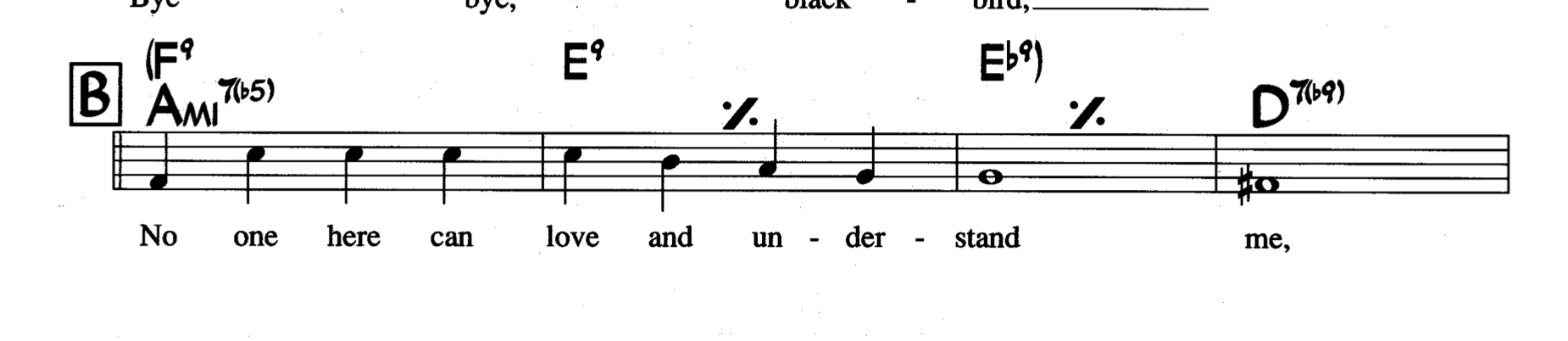
dem-changes.png


I transcribed some George Duvivier and Ray Brown lines over the "standard" descending Dom7 chords and those all make sense to me. (See linked PDF below).

But for the life of me, I can't figure out what in tarnation Paul Chambers is doing on the Miles version, even if I'm thinking Aø7:

PC-BB-lines.png


Sometimes it seems he's playing Am7b5 for the first three bars... sometimes it feels like he's playing D7 the whole time?

Does anyone have any insight into "what PC is thinking" over the first three bars? What's his harmonic strategy?

Here's Dropbox link to PDF of my transcription, including George Duvivier & Ray Brown's lines:

Descending Blackbird Lines PDF
 
And here are the recordings I pulled the lines from:

Miles Davis (last page of linked PDF)


Sonny Stitt / George Duvivier (top of first page)


Ray Brown Live at Scullers (bottom of first page)


Note: I did include all of PC's lines in the PDF, but I did NOT include all of Duvivier's and Brown's lines. Just a sampling. (Just in case you're reading along).
 
Last edited:
  • Like
Reactions: westrock
Well, I don't have the time right now to look at each note vs. the ostensible chord (whether the descending dom 7ths or the half-dim across three bars) but I'd be willing to guess that PC was playing the whole thing "by ear" in other words, constructing the line according to how it SOUNDS. I'll also note that I see a lot of E naturals being played over putative chords that would call Eb. Again I'd have to listen to this carefully (not while at work) but I'm guessing those are "tension" choices chosen on the fly according to how his mind's ear heard them in the moment.
 
I'll say that as an inexperienced bassist but also as a jazz player of 40+ years experience (saxophone) it often happens that I'm playing through a tune that I know well, and I just hear how the bass line ought to go. I just don't even think about what the chords are because I know not only how the melody goes, but how all the harmonies SOUND as well as how the tunes SOUNDED when played on the three or four most prominent and famous recordings that I've been listening to for 40 years.

Now if I can do this and just power through bass lines purely by ear based on how I want it to sound in context of how all the rest of the parts are sounding at that moment, just imagine how easy it would have been for Paul Chambers a genius bass player with decades of every-single-night gigging compared to a middle aged hack bassist. My point is that while I'm sure PC knew the sheet music chords, I very much doubt that he was thinking "chord tones" when playing the tune.
 
One of the questions I'll be asked by students is "What notes do you play over such-and-such a chord?". I try to explain that to really experience the freedom of improvised music you need to develop the idea of playing what you hear in the moment. We play differently with different people because hopefully we are listening to them and reacting to what we hear without judging what comes out too harshly or at all. I think that's what PC and any of the great players are doing. Reaching the point of trusting your ear and going with it is a great release.
 
I'd be willing to guess that PC was playing the whole thing "by ear"

My point is that while I'm sure PC knew the sheet music chords, I very much doubt that he was thinking "chord tones" when playing the tune.

I think that's what PC and any of the great players are doing. Reaching the point of trusting your ear and going with it is a great release.

When you get a chance to download the PDF, his lines start to congeal around "some idea" each time the section appears. It sounds to my ears he's being intentional about something, more than just feeling his way through. (Like on Giant Steps, you can hear him perfecting certain motifs as he goes through each chorus of the tune).

It just sounds too intentional to be "whew... I made it through there somehow."

it often happens that I'm playing through a tune that I know well, and I just hear how the bass line ought to go. I just don't even think about what the chords are because I know not only how the melody goes, but how all the harmonies SOUND as well as how the tunes SOUNDED when played on the three or four most prominent and famous recordings that I've been listening to for 40 years.

So this is EXACTLY what's interesting about PC's lines. Most of the "earlier" versions I've been able to find, all use the 1,7,b7,6 descending Dom7 sound. He's definitely NOT drawing on "what everyone else has always played here." It sounds totally different than earlier recordings, so I'm guessing (hoping) there's some intentionality behind it?

I'd wager it's influenced by Miles choosing the Aø7 for those three bars, but that still doesn't make all the puzzle pieces fit.
 
...

It just sounds too intentional to be "whew... I made it through there somehow."

...

Well, that's not what I meant. What I meant to say is that I expect he was choosing notes according to how he wanted the bass line to sound, in the context of what everyone else was playing at the moment, rather than considering the theoretical harmonic function of each note based on what chord the rest of the band might or might not have been playing.
 
It seems to me (and I'd have to do some serious listening to make this any more than an impression) that at this general period there were a lot of places where MIles and his bands would pick a more major sound over a more minor sound. If that was kind of a "Miles thing" it would also explain playing E natural over an ostensible A half dim chord. If the whole band is playing E natural over a written A half dim, is it still an A half dim?

That famous "Love for Sale" also has Miles throw in a couple bent major thirds over ostensible minor chords on the melody - it sounds fabulous even though it's not theoretically correct. And PC was on that band too.
 
he was choosing notes according to how he wanted the bass line to sound, in the context of what everyone else was playing at the moment.

Right. Agreed.

So it is possible as archeologists for us to "reverse engineer" what WAS happening harmonically, even if it wasn't top-of-mind for PC in the moment? So WE can reproduce "that sound" in similar situations? (That's all music theory is, after all. Agreed-upon names for sounds we want to reproduce.)

(All this talk about "what's happening in the moment" reminds me of the Ron Carter "C(h)artography" transcriptions mentioned last year, where Mr. Carter annotates 5 versions of Autumn Leaves with what his harmonic context was in the moment for each version.)
 
Right. Agreed.

So it is possible as archeologists for us to "reverse engineer" what WAS happening harmonically, even if it wasn't top-of-mind for PC in the moment? So WE can reproduce "that sound" in similar situations? (That's all music theory is, after all. Agreed-upon names for sounds we want to reproduce.)

(All this talk about "what's happening in the moment" reminds me of the Ron Carter "C(h)artography" transcriptions mentioned last year, where Mr. Carter annotates 5 versions of Autumn Leaves with what his harmonic context was in the moment for each version.)

Yep, it's certainly possible, and I'd propose that if you were to give certain harmonically ambiguous passages to five different people to figure out you'd end up with at least six different interpretations of what was happening harmonically. Pick one, or two, or six, and shed them and get the possibilities in your ears and under your fingers, etc... You know, the usual drill.
 
  • Like
Reactions: fu22ba55
Chromatic descending is most often a tritone root substitution so
F E Eb D
F Bb Eb D
F E A D
Then you can also decide if the bass note is the root or a chord note, so in the second bar the can be the third of a C7 and then you got to PCs line. And if you take the C7 back to F as the normal resolution of the Dominant you are at the third bar of PC. (The second and third quarter notes play around the root F.)
 
I agree with Double midi. And there’s no real problem, either, with a bass line that puts a second (or third, or fourth) degree of a scale based off a chord tone if you can take the line to a satisfactory resolution. So for example an F# over an E chord walking up or down to a third or root isn’t that unusual. I agree also that Ron Carter lines, as shown in his book on his years with Miles, show this kind of work. It looks weirder than it sounds.
 
  • Like
Reactions: fu22ba55
I'm working with a singer who does a tune called "Big Town" that has a lyric something like "Bird played it, Dizzy wrote it down". That struck me as relating to discussions like this one. It's useful to analyze stuff, but the main thing IMO is to listen and play without overly stressing the analysis. It gets a little too academic for me. Others may differ.
 
  • Like
Reactions: fu22ba55