
Enjoy the benefits of a premium membership!
Upgrade Account
-
TalkBass has been independent since 1998. Add your voice.
Create a free account to reply to discussions, view embedded media, and browse with fewer display ads.
Join free Log in
Want zero display ads or expanded classifieds tools? Compare plans.
You are using an out of date browser. It may not display this or other websites correctly.
You should upgrade or use an alternative browser.
You should upgrade or use an alternative browser.
What is the science behind this?
- Thread starter MrCash
- Start date
More options
Who Replied?
Certainly not popular science...
It could however be "poplar" science.


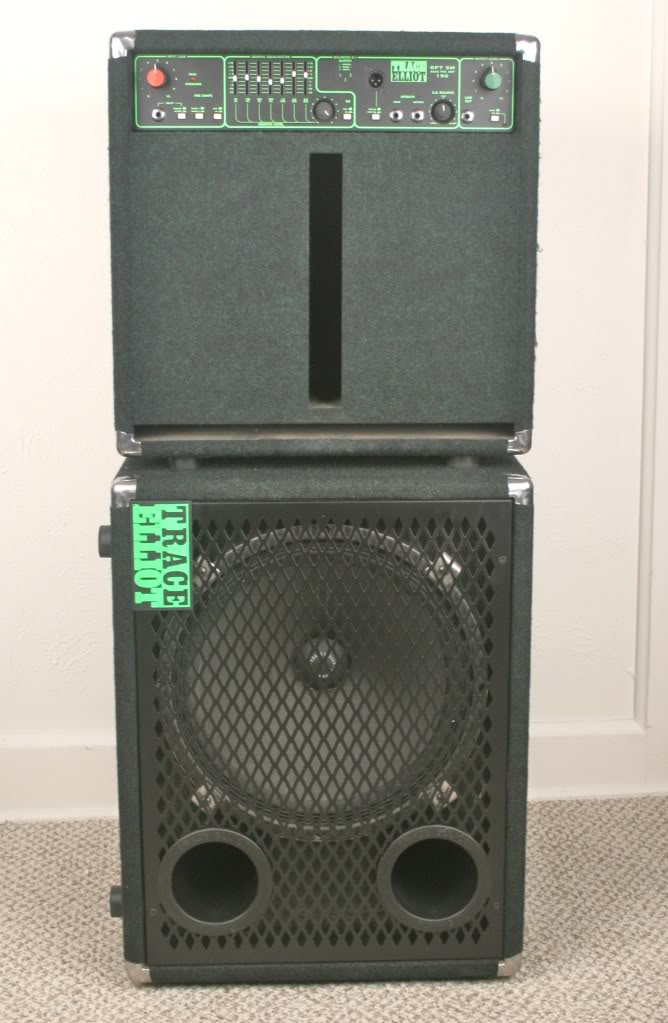
I've heard that combo a lot, and used it a few times myself. Heavy little bugger, but incredibly loud, punchy and bassy for it's size. Nothing could come close at that size back then, maybe not even now.
I think the one I'd heard and used had a tweeter mounted on the front though.
I think the one I'd heard and used had a tweeter mounted on the front though.
Certainly not popular science...
Actually Popular Science had an article on how to build home stereo cabinets of that design. My brother in-law has one.
I owned a BLX 80 and it could get a Portaflex-ish type sound, I like it. It could handle more than it looked like it could. Note definition was not the greatest. I saw some with tweeters mounted in them.
+1. But they didn't sell because they 'looked funny'.Imo that is where the configuration starts to get interesting.
You have the narrow slot acting as an acoustic (instead of electrical) low-pass filter to roll off the top end of the woofer, while simultaneously improving dispersion. If the tweeter is a wide-dispersion unit (not common in bass cabs, but possible), ideally with a radiation pattern matching that of the slot-loaded woofer in the crossover region, then at least theoretically you have the building blocks for a cab with much wider and more uniform coverage than normal.
and bass players don't have a natural tendency to gravitate to technology that's foreign to them. They're as bad as anyone where listening with their eyes is concerned.
Actually some of us ARE attracted to odd new (and old) technologies. I used to gas over this combo. I also love Billfitzmaurice's jack cabinets, Isobaric cabs, Hartke's aluminum speakers, fanned frets, 12 string basses, graphite necks, Gittler guitars, Lightwave pickups, that bass that switches between fretted and fretless with a lever, Oliver's amp with the head that lowers into the cab with a motor...
Sure some of that stuff is a gimick and never takes off. But sometimes it changes the bass playing world. And god bless 'em for tryin or we would never invent anything new and interesting.
- Apr 3, 2003
- 35,515
- 19,944
- Disclosures
- Editor-in-Chief, Bass Gear Magazine
I had done some research on these combos many years back, and Duke, Andy and others have done a great job of explaining how these slots function. Based upon this, I was never too excited by these particular Trace Elliot designs, but I picked up a BLX 150 in a trade a while back, and much to my surprise, it sounds great! As others have mentioned, the overall volume is a lot more than you would expect from a 1x10 combo (especially a "vintage" 1x10 combo), and predictably, it does not have a lot of high-frequency extension. But, it does cover the range of what I would call "vintage bass tone," and the dispersion is pretty impressive. I do wish that mine had the tweeter, but all-in-all, I am still pretty impressed with this little combo. I have tried it with a couple of different extension cabs, and I really like the combo of the BLX 150 with the 1153.
All that being said, considering all the technological advancements since this combo was designed, and considering the range of products currently available on the market, you can do more with a small combo (with or without extension cab) than ever before.
All that being said, considering all the technological advancements since this combo was designed, and considering the range of products currently available on the market, you can do more with a small combo (with or without extension cab) than ever before.
The Trace Elliot slot is different than the rectangular horn throat you described. Klipsch K-Horns also had a rectangular opening in front of the driver.These statements depend on my faulty memory: Back in the day I happily used an Ampeg V4B folded horn cab. I seem to remember replacing the drivers and wondering why the speaker opening was slotted about four to six inches wide. I ASSumed it was a structural reason.

Mr. Foxen
Commercial User

The cross firing driver baffling actually works, IME.
Give TE credit for being unafraid.
My $0.019 scientific response to the OP on the slot baffle is that it has failed to disprove natural selection.
Give TE credit for being unafraid.
My $0.019 scientific response to the OP on the slot baffle is that it has failed to disprove natural selection.

Mr. Foxen
Commercial User
The cross firing driver baffling actually works, IME.
Give TE credit for being unafraid.
My $0.019 scientific response to the OP on the slot baffle is that it has failed to disprove natural selection.
Works as in guitarists can hear themselves. But being able to hear themselves clearly is not what guitarists want, hiding from their terrible tone and playing is the key goal, hence favouring beamy 4x12s. Or when provided with a cab with speakrs that can face their ears in a standing position, they do this.
Link Removed
Now, now...be nice.Works as in guitarists can hear themselves. But being able to hear themselves clearly is not what guitarists want, hiding from their terrible tone and playing is the key goal, hence favouring beamy 4x12s. Or when provided with a cab with speakrs that can face their ears in a standing position, they do this.
Link Removed

I used to have one of these and I gave it to a lady I was giving bass lessons to when she got a gig and only had a practice amp. She still has it and even though it got immersed in water a few years back after a flood it still works fine after being dried out.

- Nov 24, 2008
- 4,343
- 7,163
- Disclosures
- Owner & designer, AudioKinesis; Auth. mfg, Big E (Home Audio only)
+1. But they didn't sell because they 'looked funny'.
Good point.
Several years ago I experimented with conceptually similar "aperture loading" for guitar speakers, in an attempt to improve dispersion and eliminate the on-axis "icepick effect". Briefly, the downsides outweighed the upsides for that application.
Even if it had worked well, trying to market it to guitar players would have been a nightmare. Ime bass players are far more open to "looks funny" than guitar players.

The main reason for the use of the slot on horns (and especially folded horns) is to improve phase coherency by eliminating path length differences in areas of the woofer that don't contribute as much to overall SPL. They also function as a LPF which is tuned by the dimensions (width) of the slot adding to the electrical filter of the crossover. Ideally it would match the crossover frequency and thus increase the slope by one order. Rarely were the results ideal, but every improvement back then was welcome.
I know all of those words, just not in that order.
Where's the aspirin?

Actually some of us ARE attracted to odd new (and old) technologies. I used to gas over this combo. I also love Billfitzmaurice's jack cabinets, Isobaric cabs, Hartke's aluminum speakers, fanned frets, 12 string basses, graphite necks, Gittler guitars, Lightwave pickups, that bass that switches between fretted and fretless with a lever, Oliver's amp with the head that lowers into the cab with a motor...
Sure some of that stuff is a gimick and never takes off. But sometimes it changes the bass playing world. And god bless 'em for tryin or we would never invent anything new and interesting.
Yup. Purists/traditionalists are everywhere, but in general we bassists are far more open to new ideas than guitarists, and thank goddess for that.

There's a lot more going on with the slot, the slot (especially when very narrow) actually acts like both a low pass and high pass filter, but on the high end the diffraction effect is one factor that alters the low pass response. The slot dimensions relative to the driver diameter affects a variety of performance parameters.
If you go back to the original Altec (and others) application, the slot also added some air mass loading which changed the coupling or acoustic impedance matching between the driver and horn throat. The slot was nowhere near as narrow as in the Trace example.
One disadvantage of a narrow slot is the loss of average sensitivity, and probably the impact on voicing would not be suitable for today's player too.
Here's an interesting discussion of this theory (though different application): Acoustics/Filter Design and Implementation - Wikibooks, open books for an open world
This shows the schematic representation of an acoustic low pass portion, the initial transition from slot to open represents the first order equation (which is what the slot by itself is).
In actuality, this is all pretty imperfect stuff, and significant assumptions are made to make it somewhat conform.
Thank you for that link as I must muffle every appliance in the house in order to keep my admittedly slight grasp on sanity.
fnord!


