• TalkBass has been independent since 1998. Add your voice.
    Create a free account to reply to discussions, view embedded media, and browse with fewer display ads.
    Join freeLog in
    Want zero display ads or expanded classifieds tools? Compare plans.

Double Bass What is this thing...

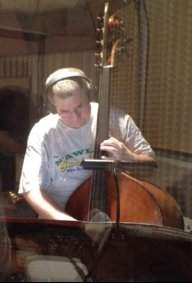
...that shows on Wayne Dockery's fingerboard under the nut (~1994 with Archie Shepp & Horace Parlan)?

Screen Shot 2025-11-14 at 11.08.40.png
 
I dunno Francois, it looks like it’s going over the strings, not under them. I heard this band at Fat Tuesday’s around then, Shepp was mostly playing standards with a few straight ahead ish originals. My first thought was some kind of foam to keep the open strings from vibrating, but it looks like it covers half and first position entirely….
 
Wild guess: a homemade adapter for the E string. Like a D-tuner, but in reverse. Open string tuned to Eb for tunes that call for an Eb drone. Add adapter for E note drone. Maybe used for only one tune per gig, but that tune modulates between the two keys.
 
Looks to me like a capo.
At first I thought so as well, but why so bulky?
My DB capo cost me just a few bucks for a velcro strap with a buckle, plus a piece of a rubber hose, plus sewing a velcro strip on the reverse:
loukash-double-bass-capo-img_2955.jpg
^ I've been using it a few times when I started to play DB last year because I play in D standard, but when my guitarist insisted on a couple of fast R&B numbers in E or in A, I had issues to stay in tune at first. :)
 
  • Like
Reactions: Don Hergert
At first I thought so as well, but why so bulky?
My DB capo cost me just a few bucks for a velcro strap with a buckle, plus a piece of a rubber hose, plus sewing a velcro strip on the reverse:
...
^ I've been using it a few times when I started to play DB last year because I play in D standard, but when my guitarist insisted on a couple of fast R&B numbers in E or in A, I had issues to stay in tune at first. :)

I'd like to see more of whatever it is the OP's device is.

I'm not a big capo enthusiast for any of the instruments I play, but I will admit I wished I had a capo option on my DB until I learned more about my EADG tuning and fingerings...

For me, the big problem with capos on any stringed instrument is how long it takes to put it on and re-tune, and how long it takes to take it off and re-tune. Re-tuning is almost always necessary with capo use unless a player just doesn't care. I played a number of years on live TV and in that environment there just isn't time or sound space between songs for re-tuning -- the only option is knowing your neck well so you don't have to use a capo.
 
  • Like
Reactions: loukash and carl h.
Re-tuning is almost always necessary with capo
Definitely on fretted instruments. I'm using a Shubb capo on a couple of songs when playing my old slide acoustic in open G. There, retuning is necessary, especially since I'm only changing strings once every few years.

I've been also using the Shubb on the fretless Fender Jazz every now and then, in D standard. Particularly at jam sessions when someone came with the idea to play Billy Cobham's Stratus… (try that in D standard without capo and you'll suffer! :D ) Having low action though, retuning isn't necessary.

Same for my DB capo. Low action on the second "fret", the capo just needs adjusting to find the sweet spot. Besides… after only 13 months of playing a DB, my intonation isn't yet perfect anyway, so…

I wished I had a capo option on my DB until I learned more about my EADG tuning and fingerings...
Well, this was the reason why I have switched to D standard in general. The vast majority of songs and tunes that we play is now much easier for me. Especially since many of my songs are based on the open G slide guitar riffs.
Last May I have joined a new bluesy trio on the DB, and when I told the guitarist/songwriter that I play in D standard, he said: "That's great. Me too."

knowing your neck well so you don't have to use a capo.

I'll surely get there, eventually. :)
 
  • Like
Reactions: Don Hergert
I think there is a false nut on his bass. Perhaps it is a removable piece that is being held in place with a combination of downward string pressure, and laterally by the device covering it.

Otherwise, I got nothin'.
 
Interesting...

Functionally, I'd classify a false nut on a stringed instrument as about the same as a capo. (Not intending any disrespect there.)

Similarly, when playing in some old-tymie fiddle circles I've wondered if it wouldn't just be better to cut all the non-fiddle instrument necks shorter by a full step. (Always playing in A or D.) :D
 
  • Like
Reactions: james condino
Functionally, I'd classify a false nut on a stringed instrument as about the same as a capo. (Not intending any disrespect there.)
Hmmmm... Not sure I get what you mean... One changes the pitches of the open strings and the other changes the string length, while leaving the open string pitches the same...