• TalkBass has been independent since 1998. Add your voice.
    Create a free account to reply to discussions, view embedded media, and browse with fewer display ads.
    Join freeLog in
    Want zero display ads or expanded classifieds tools? Compare plans.

What signature model is actually worth it?

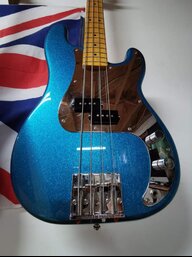
Well I need throw in my 2 cents and say the MIM Steve Harris (white with West Ham logo) is totally worth it, IF you're really trying to cop his sound authentically - otherwise, it's just a heavy P Bass ;). The MIM version has a maple body and it sounds killer. I don't want to start the whole tone-wood cluster*uck, but to my ears there's a big tonal difference compared with to my MIJ SH signature (blue sparkle) that I also play regularly in my Maiden cover band. This is despite the fact they have identical pickups, strings, setup, etc. If I could only keep one, it'd be the MIM version.

I'll see myself out now.
 
I just learned the Dave Grohl signature guitar is going for upward toward $25k. That seems insane for what is likely a standard 335 style guitar with little diamonds instead of F-holes. 335s are expensive enough, but now this?

Got me thinking about other signature guitars and basses and wondering if any of them are special or unique enough to warrant a premium, or are they just valuable to a fan because the fans like the player. Of course, fans want to buy what their idols play, thats understandable, but are any of these guitar or bass signatures good enough that a non-fan would want the unique specs?

Edit: if you know of one, list it and add why it's special. Thanks!

There's sort of a spectrum of signature model characteristics, with the following axis points:
a) It looks pretty/just like the artist's. Otherwise it is negligibly similar to off-the-shelf instruments. You could aesthetically modify an existing instrument to look like this.

b) They might be produced to exact specs with regard to weight, neck shape, pickup winding, electronics values, etc. but are otherwise not much different from off-the-shelf instruments. You could potentially refit an instrument with specially made/modified replacement parts to achieve this.

c) It has unusual electrical or mechanical modifications that make it substantially different. Generally they match modifications that the artist made to their original instrument, but sometimes it's the product of a design process between the builder and artist. Odd mechanical/construction features, unique pickup arrangements, unique electronics, etc. You would have to substantially modify an existing instrument to achieve this... unique pickups, new routing for atypical pickups, adding or subtracting electronic components (as opposed to simply replacing existing ones), modifications to the instrument's construction, etc.

Some are solidly a), some are more b). I tend to only care about c).
Good examples of c) might be:
- Jack Casady's Epiphone signature model: Highly unusual pickup/switchable resistor combination for tone changes.

- Billy Sheehan's Yamaha signature model (the "Attitude"): Unique H/P pickup arrangement, scalloped high frets, stereo output, and a reinforced neck joint that was introduced for this model but has since shown up on other Yamaha basses.

- Mike Watt's Reverend signature model (specifically the "Wattplower Mark II"): Somewhat unique 32'' scale, and an interesting take on the humbucker neck/P-pickup mid by having a three-coil P pickup. A switch selects between two of the three coils, offering P and reversed P tones in the same bass.

- Many of the signature models done by GrassRoots and Edwards-- I couldn't list them all, but some very good examples are the G-T-60B (Tetsuya), the E-AC-90 (bass player "Noisy") or the G-H-58 (Kuroyume Hitoki's signature model). Pretty much all of these are wild and unusual in their own way. I own a couple, and I'm always interested to see more.

I do sometimes see people criticizing the concept of wanting to "sound like" your favorite artist. I sort of get that from an authenticity perspective, but I have two responses to it:
1) "Your sound" as it exists at the moment, is a complex equation that partly depends upon the tools that you have. Sometimes, what you need is something unique to create unique sounds. This doesn't mean you'll be "copying the sound" of that signature model's artist... it'll sound like you, whatever music you're making with it. I use a signature model of a bass player that I have largely never listened to, because it's the right tool for my music.

2) There are plenty of legendary artists who made their careers with largely unmodified instruments... does that mean anyone using a plain jane Precision Bass, Les Paul or Telecaster is trying to cop their sound? No, not necessarily.
 
Last edited:
"Worth" is in the eye of the beholder, so this will end up primarily being a list of signature basses that people own and like.

I have several sig basses, some for features, some for fandom. By far the best value I've ever come across in an instrument is the Bass Centre Guy Pratt "Betsy" model. Absurdly cheap and I'll put it up against any bass I've ever owned.....and that's a lot of basses :)
 
The Nate Mendel is a pretty ordinary p-bass with qtr pounder and a fender bad ass bridge and the road worn treatment....but the neck is the best feeling neck I've ever played...that's why I kept it and play it constantly...of course I heard of the Foo Fighters but never heard of Nate at the time, had to look him up...I confess.
 
  • Like
Reactions: ELG60 and ColdEye
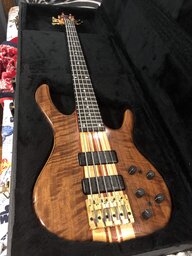
Spector Euro - Doug Wimbish Signature.

IMG_1694.jpeg
 
Also, Jack actually plays them on stage. How many signature models can you say that about?

I’ve always been of that mindset and whether or not they have proprietary electronics that differ from their other offerings.

Based on that I would also include the Will Lee model offered by Sadowsky because it has a different preamp (3 band?).
 
  • Like
Reactions: ELG60 and Burwabit
I’m pretty indifferent about the “signature” status, but if the bass offers features and/or aesthetics that I like, I’d play one. I wouldn’t pay a premium for someone’s name.

For example, I had a Sting signature Precision for a while. I’m neither a Sting fan or a Police fan, but I liked the ‘54-‘56 P Bass aesthetic, it played well, sounded good, etc. It falls into the category of “basses I’d want back.”

I’ve been curious about the Allen Woody Rumblekat. They look cool. I gave some serious consideration to a Jack Casady, but the 4 different ones I tried all had poor QC and the same issues, so I gave up on them. Still think they have potential, though.
 
MIC Squier Matt Freeman PBass. Sadly discontinued.

Precision bass vibes all the way and a neck to die for. Many have bought one just to get that neck. And thanks to the interchangeability of Leo Fender’s design it’s easy to mod - or install that neck on another bass if that’s your thing.

I’ve owned my share of PBs over thr years. MIA, MIM, MIJ, Squier, and some FSO PBs. The Matt Freeman I bought in 2014 is my all time favorite and the first PB I’ve kept for any length of time. Definite keeper.

If you do manage to find one for sale, make sure it still has the original neck.
 

Latest posts