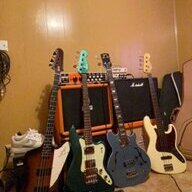
I’m deciding between a 4x10 or 1x15. Specifically Orange cabs to match my amp. I’d like it to have clarity when played in a small practice space, but at the same time be able to handle gigs. My bass is already dark sounding so I’m trying to avoid anything boomy or muffled. Are the sizes I’m looking at in the right ballpark for what I want?
Size of the drivers does not determine the voicing of the cab.
Given equal quality, a 410 is likely to be more efficient and take more power than a 115. This means it will be louder. It will also be bigger, heavier, and more expensive.
If you get a super 115 and a crappy 410, the 115 may play louder.
In general a 210 and 115 from the same product line tend to be fairly equivalent.
Depending on your volume requirements either a 210 or 115 could be sufficient. If you need more volume down the road, you could add a matching cab. If this sounds like a good idea, consider the minimum impedance of your amp and the impedance of the speakers. If the amp is 2 ohms minimum, it can drive a pair of 4 ohm cabs. But if the amp is 4 ohms minimum, you need 8 ohm cabs.
Ideally you need to know a target SPL that works for you. This comes from paying attention to the specs and personal experience. My target is 124dB. I have found that a rig capable of at least 124dB calculated meets most of my needs. There may be gigs where it's not enough, but I am not willing to turn up beyond a certain point. For the record my last touring rig was rated for almost 127dB calculated.
I have used rigs that were only capable of about 118dB. While they got the job done, it was not a joy to play through them during louder gigs. No one complained but I struggled to hear myself and sometimes I had to modify my technique to avoid pushing the amp beyond it's limit.
To figure out how loud a rig can play, review the specs. You need to know how much power the amp delivers. With tube amps the power is the same as long as the amp sees the expected load. So if a 200W tube amp has 4 ohm and 8 ohm outputs, it will make 200W at either 4 ohms or 8 ohms.
Solid state amps often make more power as the impedance goes down. For example Mesa Subway 800s are rated 400W at 8 ohms, 800W at 4 ohms, and 800W at 2 ohms.
You also need to be concerned with how much power your speaker can handle. If you have an 800W amp and a speaker that is rated for 300W, then the usable power is 300W.
The last thing you need is the speakers sensitivity rating expressed at 1W/1m. For example you might see something like
Sensitivity: 97dB 1W/1m. This means 1W is applied and 97dB is measured at a distance of 1 meter from the cone.
FYI Every time the power doubles you get +3dB. So you can estimate how loud a rig will play if you know the 1W/1m sensitivity and usable power
1W = 97dB
2W = 100dB
4W = 103dB
8W = 106dB
16W = 109dB
32W = 112dB
etc
You can also use a formula.
Calculated SPL = [Log(Usable Power) x 10] + (1W/1m Sensitivity).
Let's assume the usable power is 400W and the Sensitivity is 100dB 1W/1m
Calculated SPL = [Log(400) x 10] + 100 = ~126dB
Usually when you add an extension cab the connection is parallel. So if you add a matching cab, the combined impedance is 1/2, the combined power handling is double, and the sensitivity goes up ~+3dB. Also the cabs share the power equally.
So lets assume we have two 8 ohm cabs rated for 400W each and an amp that makes 800W at 4 ohms. The Sensitivity rating of one cab is 100dB 1W/1m
Combined Impedance = 4 ohms
Combined Power Handling = 800W
Usable Power = 800W
Combined Sensitivity 103dB 1W/1m
Calculated SPL [Log(800) x 10] + 103 = ~132dB
Let me point some things out. If the power remains the same, you get +3dB when you add the matching cab. This is because the sensitivity goes up. So adding a matching cab with a tube amp typically gets you +3dB
If the amp doubles power when you add the matching cab, you get +6dB. The first 3dB is from the increased sensitivity; the second 3dB is from doubling the power.
A 3dB change is about the minimum you can clearly hear. A 6dB change is pretty obvious.
Some solid state amps increase power as the impedance goes down, but only by 170% or so. For example one of my amps makes 225W at 8 ohms and 380W at 4 ohms.
Decibel Change = [Log(380/225) x 10] = 2.28dB
So adding the second matching cab gives you +3dB due to increased sensitivity and increasing the power from 225W to 380W gives you +2.28dB The net is 3 + 2.28 = 5.28dB. This is still a very noticeable change.