• TalkBass has been independent since 1998. Add your voice.
    Create a free account to reply to discussions, view embedded media, and browse with fewer display ads.
    Join freeLog in
    Want zero display ads or expanded classifieds tools? Compare plans.

What the heck? 14 strings

Status
Not open for further replies.
I can't wait to see the pickup for this thing. You're winding it yourself, correct? I don't remember from earlier in the thread.

If so, is there even enough room on each side to fit a pickup?

Have you thought about making the world's first 14 string FRETLESS bass??? Piezo's only. No knobs on the front. Mmm, it'd be amazing.
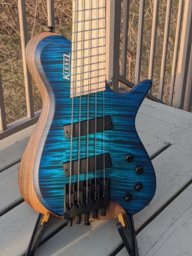
 
Okay, please don't take this the wrong way, I love what you're doing here, I have the ultimate respect for anyone willing to break with tradition, luthiers especially, and my hat's off to anyone who can do precision work with wood ('cuz lord knows I suck at it)

...but when I saw that bridge I f*ckin laughed out loud.

because it looked wierd or because you didnt think it would work?
 
Okay, please don't take this the wrong way, I love what you're doing here, I have the ultimate respect for anyone willing to break with tradition, luthiers especially, and my hat's off to anyone who can do precision work with wood ('cuz lord knows I suck at it)

...but when I saw that bridge I f*ckin laughed out loud.

You posted this in the wrong thread. It should have been posted in the but thread: http://http://www.talkbass.com/forum/showthread.php?t=378526
 
Here is a little spreadsheet to help you in your string decisions.

The first page is a list of the available steel strings offered by D'addario, SIT and Conklin. It includes Guitar and Bass strings

I took data from D'Addario and plotted the gauge of wound and plain strings as a function of mass per unit length, then fitted a power law to each graph. This is the second page.

The third page is a list of frequencies for each note at A=440 on equal temperament

The last one is perhaps the most useful. It uses the note frequency, scale length and and assumed tension of 30 lb-force per string (average of a Thomastik-Infeld Jazz Flats set) to predict the necessary values of mass per unit length. With this

value and the power fit in page two to predicts the approximate gauges of wound and plain strings (not all are meaningful) and you can look them up on page 1 to see what is the closest match.

It seems you can realistically go from F#0 to F#5 in fourths with existing strings and you could consider getting some [Invalid or Expired Link Removed] music wire and buying/making a string winder to make your own B5 string

Good luck and make sure you reinforce the head and neck so it will support ~450 lb-force of pull.

Cheers

DavidMP
 

Attachments

No offense but .. did you think this through that much regarding scale length and tuning?

I mean.. 32"-22" is a pretty wide fan, but I don't think 32" is nearly long enough. If you had started at 35"-37" or something you could have had a .195 as your lowest, and tune it to B00-C#0 or something

That way in 4ths you could have:

C#-F#-B-E-A-D-G-C-F-Bb-Eb-Ab-Db... a high Gb might be a little tricky, but you could still have 13/14 strings in 4ths easily and maybe an E/Fb on top


or start it on something lower, like on B00. Then you might be able to keep all 4ths.

B-E-A-D-G-C-F-Bb-Eb-Ab-Db-Gb-Cb-Fb


These tunings just seem to make sense to me, and I don't see how they'd be possibly with a 32" scale.
 
Hey, DavidMP!

It looks like we're doing a lot of the same work at the same time here! A couple of points, though. I see you're familiar with the smallparts music wire selection, so don't forget to take into account the listed tensile strengths. At a 20" scale even the .003" they sell will only get you to Eb5. Also, 30 lbs is somewhat floppy for bass strings and excessive for the higher strings. It's typical for the tension to steadily decrease as the pitch goes up. Most bass strings are in the 40 to 50 lb range while acoustic guitar strings feel tight at half that, 20 to 25 lbs, and electric guitars are usually strung around 15 lbs to allow bending. Obviously at 30" you're going to have less tension on the very low end, but you can probably get away with 10 lbs for the highest strings.

Cheers,
Kevin
 
Thanks David and Bjpub for the info about strings. I got the .165 .150 and .007 in the mail yesterday. Nice!
I'm about to start fretting the bass, so I'll post some pics later.
Have no fear about the strength of the headstock. It's as thick as I could possibly get away with, and there's lots of wood in the back overlapping the area covered by the fretboard. All that ipe and purpleheart could probably support a thousand lbs!
 
Here is a little spreadsheet to help you in your string decisions.
Cool ss!
The first page is a list of the available steel strings offered by D'addario, SIT and Conklin. It includes Guitar and Bass strings

I took data from D'Addario and plotted the gauge of wound and plain strings as a function of mass per unit length, then fitted a power law to each graph. This is the second page.
OK, so for the heavier gauges not offered (and therefor documented for m/ul) by D'Addario, you did a curve fit to the known sizes, and then extrapolated from that, right?
...

The last one is perhaps the most useful. It uses the note frequency, scale length and and assumed tension of 30 lb-force per string (average of a Thomastik-Infeld Jazz Flats set) to predict the necessary values of mass per unit length.
Actually, I'd agree with bppubjr that 30# is light; T-I's are looser than most other brands. If you look at D'Addario standard sets for 34" scale, you're looking at a max of (memory off the top of my head) a max of mid-to-upper 40s for the D string and maybe 36-38 for the E.

But, at the same time, noted that for a short scale you're going to be forced to go to lower tensions in order to accomplish the task.

Also, at the same time, noted that equal tension isn't necessarily a goal. People have done equal-tension sets and not liked the tone match string-to-string.


Would you mind if I incorporated your string data, and maybe the string fit calcs, into a future rev of my string ss?
 
Frets are in! Nut blank is also glued in, tomorrow I'll try to slot it. Those 2 strings are the .165 and the .150.
Picture050.jpg
 
OK, so for the heavier gauges not offered (and therefor documented for m/ul) by D'Addario, you did a curve fit to the known sizes, and then extrapolated from that, right?
Yes they are extrapolations

Actually, I'd agree with bppubjr that 30# is light; T-I's are looser than most other brands. If you look at D'Addario standard sets for 34" scale, you're looking at a max of (memory off the top of my head) a max of mid-to-upper 40s for the D string and maybe 36-38 for the E.
I use TI's on a 5 string bass and have no problem with the tension. I used them because they are proof that that tension works.

Also, at the same time, noted that equal tension isn't necessarily a goal. People have done equal-tension sets and not liked the tone match string-to-string.
Well it is all a matter of taste anyways, I love TI sets in bass and guitar because the even tension makes my life easier and they have even tone. That being said, I made changes to the file so the tension drops from 30 to 10lb-force and played a little bit more with the numbers including theoretical breaking loads (thanks for pointing that out bppubjr)

There are a few conclusions that I can draw from this exercise.
A) The Ab4 is close to the breaking strength of the string for the proposed fan, assuming the wire used is close to AISI 1085. If you were to make your own string out of 17-7PH and anneal it you might get to a Db5 at the scale we are talking about

B) To make the current string technology reach the notes desired a much more radical fan angle has to be used ~30 to 12" which is,of course, impractical

C) Thirds tunings might help with playing issues (depending on what people like) but the ~Ab4 to B4 limit is material dependent.

Would you mind if I incorporated your string data, and maybe the string fit calcs, into a future rev of my string ss?
It'll be an honour

Just out of curiosity. Anybody know who makes a 0.25 string? I've seen it mentioned before

Cheers

DavidMP

PS It looks really good
 

Attachments

Today I imbedded 3 square steel bars in the neck, w/ one extending into the headstock area for added strength. I also shaped and thicknessed the fretboard and gorilla-glued it on. The actual position of the fretboard is a little higher than when I took the previous photos

Picture024.jpg

Hopefully I'll have a little time before neck weekend to shape the headstock, drill the holes, and put frets in. I'm going to glue in the frets.

oh MAN! i hope i can be allowed to play this thing someday!

looks great!!!
 
because it looked wierd or because you didnt think it would work?

because he doesn't think it'll work...

the saddles will interfere with each other...

I personally respect the fact that you're pushing the envelope here, but believe you'll have more success using something like this bunch did for their 9 string Bass...

http://www.ghservices.com/products/basslab/lab_std-ix-dk.html

http://www.ghservices.com/products/basslab/lab/basslab-std-ix-dk-hardware1_2432x1434c40.jpg

the 9 wide bridge slider would form the basis of your bridge but you'd have to custome make your own slide for the saddles to move along as you have such a large stagger at your bridge end.

what's got me worried more is the massive angles you're proposing to take the strings through to the tuners... I think the nut will break as soon as you try to tune the lowest strings up... and the higher strings will saw their way through the nut...
 
I ask you again, how will you manage to keep that lowest string in tune? It almost makes a 90 degrees turn from nut to tuner..

I don't see how the angle will be a problem as long as it is anchored firmly. Strings angle through the body at the bridge and the are wound around the tuning peg. The only thing I think is an issue with that angle is that if he attaches it directly to the nut it might slip unless he uses some kind of locking device.
 
I don't see how the angle will be a problem as long as it is anchored firmly. Strings angle through the body at the bridge and the are wound around the tuning peg. The only thing I think is an issue with that angle is that if he attaches it directly to the nut it might slip unless he uses some kind of locking device.

It may get hung up at the nut because the angle is too sharp going sideways.

Strings at the bridge angle downwards which applies more pressure on the saddle.

This string is angling sideways, which is not the way strings move through the nut slot.

It's always best to keep them as straight as possible from the nut to the tuner, with a downward angle.
 
It may get hung up at the nut because the angle is too sharp going sideways.

Strings at the bridge angle downwards which applies more pressure on the saddle.

This string is angling sideways, which is not the way strings move through the nut slot.

It's always best to keep them as straight as possible from the nut to the tuner, with a downward angle.

I suggested he use a bobbin to angle it onto the nut.
 
Status
Not open for further replies.