• TalkBass has been independent since 1998. Add your voice.
    Create a free account to reply to discussions, view embedded media, and browse with fewer display ads.
    Join freeLog in
    Want zero display ads or expanded classifieds tools? Compare plans.

Double Bass What to indicate to players for low E flat in piece

Hi,
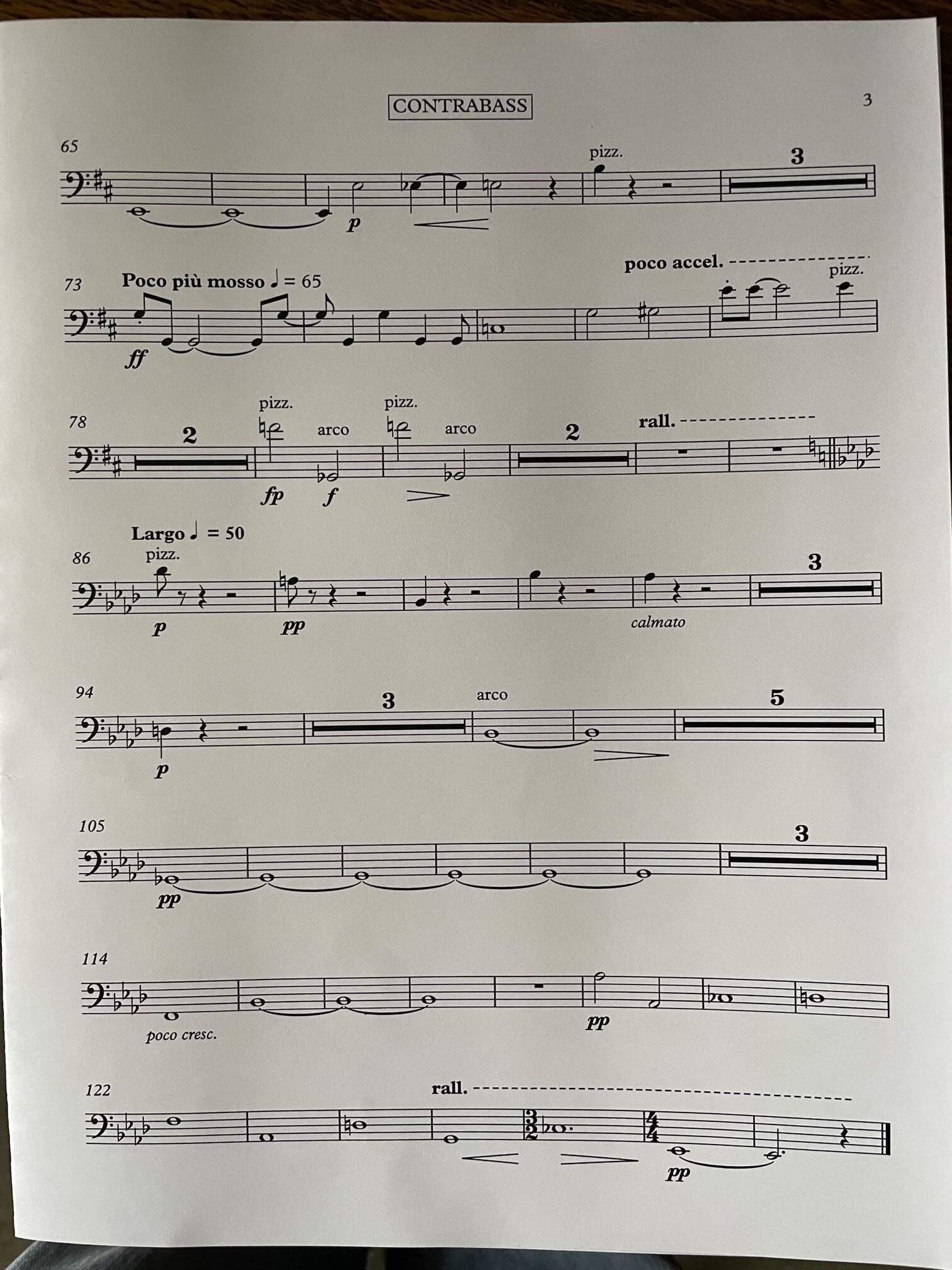
I have a piece for string orchestra being readied for publication and the last note in the work for basses is low e-flat. My question is, should I make a note at the beginning of the part that there is an e-flat at the end and scordatura might be required, or should I do nothing? There actually is not much time during the last half of the work to tune the E string down (or maybe there is, but I don't think I want basses to be a distraction while tuning down. Should an indication be made at the beginning to tune the E string down a half step? The piece is 9 minutes long and isn't difficult for the bass. Putting the last note up an octave is not an option for musical reasons.
Thanks!
IMG_0391.jpg
 
Tuning in the middle of the piece is always a bad idea.

Ligeti often included instructions in his scores that bass players should not transpose low octaves. Allow those with 5-strings or extensions to play it as written, and the others can sit it out.
Thanks. I might add a note like that (not to transpose). Since it's possible that a smaller orchestra might play the piece, I don't think I can let players sit it out. :)
 
I've never seen a composer's/copyist's note in a part indicating that it contains notes below E2.

If I can, I will usually look ahead through a piece and see where, if necessary, I should open or close gates on my C extension. Then I'll try and find a place where I can do that (like the 5 measure rest in bar 100 above) and I'll pencil in "XEb" which means stop an Eb, because that note is coming up.

On a completely unsolicited note, is there a reason you notate across the middle of the bar at the più mosso? Singers might be used to that type of rhythmic notation, but it makes it unnecessarily difficult to sight read when you do that. (IMO, of course)
 
Just leave it as is. I hate to be a bit brutally honest, but you should go in expecting that if an ensemble has a bassist without an extension or 5 string, they’re gonna transpose that E flat up an octave. Unless indicated like Paul mentioned, that’s just generally the common impulse if a player doesn’t have those notes. If it’s really crucial to you, I’d just leave it as an optional note and assign that low Eb to another instrument in the ensemble that could play it.

Drop D might be something interesting to consider though. If it doesn’t effect the sonority of the bass and the piece (as a double bass sounds really good in D major when in drop D), it might be a good thing to include on the part for those without an extension or a 5 string.
 
I've never seen a composer's/copyist's note in a part indicating that it contains notes below E2.

If I can, I will usually look ahead through a piece and see where, if necessary, I should open or close gates on my C extension. Then I'll try and find a place where I can do that (like the 5 measure rest in bar 100 above) and I'll pencil in "XEb" which means stop an Eb, because that note is coming up.

On a completely unsolicited note, is there a reason you notate across the middle of the bar at the più mosso? Singers might be used to that type of rhythmic notation, but it makes it unnecessarily difficult to sight read when you do that. (IMO, of course)
I'm sure professional players do what you do and look ahead. I agree the notation in that bar at the piu moso could be improved. It used to be worse. I'll take another look at it. Thanks!
By the way, I've been a cellist for 50 years. But since basses have very different issues to deal with that's why I'm asking for advice on the low E-flat. If everyone had extensions my life would be easy!
 
  • Like
Reactions: Carl Hillman
Leave it as is, with no suggestions as to tuning. Bass sections see this stuff all the time, and should be trusted to make the appropriate musical decision for the group. In my bass section in college if we didn't have a C-ext, we would usually just play the stray Eb up an octave, but in your piece the Eb is on the last note and it seems like the shape of line on the cadence is important, so at least one of us would tune down for this to make it sound right (and tune down before the start of the piece). If I were the one tuning down, I would go to D because I have always used drop tunings on DB and other instruments, but plenty of other bassists would find it easier to tune down half a step. The basses will figure it out, don't worry.
 
"On a completely unsolicited note, is there a reason you notate across the middle of the bar at the più mosso? Singers might be used to that type of rhythmic notation, but it makes it unnecessarily difficult to sight read when you do that. (IMO, of course)"

M 73/74 look pretty normal to me. What would be a better way?
 
The succession of pizz and arco notes at bars 80-81 will be quite awkward to play. I suspect you wont get the full duration of the low G flat to be played arco, if it has to be followed immediately by the pizz high F.

Especially we German-bow players. When I write, I try to provide a beat or two for those changes.
 
  • Like
Reactions: MonetBass
The more (classical) music I am exposed to, the more I notice little nuances like these, which, without meaning any offence to the OP, appear to make very little difference in the context of the whole piece whilst being quite hard to play...
 
  • Like
Reactions: AGCurry
"On a completely unsolicited note, is there a reason you notate across the middle of the bar at the più mosso? Singers might be used to that type of rhythmic notation, but it makes it unnecessarily difficult to sight read when you do that. (IMO, of course)"

M 73/74 look pretty normal to me. What would be a better way?

Your mileage may vary, but I'd rather see it like this.
Example-1.jpg


Here's a (kind of silly) video that gets into it.

 
Last edited:
I hate to be a bit brutally honest, but you should go in expecting that if an ensemble has a bassist without an extension or 5 string, they’re gonna transpose that E flat up an octave.

This is always my advice to composers as well. Don't write extension/5th string notes that you can't live without unless you know for certain that the ensemble is equipped to play them. Retuning presents a lot of issues: is your piece the only piece on the program for the bassists involved? If not, are there breaks before and after the piece? It's going to take a fair amount of time between pieces for them to tune the E down and then double check/fix their other strings (in my experience, changing the pitch of one string always throws the others out of whack). Can you expect that they all will have a clip-on tuner to do so? Tuning to a reference A would make this a lot slower and less accurate, and while many people might use a phone app tuner backstage before the show, that's not going to work very well when there are other people tuning right next to them. If there's a piece before and after yours, then they will have to go through the whole process twice. That's a lot of lag in the program, and a recipe for a lot of out of tune basses.

You're welcome to ask that they don't take the note up the octave, but you should expect that they will sit it out if they only have a low E. I can't imagine that many conductors or bass sections would agree that the low Eb is actually all that important if this is the only way to get it. You should expect that this note will be played up an octave without an extension.

The succession of pizz and arco notes at bars 80-81 will be quite awkward to play. I suspect you wont get the full duration of the low G flat to be played arco, if it has to be followed immediately by the pizz high F.

Also in those measures--the fp and the decrescendo on the pizz notes are pointless. There is no way to control the dynamic after the note has been plucked, other than to let it ring and decay naturally.
 
  • Like
Reactions: AGCurry
Your mileage may vary, but I'd rather see it like this.
View attachment 4677960
I disagree about the first bar. The original version is absolutely fine, and actually would be easier for me to sight read. Your second bar makes sense, but it works either way.

The reason is because, in this slower tempo, one should feel the last note in relation to the four. Not the three. The tied dotted quarters obscure that relation, and seeing the two next to each other makes me think of 12/8.
 
Last edited:
  • Like
Reactions: SAlcott and Ramiste
[Rant mode On]
Dear composers,

You don't request flute or piano players to alter the range of their instruments. Do you?

Why not considering keeping the normal range and tuning for all the instruments in the orchestra, including the 4-string bass tuned EADG?

Sorry, but I don't buy the argument that your music absolutely requires it and that it is non negociable. Composing music implies dealing with lots of constraints:
- instruments and singers have access to a finite range;
- winds players and singers need to breath once in a while;
- arco players have only a finite arco length;
- keyboard players have only ten fingers and cannot span 2 octaves with one hand (too bad if your music requires it!).
- etc.
Dealing with constraints in a creative manner can actually boost your inspiration.

If your music absolutely needs to tamper with tunings to be good, that makes me skeptical.

This being said, I am not arguing that it is not a valid approach to push the limits of musical performance. But I find it most justified when this is done by a composer who performs it himself/herself on the instrument, not that much when a composer expects section orchestra players to do it.
[Rant mode Off]

Now, you are of course free to compose whatever music you want, and to make any unusual request to the orchestra. But don't be surprised if your music is played less than you would like it to be, or not exactly like you requested.

If your music requires basses with C-extensions or 5-string basses, then fine. But not every orchestra will be able to play it as intended. If you write mostly for the Berlin Philarmony, please ignore this post.
 
Last edited:
Composing music implies dealing with lots of constraints:
- instruments and singers have access to a finite range;
- winds players and singers need to breath once in a while;
- arco players have only a finite arco length;
- keyboard players have only ten fingers and cannot span 2 octaves with one hand (too bad if your music requires it!).

Adding:
- transition from pizz to arco (and vice versa) requires at least a little time.
 
  • Like
Reactions: MonetBass
The succession of pizz and arco notes at bars 80-81 will be quite awkward to play. I suspect you wont get the full duration of the low G flat to be played arco, if it has to be followed immediately by the pizz high F.
I suspect you are right. I'm a cellist and have to deal with the same thing from time to time. If a section was large enough, divisi could always be used, but I never seem to got performances with groups that have more than 4 basses. I might make a suggestion in the score. It might not be a really big deal since I anticipate a slight diminuendo on the arco note anyway. I'll give it some thought. Thanks!
 
This is always my advice to composers as well. Don't write extension/5th string notes that you can't live without unless you know for certain that the ensemble is equipped to play them. Retuning presents a lot of issues: is your piece the only piece on the program for the bassists involved? If not, are there breaks before and after the piece? It's going to take a fair amount of time between pieces for them to tune the E down and then double check/fix their other strings (in my experience, changing the pitch of one string always throws the others out of whack). Can you expect that they all will have a clip-on tuner to do so? Tuning to a reference A would make this a lot slower and less accurate, and while many people might use a phone app tuner backstage before the show, that's not going to work very well when there are other people tuning right next to them. If there's a piece before and after yours, then they will have to go through the whole process twice. That's a lot of lag in the program, and a recipe for a lot of out of tune basses.

You're welcome to ask that they don't take the note up the octave, but you should expect that they will sit it out if they only have a low E. I can't imagine that many conductors or bass sections would agree that the low Eb is actually all that important if this is the only way to get it. You should expect that this note will be played up an octave without an extension.


Also in those measures--the fp and the decrescendo on the pizz notes are pointless. There is no way to control the dynamic after the note has been plucked, other than to let it ring and decay naturally.
The Fp is mainly there because all the other strings on that beat also have Fp (arco, though). It looks cleaner in the score to make them all consistent. It also gives the basses the idea of what the effect of that beat should be in the ensemble.
 

Latest posts