• TalkBass has been independent since 1998. Add your voice.
    Create a free account to reply to discussions, view embedded media, and browse with fewer display ads.
    Join freeLog in
    Want zero display ads or expanded classifieds tools? Compare plans.

What was your first bass guitar?

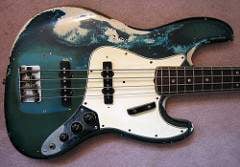
Memphis P copy like this one:

m1nswqbigazmpid4bmfz.jpg


That was mine too! Didn't think I'd find a picture of the miserable boat anchor, but you did. I guess I can't talk bad because it got me hooked.
 
  • Like
Reactions: 5StringBlues
Mine was a early to mid 90s Squier i bought used for a price i cant remember. It was white on white with a rosewood board. Played and sounded like crap, was too poor of a student to get a set up and new strings and really didnt put much value in them. I bought it the summer before i went off to post secondary and it lasted two months before some unknown person "borrowed" it and never brought it back. I didnt try again til my early 30s when the debt was gone and the career was established, then my next "first bass" was a MIA Fender Jazz which i still play regularly
 
What does it sound like? Is that a tone selector switch I see there? Does it sound like any other basses out there? Definitely a cool bass.

The Ripper has two pickups, a four-way selector, master volume and two passive tone controls: Q-filter midrange and standard HF tone. The pickups are sidewinding humbuckers, but with a single set of magnets and narrow aperture, so the tone seems more natural, a bit like single coil. The electronics were designed by Bill Lawrence and are arguably some of the coolest, most versatile elecronics put into a passive bass. Too bad it came out as active electronics were becoming the new, cool thing.

However, being unusual in some ways, it isn't always appreciated. The pickups are more clean and natural sounding than many humbuckers. It has dynamic responsiveness almost to a fault, though that lets it do some cool tones I can't begin to reach on my other basses. There is also a lot to learn about when and how much to use the Q-filter to cut mids with each setting. Also, there is plenty to learn about how to adapt playing style to use that dynamic response. I find it well suited to both pick and finger style playing.

Stock wiring has 1) series, 2) bridge only, 3) parallel and 4) series reversed polarity. Long story short, mine got a bit altered. The net effect at this point is that mine has 1) series, 2) neck only, 3) bridge only and 4) series reversed polarity. Essentially, I have neck only instead of parallel.

At this point, I suspect the neck only setting may have a bit in common with a single coil P bass. Deep, focused, and somewhat less mid emphasis than a split coil P, but musically it still has a fair amount in common. It's the setting I've used the most.

Series is bigger and fatter, full of both solid lows and more mids. Bridge-only is the more aggressive tone you would expect and the polarity reverse setting I think is the sound you can hear on some of ELP's "Pictures at an Exhibition" which takes that bark to an extreme and loses nearly all the low end.

It's a different approach to tone than many two pickup basses: you don't get your tone with the blending of two pickups, you start with one of the four rather different tones and then sculpt it with the midrange and HF tone controls.

Otto
 
Kinda irritates me to think about. It was a Jazz knockoff made by Eastwood. I didn't have it long when my first bass teacher, at my first lesson, essentially told me it sucked and that I'd have trouble advancing as a bass player unless I got something better.

I ended up trading it, plus money to Bass Northwest in Seattle for Yamaha BBG4, which I still have, and love....but, his insistence on the instument being a problem led me down a path of thinking that it was the gear more than the player, and I actually kinda wish I still had the thing.

Suprisingly enough, this teacher was a very well respected dude in these parts.
 
I had a no-name copy, vaguely fender-ish but it had been repainted so many times and worked on that you couldn't tell what it had originally been. My Dad bought it for me for $75 Canadian... he was ripped off. I refinished it and put a logo on the headstock: "Schidt" cos it was.
I quickly got rid of it though and got a Gibson Grabber; I could say that was my first real bass.
 
Bought my wife a Series 10 because it was decent but cheap, and by far the lightest bass we had found. She lost interest pretty quick and I hung on to it. Over the years I'd get asked to fill in with friend's bands. Finally got serious and bought something better, but I will still keep it I think. Maybe convert it to BEAD. Or The kids might want to learn.

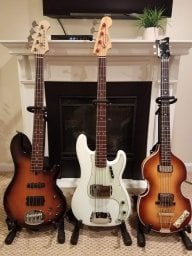
Got tired of it being all black, so a few years back I sanded the top down and stained it. The 'plywood stripes' were a surprise bummer but I kinda like em now. Here it is with its 'replacement'
 

Attachments

  • IMG_20160105_140116158.jpg
    IMG_20160105_140116158.jpg
    889.5 KB · Views: 62
Kinda irritates me to think about. It was a Jazz knockoff made by Eastwood. I didn't have it long when my first bass teacher, at my first lesson, essentially told me it sucked and that I'd have trouble advancing as a bass player unless I got something better.

I ended up trading it, plus money to Bass Northwest in Seattle for Yamaha BBG4, which I still have, and love....but, his insistence on the instument being a problem led me down a path of thinking that it was the gear more than the player, and I actually kinda wish I still had the thing.

Suprisingly enough, this teacher was a very well respected dude in these parts.

I can totally sympathize, albeit in a different field. When I was going to a school for cartooning/animation/graphic design, my first-year animation teacher, a respected member of his craft who'd worked for a number of studios, told me in no-so-many words that I'd never make it in the field if I chose to stick with my style of choice over his stylistic preference. :sour:

In the long run, though, I gained the "spiritual victory" since my preferred style is now heavily saturated into the craft, is more widely accepted and is an obvious influence upon more and more fantastic animators! :spit: :smug: