• TalkBass has been independent since 1998. Add your voice.
    Create a free account to reply to discussions, view embedded media, and browse with fewer display ads.
    Join freeLog in
    Want zero display ads or expanded classifieds tools? Compare plans.

What's On Your Workbench?

I don’t use software but when I’m cutting a new nut and adjusting for string spacing at the saddles (when that’s an option) I shoot for 1/8” or a little less to the edge of the board so, just about the same as your .1” measurement.

The only exception for me is with Jazz basses. I like J basses but I don’t like narrow string spacing so I’ll usually set the strings as close to the edge of the board as I can get away with.
 
  • Like
Reactions: RichterScale
I shoot for 1/8” or a little less to the edge of the board so, just about the same as your .1” measurement.
My current bass is a 5 string and so were the last 2. So I've gotten used to it and haven't had a 4 string since the 90s. The 4 string will probably feel skinny until I get used to it. Plus, I'm doing a slightly narrow spacing, similar to the 5 string, since I'm used to it and it's actually comfy for me. Point is, I think I can spare a little room, so I'll probably bump up the overhang to 1/8". It seems about right.
 
  • Like
Reactions: TerribleTim68
Question about fretboard overhang.
When using fretfind2d, it wants the measurement from the center of the first and last strings, to the outside edge of the board.
For those using fretfind or other printable software for fret spacing, are you bothering to use this feature and if so, are you factoring in the difference in gauge between the first and last string?
Or, are you mostly using this stuff to get fret positions and figure the rest out in real time while building?

For example, I'll have a .095 E string and .040 D string. Since the software wants to know the desired overhang and calculates from the center of the string, I made the overhang 0.1" + half the width of the string. So I typed in 0.12" and 0.147". That should leave me with 0.1" space from the edge of the string and edge of the board on both sides.
Granted, this is all assuming that I'm gluing the printout to my blank and using it for final dimensions.
My assumption is that the printout is good for fret position and as long as you have your final neck width dimensions, string positions and spacing, etc can all be figured out and done on the fly.
I'm mostly curious if anyone bothers to use that feature in FretFind2D.
Also, I'm curious what most people consider a standard space from the outer strings to the edge of the board on most basses.
Yup, I use that feature, because I also make my neck templates with a fretboard printout. I get all of that stuff really precise because it looks cleaner and helps with overall feel. I feel like I can get the neck a bit narrower side to side when I factor in the exact string paths with planned string gauges.

I find 4mm on the bass side and 3.5mm on the treble make things comfortable and the strings don't slip off the edges when digging in. You can mess with it a bit adjusting the string spacing on the nut too. When I plan a fretboard in fretfind, I expect the middle string paths to be irrelevant because I like a nut with slots that have varying widths based on string thickness. I also use the "All" feature for fretboard overhang so that I can specify 4mm on the last string and 3.5mm on the first string and have them remain a consistent distance the length of the fretboard.

Nerd power! :bookworm:
 
Screenshot_20211218-190002~2.png
 
  • Like
Reactions: TerribleTim68
This week in the scary Passinwind build queue, actual wood:


PK_PW100B_1200.png


I still consider this more a proof of concept thing than the actual finished (DIY) product and I have quite a few new raw knob cuts from my vendor to work through detailing. I'll probably also take another stab or three at the panel etching sooner than later too.
 
Question about fretboard overhang.
When using fretfind2d, it wants the measurement from the center of the first and last strings, to the outside edge of the board.
For those using fretfind or other printable software for fret spacing, are you bothering to use this feature and if so, are you factoring in the difference in gauge between the first and last string?
Or, are you mostly using this stuff to get fret positions and figure the rest out in real time while building?

For example, I'll have a .095 E string and .040 D string. Since the software wants to know the desired overhang and calculates from the center of the string, I made the overhang 0.1" + half the width of the string. So I typed in 0.12" and 0.147". That should leave me with 0.1" space from the edge of the string and edge of the board on both sides.
Granted, this is all assuming that I'm gluing the printout to my blank and using it for final dimensions.
My assumption is that the printout is good for fret position and as long as you have your final neck width dimensions, string positions and spacing, etc can all be figured out and done on the fly.
I'm mostly curious if anyone bothers to use that feature in FretFind2D.
Also, I'm curious what most people consider a standard space from the outer strings to the edge of the board on most basses.

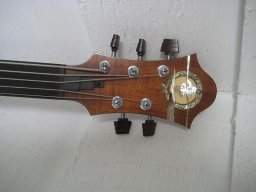
I like to use 5/32" from outer string centers to board edge. I measure the distance at each side of the nut and use a spacing guide to set the strings equally spaced. Why not proportional spacing? Because your fingertips are going to feel for and mate with string centers and don't care if the string spacing doesn't "look right". We all play by feel, so consider if you were a blind bass player. Equal spacing would have a small but possibly not insignificant effect on playing comfort.

Here's the nut / bridge string spacing pdf:

 
  • Like
Reactions: RichterScale
7144355F-3B92-4B41-A197-BA5116F2EE1F.jpeg

Well, still miles to go before this is really ready for prime time but, after a fair amount of machining, wrenching, and some nail-biting my grandfather’s table saw has been returned to good working order.

Still to be done is to get the table squared up to the blade a little better, build it into a larger table with a connected catch table and mount a significantly better fence. I also plan to mount a router under the table so it can pull double duty. …and I seriously need to buy a couple of decent blades - the ones I have are awful.

My grandfather bought this little 8” Shopmaster saw (possibly used) in the 1950s. By the early 1970s he had given it to my father who built a lot of cool furniture with it over the next 20 years. By the time my father gave it to me it was completely worn out. The aluminum castings were so badly worn there was wobble in every moving part.

If I hadn’t been the 3rd generation owner I would never have bothered restoring it but…. here it is! Guess I gotta start building a table now.
 
My wife got me this for Xmas. Y'know, to help with the a.d.d. I guess.
The strings are plastic and don't stay tuned. Any way to hot rod these things?
View attachment 4517886

Tune it and wait. Repeat until it's stable. Even "good" uke strings stretch like crazy and sometimes take a couple weeks to get to the point where they're really stable. If you want to put new strings on it, I would stick with plain old nylon while you're getting used to it.

In terms of setup, cheap ukes often have nuts that are way too tall. Besides ruining playability, this really contributes to poor intonation on lower frets. And the saddle is often set too high as well. My uke setup process is to capo the 1st fret then drop the saddle height until action at the 12th is where I want it (usually between 2 and 2.5mm). Then check clearance over the 2nd fret with the capo still on the 1st fret, and set the nut height to the fret height plus whatever that clearance measurement was. Adjusting the saddle and nut height only takes a couple minutes and it can make a cheaper uke play like something high end.
 
I'd bet that new string stretch probably kills the enthusiasm of new uke players quicker than anything. It's frustrating to have a brand new instrument that's going out of tune all the time. Bad setup would be next in terms of enthusiasm killers. Once the strings finally settle, it's harder than it should be to fret notes and the intonation is way off. No wonder so many cheap ukes end up unplayed. Cheap ukes often have poor tone and volume (tops and/or bracing are overbuilt), which you can't really do anything about, but if you feel like it won't stay in tune and it's hard to play then the bad tone doesn't even factor in. I find that once the strings are stable and the uke is set up well, there's enough of an enjoyment-improvement that the poor tone/volume doesn't matter as much. A cheap uke can be set up to play as nicely as an expensive uke and once it's like that it'll be easy and fun to play.
 

Latest posts