• TalkBass has been independent since 1998. Add your voice.
    Create a free account to reply to discussions, view embedded media, and browse with fewer display ads.
    Join freeLog in
    Want zero display ads or expanded classifieds tools? Compare plans.

What's On Your Workbench?

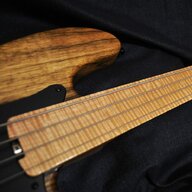
If you don't mind sharing, what does a burl like that cost? I've seen whole burls sold by the pound, but I imagine once it's cut it's probably not sold that way.

I don't mind at all. Unless you are buying burls that have already been blocked out for turning blanks you're probably still going to end up paying by the pound. This particular burl was 25 lbs dead on at 16$ per lbs, so 400$ total. Most major builders charge at least 300$ for the addition of a burl top this nice and even then a full one piece top is very rare.

I figure at 2 1/2" I can get 4 or 5 full tops from this burl. Now I may or may not charge a full 300$ per top but in the long run it will pay for itself and best of all, I get a beautiful burl top for a personal bass. :bassist:
 
I don't mind at all. Unless you are buying burls that have already been blocked out for turning blanks you're probably still going to end up paying by the pound. This particular burl was 25 lbs dead on at 16$ per lbs, so 400$ total. Most major builders charge at least 300$ for the addition of a burl top this nice and even then a full one piece top is very rare.

I figure at 2 1/2" I can get 4 or 5 full tops from this burl. Now I may or may not charge a full 300$ per top but in the long run it will pay for itself and best of all, I get a beautiful burl top for a personal bass. :bassist:
Thanks!

When I retire one of my ideas is wood processing - finding cool wood, cutting it down to instrument size and selling it. I saw a story somewhere about people illegally harvesting burls to make money, blood burls :-D
 
It's not on the bench anymore, but this was an abandoned guitar project I started, dropped, then decided to make work. I've been a bit under the weather and avoiding doing anything requiring full mental capacity (bass build stuff), but wanted to keep busy. And when I thought of "diminished mental capacity", for some reason "GUITAR" came to mind :laugh:

Anyway, here's a bunch of random stuff turned into a guitar that works okay enough.

IMG_6489.jpg
IMG_6490.jpg

IMG_6492.jpg

IMG_6493.jpg

IMG_6494.jpg

IMG_6495.jpg

- The patch in the back was where I drilled through the body, twice, trying to rout the pickup wire hole.
- The random selection of knobs was due to "the beveled knob scoops didn't fit the knobs I wanted to use"
- Tailpiece is part of a trapeze tailpiece that I didn't want to use the swingin' part, so I drilled holes in it and used neck mount screws
- There was plans to do more intricate wiring as well, but... meh.
- It's better than the firewood it was destined to be when I realized the neck was set too high off the body

GFS Ric-style humbuckers, Schaller bridge, V-T-Select, Grover tuners.
Sapele back, chambered. Weird figured maple top. Rosewood board, BEM neck.

I like building basses. Not so much guitars.
 
thanks for that... it’s like.. I know it’s just part of the whole thing, but I felt like such a dumbass because I walked right into it.

Basically I was planing/flattening the bottom panel for a pedal board, and up to that point I couldn’t believe how well it was going. The little sapele square was a fix to lengthen an oak scrap into a board, all of that oak glued up into a panel worked the best of any time I’ve done that to date.
My router planing fixture was working phenomenally, and I really just went too hard for too long; I think what happened was the bit worked its way loose from the chuck. It suddenly dug in then jumped with a bang. This honestly could have been dangerous or at least damaged more than my workpiece...

Anyway I think it’s pretty trashed, I may just cut my losses and find a better solution.
You'll find that about half your time building instruments is spent fixing or "featuring" things that don't go as planned.
 
I continue to blindly learn how to turn stuff on my lathe. Just when I think I've got it, I catch a tool and my confidence goes away. At some point I probably need to take a class and have someone tell me what I'm doing wrong, but in between those catches it's a very enjoyable hobby and creates these wild things.

There are some carryovers from bass building in being able to look at a piece of wood and imagine the grain inside. This was a piece of firewood, basically a red oak crotch that I mounted sideways and turned into a live edge bowl. It''s got inclusions, holes and knots, but it looks cool as a bowl.
20200303_135420.jpg
20200303_135410.jpg
 
I like it!

I watch a lot of home improvement shows and one that I watch frequently is "Home Town". The guy is actually a furniture builder who does home reno with his wife, but he often makes furniture for said houses they are reno'ing. I watch him turn table legs or lamp posts and it just seems so violent at times. So maybe you're doing it right? :cautious: :wideyed:

Oh, he owns "Scotsman Company" in Laurel, Mississippi, in case you care. ;)
 
This was a piece of firewood, basically a red oak crotch that I mounted sideways and turned into a live edge bowl. It''s got inclusions, holes and knots, but it looks cool as a bowl.
View attachment 3729935 View attachment 3729936
I'd eat M&Ms out of that thing, any day. VERY COOL!
"Lathe envy" is a thing I never knew I'd end up with, but lo and behold...

OH, and PBS airs a show called "American Woodshop" and they frequently turn items. It's a very informative and detailed show, if you can find episodes of that, they are worth a watch.
 
Last edited:
I'd eat M&Ms out of that thing, any day. VERY COOL!
"Lathe envy" is a thing I never knew I'd end up with, but lo and behold...

OH, and PBS airs a show called "American Woodshop" and they frequently turn items. It's a very informative and detailed show, if you can find episodes of that, they are worth a watch.
A friend of mine sends me that show when they do any turning. I'm using carbide tools right now, not using bowl gouges. I don't have a slow speed grinding wheel to sharpen them (I do have a couple bowl gouges). I need to start using them, I'm sure that will be helpful.

It's cool that you can go from a hunk of wood to a finished product in a couple hours or less.

Oh and thanks!
 
PBS has (or has had) so many great woodworking shows. I grew up on New Yankee Workshop and The Woodwright's shop. Those shows are a big part of what got me in to this hobby. What a gift that channel is.

I loved the Woodwrights Shop! It always amazed me how quickly and accurately Roy could do things with antique style hand tools. I understand that for the one he made on the show there were 3-5 others but still it was/is pretty cool what can be done that way.
 
More Jazz Bass nonsense.

Qwh8r41.jpg


Decal is done, and lacquer is leveled and buffed out. Oddly the outline of the decal has reappeared in the last week, as has some of the sanding marks from the lacquer prep. It is like the lacquer is still losing solvents and shrinking over time? I'm using an acrylic lacquer from the car parts shop around the corner from my house. Cheap and nasty lacquer!

oZBCNlz.jpg


Fretwork is complete! This neck is developing a subtle ski jump, but what neck isn't! The previous owner had big bad La Bellas on there.

A cream Jazz body showed up, but annoyingly the courier smashed the body.

1noF0ZN.jpg


You can't really drop fill that sort of damage. The poly finish is chipped up off the top of the body, down to the bare wood, revealing all the layers of paint in between.

I'm getting another body sent, but I took the chance and mocked up the bass.

F4qJEao.jpg


I've not seen heaps of white '60s Jazz basses kicking around. There were a lot of sunbursts and deep-cut custom colours, but not too many white ones.


b3QTztd.jpg


The original Fender body is on the left. It is a lot clunkier, with hard contour transitions and a small roundover on the body. It weighs a tonne and it is heavily routed. The cream body is a lot smoother and closer in specs to a '60s body.

The sunburst body will become a pickup mule! I have plans to stick a mudbucker at the neck on it.
 
More Jazz Bass nonsense.

View attachment 3734119

Decal is done, and lacquer is leveled and buffed out. Oddly the outline of the decal has reappeared in the last week, as has some of the sanding marks from the lacquer prep. It is like the lacquer is still losing solvents and shrinking over time? I'm using an acrylic lacquer from the car parts shop around the corner from my house. Cheap and nasty lacquer!

Yup, lacquer will continue to shrink pretty much forever but the bulk of it happens in the first few weeks.
 
  • Like
Reactions: Axstar
Yup, lacquer will continue to shrink pretty much forever but the bulk of it happens in the first few weeks.

Good to know I'm not losing the plot! I thought that maybe I missed a bunch of marks when I first polished the headstock face.

I tried to speed up the lacquer cure by leaving the neck next to a radiator, but this made the lacquer wrinkle. I guess that the warmth made a lower layer of the lacquer off-gas a bit too quickly?
 
Good to know I'm not losing the plot! I thought that maybe I missed a bunch of marks when I first polished the headstock face.

I tried to speed up the lacquer cure by leaving the neck next to a radiator, but this made the lacquer wrinkle. I guess that the warmth made a lower layer of the lacquer off-gas a bit too quickly?

Yes. As you have [unfortunately] discovered, rushing lacquer just results in problems. I am by no means an expert, but even on the handful of projects I have used it I have run into problems when trying to rush.

The one (only?) good thing about lacquer is you can sand it down and the next layer will melt into the previous, preventing witness lines.
 
  • Like
Reactions: Axstar