

Enjoy the benefits of a premium membership!
Upgrade Account
-
TalkBass has been independent since 1998. Add your voice.
Create a free account to reply to discussions, view embedded media, and browse with fewer display ads.
Join free Log in
Want zero display ads or expanded classifieds tools? Compare plans.
You are using an out of date browser. It may not display this or other websites correctly.
You should upgrade or use an alternative browser.
You should upgrade or use an alternative browser.
What's the worst that could happen replacing a bridge?
- Thread starter Chinchano
- Start date
More options
Who Replied?

Ajapses
Gold Supporting Member
The worst? You use a worn screwdriver bit and strip a screw head. Your diesel mechanic buddy lends you some kind of strange easy-out thing, but you slip when using a hand drill and suddenly have an extra hole. In frustration, you start prying the bridge off with a chisel and screwdriver. It doesn't work so you get another bright idea of using a propane torch to remove the screws. After you set the bass on fire, the fire department is slow to respond because they're having an in-house chili cookoff. Your home is reduced to ashes. Without your home providing balance against all the basements around the world filled with old National Geographic magazines, the planet changes it's axis tilt. This upsets the solar orbital equilibrium. Mercury is the first to be sucked in to the sun. The resulting explosion produces a fireball that consumes Venus and our home. Not to mention the effect on the galaxy and local group.
Don't screw up!
Don't screw up!

To be extra careful, you could take some clean-release masking tape and protect the body around the bridge--before you take the old one off. Just some insurance against marring the finish if a screwdriver should slip.
Worst case scenario:
You go through the time and effort to not only install a new bridge and re-string the instrument, but to set the intonation and action optimum, just to realize the damn thing plays and sounds just the same as it did before.
That could be good in the case of a straight replacement.
Before you start, lay the new bridge side by side with the current one and line up the screw holes, then adjust the intonation to match.
It won't be dead on and you will still need to adjust after installing, but it will be in the ballpark.
Great tip!

Before you start, lay the new bridge side by side with the current one and line up the screw holes, then adjust the intonation to match.
It won't be dead on and you will still need to adjust after installing, but it will be in the ballpark.
Thanks!
The worst? You use a worn screwdriver bit and strip a screw head. Your diesel mechanic buddy lends you some kind of strange easy-out thing, but you slip when using a hand drill and suddenly have an extra hole. In frustration, you start prying the bridge off with a chisel and screwdriver. It doesn't work so you get another bright idea of using a propane torch to remove the screws. After you set the bass on fire, the fire department is slow to respond because they're having an in-house chili cookoff. Your home is reduced to ashes. Without your home providing balance against all the basements around the world filled with old National Geographic magazines, the planet changes it's axis tilt. This upsets the solar orbital equilibrium. Mercury is the first to be sucked in to the sun. The resulting explosion produces a fireball that consumes Venus and our home. Not to mention the effect on the galaxy and local group.
Don't screw up!
By far, this is the worst case scenario.

No one told you that your old bridge was really a prison for the demon god Cthulhu. When you took the bridge off, Cthulhu escapes and turns humans into gibbering piles of insane quivering mounds of flesh to feed his appetite. The Old Ones return to Earth and everything is consumed in flame.

That could be good in the case of a straight replacement.
Please explain. I considered my scenario a waste of time.
my scenario
???
I just replied that (if the tone, adjustability, fit, etc was good), a straight replacement (same results [minus the opened slots]) would be considered good.
How about this?
Your change in bridge results in so much tonal improvement you get discovered by a guy from island records to be hired into their pool of musicians to suport acts on their label. Then, you get assigned to support Justin Bieber on his tour. You hate the idea, but the money is good and it might lead to a better gig down the road so you take the deal. Then, Bieber takes notice of your great tone he almost seems to become obsessed with you. You try to avoid him at evey turn, but there he is, always following you, always staring at you, sometimes saying ambiguous come on lines. You are curious why you keep getting bonus pay in every check and you have also been assigned our own private dressing room to prep before shows. You are nervous, but the bonuses are large enough and other national acts have taken notice of you. People assume your are some sort of bass god because of your own room and special treatment.
But then, it happens. One day you open your wardrobe case to find a nude Justin Bieber who immediately jumps on you and tries to have his way with you. In your horror you eventually manage to escape his grip and flee out the door only to be stopped by two large bodyguards who restrain you and force you back into the room. Justin confesses his love to you and offers to marry you. But upon your refusal a black sack is placed over your head and you feel a painful whack on the back of your skull before you lose consciousness.
You awake to find yourself chained up in what can only be described as a medieval dungeon decorated in bright colors with a bed, rows of handcuffs and chains on the wall and shelves of bright colored sex toys. Other large leather and metal devices are in the room, but you cannot quite guess their function. Twice a day, an old frail man brings you food, but does not make eye contact or speak a word. A few weeks go by and you try desperately to remember how many dates were left on the tour, but time has become a blur.
But one evening, the door opens and it is not the old man with your dinner. It is him, and his two large bodyguards dressed in leather head to toe with masks. The real horror has only begun.....
Your change in bridge results in so much tonal improvement you get discovered by a guy from island records to be hired into their pool of musicians to suport acts on their label. Then, you get assigned to support Justin Bieber on his tour. You hate the idea, but the money is good and it might lead to a better gig down the road so you take the deal. Then, Bieber takes notice of your great tone he almost seems to become obsessed with you. You try to avoid him at evey turn, but there he is, always following you, always staring at you, sometimes saying ambiguous come on lines. You are curious why you keep getting bonus pay in every check and you have also been assigned our own private dressing room to prep before shows. You are nervous, but the bonuses are large enough and other national acts have taken notice of you. People assume your are some sort of bass god because of your own room and special treatment.
But then, it happens. One day you open your wardrobe case to find a nude Justin Bieber who immediately jumps on you and tries to have his way with you. In your horror you eventually manage to escape his grip and flee out the door only to be stopped by two large bodyguards who restrain you and force you back into the room. Justin confesses his love to you and offers to marry you. But upon your refusal a black sack is placed over your head and you feel a painful whack on the back of your skull before you lose consciousness.
You awake to find yourself chained up in what can only be described as a medieval dungeon decorated in bright colors with a bed, rows of handcuffs and chains on the wall and shelves of bright colored sex toys. Other large leather and metal devices are in the room, but you cannot quite guess their function. Twice a day, an old frail man brings you food, but does not make eye contact or speak a word. A few weeks go by and you try desperately to remember how many dates were left on the tour, but time has become a blur.
But one evening, the door opens and it is not the old man with your dinner. It is him, and his two large bodyguards dressed in leather head to toe with masks. The real horror has only begun.....
Ajapses
Gold Supporting Member
That is far worse than the end of the Universe!!! Why don't you just change tuners, instead?
???
I just replied that (if the tone, adjustability, fit, etc was good), a straight replacement (same results [minus the opened slots]) would be considered good.
Oh, you mean as opposed to having a detrimental affect on tone or playability. Got it.

I would consider the waste of time a PITA as well--and that is often the case with the basses I replaced bridges on.
Last edited:

worst scenario? You install the bridge and realize you cant set your action low as before, and your bass is a neck-through or set neck...

Has anyone delved into the whole "waste-of-money-trying-to-improve-your-sound" pitfall yet?
The thing about this is that nobody believes it until they experience it couple of times.
I just completed the job. The tips you guys provided saved me a ton of time. Intonation only needed a very slight adjustment and action. Other than that this thing is ready to play. These photos are farrrrrrrr from professional but you can see the diff.
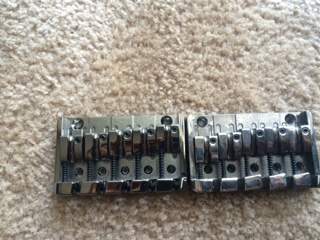
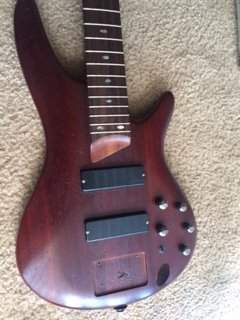
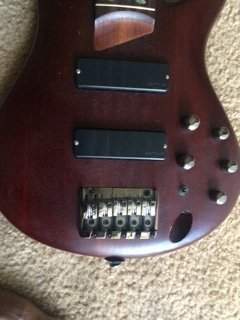
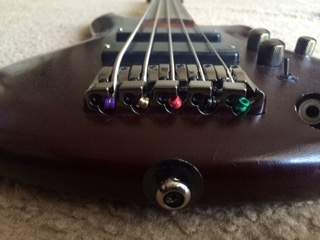
Last edited:
worst scenario? You install the bridge and realize you cant set your action low as before, and your bass is a neck-through or set neck...
You guys sure aren't helping this noob much! Hey, the BEST kind of operation is just what he is asking about. Replacing a damaged (bent) bridge with a new one of exactly the same kind. It's hard for this to go wrong. You just take off the strings, unscrew the defective bridge and screw the new one down. If there is trouble it will be along the lines of a couple of the screw holes strip out and the screws won't tighten. In that case you put a couple toothpics in the hole with some moo glue and tighten it all up. You probably won't even have to touch intonation, though I'd do a complete setup just for drill.
So how do things do wrong? Well the first one is that the mounting holes in the replacement bridge don't match the holes in the old bridge or the bass !!!. Yeah, stuff happens. This tends to happen a lot if you try to replace the old bridge with a "better" bridge. And that gets even worse because you may find that most holes don't match (which is good you just drill new pilot holes for the screws) or worse "almost" match which means you must drill out that hole, glue a dowel into it, and then trim it flat with bass surface. Worst of all worlds is when one or more old screw holes isn't covered by area of new bridge. And last kick in the teeth is that you find after spending a fortune on a new bridge, filling screw holes, aligning the bridge position so strings are spaced right on neck and intonation adjustment has enough range, you discover the tone isn't any better than it was before! This is why when I install a new bridge it is for FEATURES like top-loading rather than pushing strings through holes. And as noted above, a different bridge my not go low enough for your bass and if its through-body you can't shim the neck back into OK. Another important thing to watch is to be sure the line of saddles is adjusted close to maximum distance and then mount bridge so saddles are in a line right were the old intonation line was. If you aren't careful with this you find that the B string won't have enough distance to pull it into intonation and it's worse because it's fat and doesn't bend easily.
But as I said. easiest fix is just to replace the bad bridge with a new one just like it and be on your way.
Oh wait! I see you already did it just like I said and are on your way! Nice job! And Oh, by the way, I forgot to mention, trying to replace a bridge that is recessed into the body like yours with something other than an exact replacement is probably the BIGGEST of all bridge replacement nightmares! You did good!
You guys sure aren't helping this noob much! Hey, the BEST kind of operation is just what he is asking about. Replacing a damaged (bent) bridge with a new one of exactly the same kind. It's hard for this to go wrong. You just take off the strings, unscrew the defective bridge and screw the new one down. If there is trouble it will be along the lines of a couple of the screw holes strip out and the screws won't tighten. In that case you put a couple toothpics in the hole with some moo glue and tighten it all up. You probably won't even have to touch intonation, though I'd do a complete setup just for drill.
So how do things do wrong? Well the first one is that the mounting holes in the replacement bridge don't match the holes in the old bridge or the bass !!!. Yeah, stuff happens. This tends to happen a lot if you try to replace the old bridge with a "better" bridge. And that gets even worse because you may find that most holes don't match (which is good you just drill new pilot holes for the screws) or worse "almost" match which means you must drill out that hole, glue a dowel into it, and then trim it flat with bass surface. Worst of all worlds is when one or more old screw holes isn't covered by area of new bridge. And last kick in the teeth is that you find after spending a fortune on a new bridge, filling screw holes, aligning the bridge position so strings are spaced right on neck and intonation adjustment has enough range, you discover the tone isn't any better than it was before! This is why when I install a new bridge it is for FEATURES like top-loading rather than pushing strings through holes. And as noted above, a different bridge my not go low enough for your bass and if its through-body you can't shim the neck back into OK. Another important thing to watch is to be sure the line of saddles is adjusted close to maximum distance and then mount bridge so saddles are in a line right were the old intonation line was. If you aren't careful with this you find that the B string won't have enough distance to pull it into intonation and it's worse because it's fat and doesn't bend easily.
But as I said. easiest fix is just to replace the bad bridge with a new one just like it and be on your way.
Oh wait! I see you already did it just like I said and are on your way! Nice job! And Oh, by the way, I forgot to mention, trying to replace a bridge that is recessed into the body like yours with something other than an exact replacement is probably the BIGGEST of all bridge replacement nightmares! You did good!
Thanks man! It was actually not as scary as I thought lol.

Will new strings always need a truss rod adjustment?Yep, you just have to reset the action and intonation if you use the same set of strings, you shouldn't have to touch the truss rod.
Sometimes, it depends on how picky you are with your setupWill new strings always need a truss rod adjustment?
Latest posts
-
Anyone been to the current David Byrne tour - Who Is The Sky ?
- Latest: aarono2690
-

-
-

-