• TalkBass has been independent since 1998. Add your voice.
    Create a free account to reply to discussions, view embedded media, and browse with fewer display ads.
    Join freeLog in
    Want zero display ads or expanded classifieds tools? Compare plans.

What's To Know About Flatwound Strings For a 6 String Fretless Bass?

I use the TIs exclusively on my fretless basses. They sound great and bridge the gap between flats and rounds very well. The tension is similar to a standard round. I have tried other flats and use them on most of my fretted basses. But I can't get the tone I want with a standard flat. For the fretless, especially a 6, I want a more round type sound. TIs are the only flatwound string that gets me there. I also like the labella white tapewounds, they are a roundwound wrapped in tape. They are almost too smooth, very slippery. I let them go because of grounding issues inherent with tapewounds, but on the 6 they sound very good too.
 
  • Like
Reactions: Count Bassula
I'm an experienced guitarist, but new to bass.

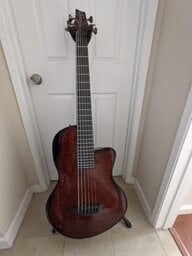
I just picked up a 6 string fretless bass but the seller unfortunately put round wounds on it. The guitar has a 34" scale. The strings are held by the bridge, not through the body.

What gauges are available in flatwounds? I am looking for the lightest gauge available.

Also what are the different metal choices used in different strings?

I thought it would be tuned like a guitar but apparently people tune the low string to B and the high string to A. This is interesting as it gets rid of the shifted B string when tuning a guitar.

One set I was looking at said the strings are not for through body guitars, and the wrapped portion must only be the part that is around the post or the strings will break.

What flatwound strings will be good for this guitar? Lighter is better...
The guitar has a 34" scale. The strings are held by the bridge, not through the body.

Thanks!
In no particular order:

- there is nothing unfortunate in using roundwounds on a fretless. The champion of the instrument, Jaco Pastorius, used Rotosound Swing Bass 66 stainless-steel rounds, as did/have countless others, and that distinctive "mwah" tone comes from rounds, low action and a bridge pickup. The board may require some maintenance after a number of years. You could also use modified roundwounds
(groundwounds such as D'Addario Half-Rounds, GHS Brite Flats, Elites Groundwounds, Magma Flats;
pressurewounds by GHS or Ken Smith Compressors, Rotosound Solo Bass 55, S.I.T. Silencers)
which are gentler on boards and still vaguely in the roundwound tone ballpark

- a further alternative could be black nylon tapewounds (or, for a clearer appearance but also tone, La Bella "White Nylon" - it's actually transparent - in their three available flavours, to wit Gold=brass, Copper and regular White=steel); the typical tone of bass tapes, or guitar ones for that matter, is muted in the high-highs but, depending on brand, sometimes very favourably comparable to that of worn-in rounds, with a super-smooth feel and virtually no ill effect on the fingerboard

- having found out the traditional tuning for long-scale 6-string bass is BEADGC, do you plan to embrace it, or would you still prefer tuning to EADGBE, as some...longboard 6-string players actually do?

- if the latter, regardless of the naysaying you could indeed use that La Bella bass VI flatwound set, on one condition: whip out the measuring tape, measure your bass from ball-end to nut, and make sure the distance is no longer than 35.5". If it is, that set is absolutely an option (for E-e tuning). You may have to shave back some of the silk, and possibly also need to keep the string raised over the nut with a pencil for a week or so, until its initial stretching has the tapering point clear the nut slot entrance.
As to why bass strings should taper between nut and tuning post, see here:
https://www.talkbass.com/threads/bass-string-taper-on-basses-explain-please.1635166/

- if you're still interested in flats, by all means get flats - just be aware that their tone tends to be on the mellow side. On the other hands, there is a wide range of flavours you can get, depending on brand. You will have noticed by now that 6-string flatwound sets aren't cheap, nor are they plentiful. If you read up on the different broad tone groupings of flats (see for example here
https://www.talkbass.com/posts/27283101/) and find something that interests you, which YouTube video reviews confirm, you don't strictly have to limit yourself to 6-string packets: another option is getting a 5-string set, and supplementing it with a single high C from another brand. Alternatively, electric-guitar flatwound exist, some are available as singles from online stores (I'm a big fan or D'Addario guitar Chromes), and they're often long enough (their winding clears the nut) for bass use, if you thread each through washers or old bass ball ends in order for their small ball end not to slip through the bridge anchoring hole, and if you are prepared to wound it bare-cored to the tuning post if needed. Ditto if you go EADGBE: just get a 4-string set, add single B and high E or appropriate gauge

- as for the stainless steel tone and whether you'll find it offending to your ear, it would only apply to rounds (flatwound construction, which mellows tone, trumps any purportedly inherent trebly property of steel), and even if you opt for rounds you'll have to try and decide for yourself (you'll use the bass with a bass rig, as opposed to a guitar one, anyway). Not to mention the fact a fretless bass, with its lack of metal-to-metal contact at the board - replaced by the string's active end being between wood and flesh - is a lot mellower to start with.
 
Last edited:
In no particular order:

- there is nothing unfortunate in using roundwounds on a fretless. The champion of the instrument, Jaco Pastorius, used Rotosound Swing Bass 66 stainless-steel rounds, as did/have countless others, and that distinctive "mwah" tone comes from rounds, low action and a bridge pickup. The board may require some maintenance after a number of years. You could also use modified roundwounds
(groundwounds such as D'Addario Half-Rounds, GHS Brite Flats, Elites Groundwounds, Magma Flats;
pressurewounds by GHS or Ken Smith Compressors, Rotosound Solo Bass 55, S.I.T. Silencers)
which are gentler on boards and still vaguely in the roundwound tone ballpark

- a further alternative could be black nylon tapewounds (or, for a clearer appearance but also tone, La Bella "White Nylon" - it's actually transparent - in their three available flavours, to wit Gold=brass, Copper and regular White=steel); the typical tone of bass tapes, or guitar ones for that matter, is muted in the high-highs but, depending on brand, sometimes very favourably comparable to that of worn-in rounds, with a super-smooth feel and virtually no ill effect on the fingerboard

- having found out the traditional tuning for long-scale 6-string bass is BEADGC, do you plan to embrace it, or would you still prefer tuning to EADGBE, as some...longboard 6-string players actually do?

- if the latter, regardless of the naysaying you could indeed use that La Bella bass VI flatwound set, on one condition: whip out the measuring tape, measure your bass from ball-end to nut, and make sure the distance is no longer than 35.5". If it is, that set is absolutely an option (for E-e tuning). You may have to shave back some of the silk, and possibly also need to keep the string raised over the nut with a pencil for a week or so, until its initial stretching has the tapering point clear the nut slot entrance.
As to why bass strings should taper between nut and tuning post, see here:
https://www.talkbass.com/threads/bass-string-taper-on-basses-explain-please.1635166/

- if you're still interested in flats, by all means get flats - just be aware that their tone tends to be on the mellow side. On the other hands, there is a wide range of flavours you can get, depending on brand. You will have noticed by now that 6-string flatwound sets aren't cheap, nor are they plentiful. If you read up on the different broad tone groupings of flats (see for example here
https://www.talkbass.com/posts/27283101/) and find something that interests you, which YouTube video reviews confirm, you don't strictly have to limit yourself to 6-string packets: another option is getting a 5-string set, and supplementing it with a single high C from another brand. Alternatively, electric-guitar flatwound exist, some are available as singles from online stores (I'm a big fan or D'Addario guitar Chromes), and they're often long enough (their winding clears the nut) for bass use, if you thread each through washers or old bass ball ends in order for their small ball end not to slip through the bridge anchoring hole, and if you are prepared to wound it bare-cored to the tuning post if needed. Ditto if you go EADGBE: just get a 4-string set, add single B and high E

- as for the stainless steel tone and whether you'll find it offending to your ear, it would only apply to rounds (flatwound construction, which mellows tone, trumps any purportedly inherent trebly property of steel), and even of you opt for rounds you'll have to try and decide for yourself (you'll use the bass with a bass rig, as opposed to a guitar one, anyway). Not to mention the fact a fretless bass, with its lack of metal-to-metal contact at the board - replaced by the string's active end being between wood and flesh - is a lot mellower to start with.

Great explanation. Thank you.

I want flatwounds because I have a 4 string bass with flatwounds, and I like it. I also want to slide a lot, and the round wound strings are like running my fingers along a rasp.

I also like the sound of the fretless slides other techniques which I will have a hard time to do on roundwounds and still keep the skin on my fingers.
 
Great explanation. Thank you.

I want flatwounds because I have a 4 string bass with flatwounds, and I like it. I also want to slide a lot, and the round wound strings are like running my fingers along a rasp.

I also like the sound of the fretless slides other techniques which I will have a hard time to do on roundwounds and still keep the skin on my fingers.
Jaco coated his fingerboard in Marine Epoxy.
 
  • Like
Reactions: Count Bassula
Great explanation. Thank you.

I want flatwounds because I have a 4 string bass with flatwounds, and I like it. I also want to slide a lot, and the round wound strings are like running my fingers along a rasp.

I also like the sound of the fretless slides other techniques which I will have a hard time to do on roundwounds and still keep the skin on my fingers.
Gotcha. I would definitely rule out rounds in that case. As I would groundwounds as well, which I've no personal experience of, but which many describe as "grabby". (Pressurewounds may not be that bad though.)
Nylon tapewounds, on the other hand, are definitely contenders I suggest you investigate.
 
  • Like
Reactions: Count Bassula
my only recommendation is TI flats. Take a deep breath on the pricing, but remember it is a 6 string instrument. I play a Ken Smith BSR6 and these strings are my go to. Bright enough to cut through most mixes and last FOREVER. But still half the price of a set of 4 TI Spirocore Weichs for my double bass.
My first encounter with TI's was my set of TI Spirocore Weichs on my upright year's ago. I liked them so much I wondered if they made them for solid body basses. I was happy they did :thumbsup:

Because I was thinking of cutting up an uoright set if they didn't. Hey I was a kid, what did I know.

:)
 
  • Like
Reactions: Count Bassula
Flats on a six:

The silks are meant to protect the bit of the string that winds around the post. That means ideally, the silks start somewhere between the nut and the tuner post. You can get away with winding a bit of bare metal on a post, though. If in doubt, measure the distance from ballend to nut and the distance from ballend to winding post on each string and send those measurements to the string brand of your choice. Most string brands are really easy to deal with and will answer quickly to an email.

A flatwound string has a different life cycle than a roundwound one. At the point where the roundwound is considered dead, the flatwound is considered nearly worn in. You put on a set and then play it heavily for about half a year, then you get to experience how the strings really sound and feel.

Nearly all flatwounds will feel uncomfortable to play to a certain degree when you put them on. They all will get much smoother with time, ignore first impressions. It's also a good idea to take a fresh flatwound set and wipe them down with a robust cloth and alcohol (not whiskey).


Here's my experience so far:
TI Jazz Flats: These are expensive, yes. But price does not really matter on flatwound strings because you can keep them on the bass for years and years. When you take a normal roundwound set that will set you back around $45, you'll break even after two years if you change your rounds every six months.
The TI flats have a very low tension. They feel a bit like playing on boiled spaghetti. You either love it or you don't - and that is the main risk here. Apart from that, they have a beautiful singing voice and very pronounced mids, which work really well on a fretless.

Optima Flatwounds: These are a perfect middle-of-the-road set. They have bass, they have mids, they have some treble, but it's all very balanced and nothing sticks out. The sound is very organic, your ears are reminded of wood, more than metal. I have them on my main bass and even though I have multiple other sets lying around to try at some point, I have no intention to change those. They've been on for three years now and just perfect for me.

Pyramid Flatwounds: Also a string that is very balanced. It has a bit of a low mids thump to it, and they feel a bit rough at first, but settle in nicely.

LaBella Deep Talkin Flats: I've had the golden ones and the regular ones. The golden ones became one of my favorite strings ever. First of all they are the smoothest strings I ever played. Their tension is a bit higher, which you will feel in your plucking hand. Their thump is a good bit lower, rather seated in the bass register than in the low mids. They turn a bit darker than the TI or Optima strings when you play them for years.

Chromes: These are, in my experience, the worst strings in terms of how they look and feel right out of the box. They are as comfortable as a cheese grater, but these will turn smooth like any other. They are supposed to be on the brighter side and I have yet to experience a flatwound string with more treble content than the Chromes have. When settled in, they sound like flats that have been on for about three months and not yet fully shed their treble content.

One string I feel like it should be mentioned here is the LaBella Low Tension Flats. These are supposedly boiled spaghetti like the TIs are, and from what the OP writes, it could be right up their alley. I've never played them, though.
 
But… being a 6 string electric fretless player in addition to DB, my only recommendation is TI flats. ..... Bright enough to cut through most mixes and last FOREVER. .
/thread.
This guy said everything that you need. But it will depend. I love TI's on fretted instruments, but there is a minus there (below)

Tension, not gauge IME, is the biggest factor in having a good feel for an instrument with big fat flatwound strings like a low B. Not all flats are balanced string to string the way TI's are. Don't let the .136 low B worry you, TI Jazz Flats are a fave for many players because of how they feel once you've worn them in. They'll sound a bit tinny and feel grippy at first, give them a week or two of solid playing and they'll be on your instrument until they break. I have TI's on 34' scale necks.

Now the minus. You want MWAH sounds wherever you go on the neck on your fretless? Not afraid of maintenance on your neck?
If you want the bass to sound like a regular bass - flats are great. You want MWAH everywhere, a low action & roundwounds are the go. Just be mindful, you will dig pits into your fretboard with rounds over time, necessitating planing the fretboard at some point.
 
  • Like
Reactions: Count Bassula
Because I bought one with rounds and I want flats. Can I proceed?
???
Because this is talk bass and they want to know. I’m not understanding your reply.
Back in prehistoric times, flats were all there was. Then they came up with rounds which woke up the tone of the bass. To me, putting flats on a 6er is like putting bias ply tires on a new Camaro.
 
Another vote for TI Jazz Flats. The price is acutely painful, but they do last a long time. And they're among the lowest-tension 6-string flat sets you'll find. Not to mention possibly the best-balanced.

This is assuming you're using something like the usual tuning, which is BEADGC. (I, and a few others, use BEADGB, but the difference isn't great enough to make the high string not work. If you're going for EADGBE an octave down, that's a whole other thing.)

Now that I think of it, Dogal makes a couple of flat sets. But the lightest, the Hellborg set, is even more eye-wateringly pricy than the TIJFs, and the "regular" 6 string flat set ("Jaco system"?) is nearly as pricy.
 
  • Like
Reactions: Count Bassula

Latest posts