• TalkBass has been independent since 1998. Add your voice.
    Create a free account to reply to discussions, view embedded media, and browse with fewer display ads.
    Join freeLog in
    Want zero display ads or expanded classifieds tools? Compare plans.

When does a bass upgrade translate to a performance upgrade?

With me it doesn't have to be an over the top ($$$$$$) quality upgrade to improve my playing, but it is all in the neck.....at least for me. Yeah, I have my share of working man basses, but something about my new Lakland neck....on a Skyline.....that make my left hand float like the proverbial butterfly. The Lakland, for around $1k, has made me a better player because of comfort. Now...could a workhorse $500 dollar bass provide that happiness, yes almost.....my Schecter. But IMHO, shop for the neck that works for your hand, in order to improve your performance. And if you haven't tried a Lakland neck, give it a go. BYW.....I play 5 strings normally.
 
...was still a :poop: player.......................... :D Sad, but true in a lot of cases, I believe. They think the gear will make them a better musician.
+1

Just my opinion, but better gear only makes you a better player if there is a deficiency in your current gear. I buy good gear because I want the gear to do as much of the work as possible. I want to think about making music, not how to make my piece of :poop: bass sound good. But, that doesn't mean you have to spend $2,000 to get a good bass.
 
To improve your playing, I would recommend the following modifications of needed.

1) Fret leveling. It will let you lower the action without buzz, so playing is easier.
2) Fret end dressing. It will decrease friction when you move your hand up the side of the neck. This is something you really notice when you compare to a higher end bass, especially on the higher frets.
3) Consider sending the corners of the fingerboard to make a rolled fingerboard. It will likely increase comfort.
4) Sand down the gloss on the back of the neck finish off applicable. It will make for a faster neck.
5) Do a proper setup including filing the nut if applicable. Replacing the nut is really inexpensive in most cases, but you would have to set it up. If you want to do this more than once, files are around $70, which is about the cost of a new nut and a professional setup.
6) If your pots make static sound, get some electric contact cleaner. Probably $9 for a lifetime supply.

Other things to consider but less useful most of the time.
7) IF you have neck drop OR you have tuning instability, swap out the tuners and/or bridge based on goals.
8) IF you have lacking sustain, consider a new bridge for minor improvement.
9) IF you don't like how your bass sounds, get new strings, consider using foam, etc.
10) If your bass has a hiss or too much background noise, consider a different pickup.

All other modifications, do if you have money and don't care about spending it. Just remember, you can get used, American made high end instruments for $800. If you are buying $400 worth of stuff to put on your $200 bass because you don't like it, maybe you should try a different bass.
 
My opinion is a bass is a "performance upgrade" IF it inspires you to practice more. The upgrade really comes from more practice, but if the bass for some reason makes you want to practice more, then it's contributing a bit in its own way.

I have a few basses that are all built to the same general level of mechanical fit, etc, and that have virtually identical neck profiles, but that have different pickup configurations and circuits that are optimized to get different sounds. If I get bored with one bass, I can "re-inspire" myself by moving to a different one. Some folks can live with just one good bass. I ain't one of those folks.
 
I have 2 decent, low-cost "working man's" basses. I've been thinking of an upgrade. Basically, same bass but nicer components. I want to separate inspiration from GAS.

So basically you are talking about the difference between a MIM Femder and a MIA Fender? Same bass but nicer components? Save your money. I’ve been down this rabbit hole. The nicer components on the MIA Fender is nowhere near the $1200 or so over the MIM Fender. The tone is 99% the same.
 
... When does a nicer bass translate into making you a better player? ..

When it's AWESOME, that's when! I bought a dozen basses in the last year or so, looking to hone in on an ideal gigging bass. Eventually pinpointed the one that sounds, feels, and looks exactly suitable to my personal tastes. Biggest thing for me is a super-comfortable neck profile + low & buzz-free playing action... having that come together in a reasonably lightweight (10.0 lbs) package has promoted this bass to the front line! And because it's so enjoyable to play, I find myself playing it constantly and it's bringing out the best in me :)
 
A bass upgrade will improve the performance only when the previous bass was the major factor holding you back. This is almost never the case, in my opinion. A better bass can indeed be an inspiration and lead to more practicing, but as an actual direct effect on performance quality, just doesn't happen unless you have a really crappy bass (or one that just really doesn't suit you somehow) to begin with.

Face it, the bass is not the problem.
 
There are stories online about people that had the pleasure of trying out Brian May's "Red Special" guitar - the one that he used for most of his career, and the he and his dad put together when he was a teen. By all accounts, it's an almost unplayable guitar, at least when compared to a regular production electric guitar. Yet, Brian seems to have been quite capable of coaxing good music out of it. Hendrix managed to play rather decently on a guitar designed for a right hander, and it was a 60's Fender - while they're worth a lot as collector's items, today's MIM's are built better, and far more consistent.

The differences between a MIM Fender and MIA Fender are not going to turn a hack into a virtuoso.
 
  • Like
Reactions: alanloomis1980
So I'd love to hear your experiences and opinions on the subject. When does a nicer bass translate into making you a better player?
If your old bass is fully functional, then I'm gonna go with "almost never."

An instrument is basically just a tool. A "better" instrument might suit your playing style a little better, e.g. have a neck profile that you like. Or, it might maintain intonation and require less repair. Or, it can give you a few additional options for tone or extend range a little bit (5- or 6-string instruments). However, that's not going to improve your timing, or harmonic sense, or ability to listen and respond to other musicians.

Any increased incentive due to getting a new toy -- err, instrument -- will be short-lived.

There are viable reasons to want a new instrument. However, you should not be under any illusions that it will improve your musicianship.
 
I have 2 decent, low-cost "working man's" basses. I've been thinking of an upgrade. Basically, same bass but nicer components. I want to separate inspiration from GAS.
When does a nicer bass translate into making you a better player? Is it as simple as inspiration to pick it up more? Does the craftsmanship translate into something tangible?
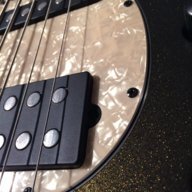
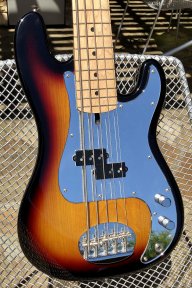
I see you have a P-looking bass in your avatar pic. When I was buying my 2nd bass, after I’d identified that the sound I really wanted was the P sound, I tried some Ps and was really, really impressed with the American Standard, but at that point in my bassmanship (novice), I felt I just couldn’t justify spending well over a thousand dollars on a bass. So, I bought an MIM Standard, upgraded the electronics (this was a while ago, when the stock electronics weren’t very good), shielded the cavity, put in a new alnico pickup (instead of the stock ceramic) and had a setup done. At that point it sounded great and played well, but to some extent it felt like lipstick on a pig — sounded just how I wanted, played fine, but inherently it would always be an MIM with its many glued together pieces of poplar body, a rough looking piece of rosewood for the fretboard, the white pickguard I’ve never changed, etc. Boring black urethane paint job, slightly heavy. I always did like the neck though (important!).

Okay, so years later, after always being bothered a little by not having just gotten that American Standard I’d fallen in love with at the store back when I bought my MIM, I went ahead and bought a very nice American Standard much like I’d long wanted. Funny thing is, after having the MIM tweaked just how I liked it and using it to make music for 15 years, I was surprised to find that...I clearly like my MIM better! I’m just comfortable with it now, I’d always liked the neck (that’s why I bought this particular one), plus the electronics are all good and the pickup sounds like my dream sound...

What’s the point? I don’t know, lol. I’m not saying not to buy a nicer bass. Nicer basses are nicer, generally. For me, if they’re too expensive though, I get less comfortable with them, at least until it’s been so long that the money spent eventually becomes forgotten (takes years). But if you see something you need or fancy, get it if you can swing it. Try it out, see how it goes. Some of my fancier gear are my favorites. But also, some of my cheaper gear are favorites (and same goes for medium-priced gear, too).

For me, I absolutely did have to upgrade to pretty nice gear at one point to see what I was missing and what really suited me best. Now though, I know who I am as a player and what suits me, so I’m often more willing to spend in the mid or lower mid-priced range if something strikes me as fitting a need. But not always. Sometimes I want something a little nicer. But it’s all the same notes, basically. Still, you do want something you dig, not something uninspiring (let alone something you loathe). Higher priced stuff can be the answer, but not always. For one, an expensive piece of gear that you hate is hated doublely! But a cheap piece of crap is a cheap piece of crap. And so on. Anyway, good luck on your gear quest :bassist:
 
Last edited:
  • Like
Reactions: alanloomis1980
I think part of the equation that should not be ignored is that even the lowest bargain basement end of the market is far better quality than most starter instruments were back when I was starting. For bass guitars, at least, you would have to have pretty bad purchasing luck these days to get a bass actually bad enough to hold back your development as a bassist. (Not quite as true for some other instrument types, e.g., classical woodwinds.)
 
The main question is whether there's something inherently wrong/suboptimal with your current bass. My first bass was a very inexpensive MIJ lawsuit version back in the 70s. It sounded and looked good, but it was a beast to play. It was very heavy, had a tremendous amount of neck dive and a very sticky gloss finish on the back if the neck. All of these factors limited my playing - my left hand was kind of literally stuck in place, holding up the heavy neck. Because I was a novice bass player, I didn't know that these were problems - this was just my normal. Then, I got to try a normal P bass and it was almost magical - my left hand could move at last. Again, this was just a normal P bass with a normal weight, balance and finish, but compared to what I had been playing, it was a big difference.

Anyway, there are perfectly good basses out there that are not all that expensive, there are ones that are very expensive and there are all points in between. I think a lot of us here on TB use the angle of playing better and getting inspired to justify our GAS, but it's most likely just GAS. The only exception might be if you're having change the type of bass you're playing. For example, when I went from a 4 string to a 5 string, it was because I needed the lower range because I got tired of down and drop tuning to accommodate a few different singers. That was more functional. Similarly, learning fretless or upright is kind of a different endeavor. Otherwise, it's probably GAS.
 
  • Like
Reactions: dmt
There are stories online about people that had the pleasure of trying out Brian May's "Red Special" guitar - the one that he used for most of his career, and the he and his dad put together when he was a teen. By all accounts, it's an almost unplayable guitar, at least when compared to a regular production electric guitar. Yet, Brian seems to have been quite capable of coaxing good music out of it. Hendrix managed to play rather decently on a guitar designed for a right hander, and it was a 60's Fender - while they're worth a lot as collector's items, today's MIM's are built better, and far more consistent.

The differences between a MIM Fender and MIA Fender are not going to turn a hack into a virtuoso.

+1, was just thinking how many greats start out with minimal and/or poor quality gear and make it work for them.
 
This is a fun thread! Like I said, i have theories and many are being confirmed by what y'all are saying. I avoided specifics on purpose because i wanted to start a broad discussion on how gear affects musicianship.

It could even have the opposite effect when you start hunting for "the one" instead of working on improving. You'll spend money you don't need to spend and waste time and focus on what isn't important.
This one rings true for me. I know focused, organized practice time is the way to grow- not spending all my time on TB or chasing gear!

Depending on what you're starting with, sometimes a better neck can result in better playing.
but it is all in the neck.....
What exactly are you trying to "fix?" What do you mean by "performance" upgrade? .
A nicer bass might make you feel better, but play better?
An argument can be made for a good neck compared to a a bad neck, of course, but I've played basses with bad necks quite a few times when shopping and I still managed to make them sound good.
In my particular case, neck is what I'm looking at. Learning how to level and finish frets has gone a long way already.

Regardless of cost , where it’s made, Name on headstock , it comes down to what works best for you.
The bass that feels the best in your hands is the bass that will improve your playing and inspire you to play more .
This leads me to believe it is subjective...

Amplification, the business end of the cord, is a different problem, at least for me.
Yes! I believe for me an amp is a more tangible upgrade, affecting the groups I can play with and the venues I can play.

So basically you are talking about the difference between a MIM Femder and a MIA Fender?
Just my opinion, but I wouldn't throw money at a bass just because of what you read on TB.
Squier vs MIM, but basically yes. I avoided the cliche "F v. S" because I think it applies to all brands. But in all those threads, players talk about "better" components, but my whole point here is does that make you a better player?

Any increased incentive due to getting a new toy -- err, instrument -- will be short-lived
Face it, the bass is not the problem
I believe this to be true!