• TalkBass has been independent since 1998. Add your voice.
    Create a free account to reply to discussions, view embedded media, and browse with fewer display ads.
    Join freeLog in
    Want zero display ads or expanded classifieds tools? Compare plans.

When is a guitar vintage? And when does the value increase?

I'm not sure I can explain it either. It holds true for Fender, Gibson and Martin. Because of the poor quality, that was what gave myself and my colleagues (Suhr, Anderson, Spector, Tobias, Taylor etc.) the opportunity to establish ourselves.

R

I'm going to pick a nit here. I think there are better examples of acoustic guitars who filled the hole of building AG's "Like Martin used to." and established themselves thereof, eg. Froggy Bottom, Santa Cruz, Collings etc. Martin was already coming back and I think where Taylor succeeded was in re-imagining the whole AG building process and providing something somewhat like boutique quality at factory built prices. Like Apple, Taylor has been able to tell the consumer what they can have in an acoustic guitar and then convince them that they want it. A bolt on neck, top to bottom throughout the line. How do you sell that to AG snobs? Somehow they did.

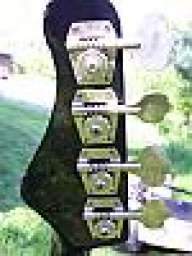
On to the topic. The vintage craze has created some real oddities. People are paying $1000 or more for big headstock, 3 bolt CBS fenders. So which is it? Were they so bad they almost killed the company or were they not so bad that they're collectable? You're never going to convince me that the passage of 40 years has turned frogs into princes.

mugre
 
On to the topic. The vintage craze has created some real oddities. People are paying $1000 or more for big headstock, 3 bolt CBS fenders. So which is it? Were they so bad they almost killed the company or were they not so bad that they're collectable? You're never going to convince me that the passage of 40 years has turned frogs into princes.

mugre

Could it be that someone looking for say, a vintage Fender, knows they can't afford a 60s model, but figures the next best thing is the 70s? I'm not necessarily supporting this logic, but maybe some folks are under the impression that since P's and J's were largely unchanged over the course of history that the oldest one they can afford is the best. This might explain why the prices of 70s Fenders have gone up so drastically in recent years; because nobody can afford the 50s and 60s resulting in an artificially perceived notion that the 70s basses are all of a sudden in "high demand." Just a thought.
 
On to the topic. The vintage craze has created some real oddities. People are paying $1000 or more for big headstock, 3 bolt CBS fenders. So which is it? Were they so bad they almost killed the company or were they not so bad that they're collectable? You're never going to convince me that the passage of 40 years has turned frogs into princes.

mugre

Nothing has changed, they're still as awful as they used to be. But the thirst for image is such that people will pay a hefty premium for an old Fender (eg. "roadworn" factory guitars). Every 25 year old kid wants to look like he grew up on the Mississippi delta, playing guitar in dives since the age of 6. And since no kid can afford a $12,000 guitar, they go after the oldest guitar they can afford. Regardless of whether it's a piece of crap.
 
I personally don't think any instrument made after 1969, with a few exceptions, will increase in value at anywhere near the rate of those before 1969. The 70's were a horror for US guitar and bass manufacturing. Things started to improve in the mid to late 80's.

Roger

I tend to agree.
The 70s fenders (ok most all post CBS ) were a not great. By the late 70s Fender had massive heads, exceedingly heavy, anemic sounding, and horrible quality control. The fact that there are now 70s re-issues is to me completely mind boggling. Why celebrate an era of failure?

Gibson, mid 70s to late 80s. largely middle of the road gear, focusing again on heavier is better.

The failure of Gibson and Fender in the 70s along with their constantly increasing prices and lack of QC and innovation gave us the invasion of the Japanese brands.

And the Japanese offerings, Tokai, Fernandes and Ibanez were overall far superior and far less expensive than the comparable American offerings.

IMO, it really wasn't until BC Rich, Charvel And Jackson started taking off (early 80s) and putting out 1st quality volume guitars that Fender and Gibson got back to focusing on again putting out quality products.
 
Could it be that someone looking for say, a vintage Fender, knows they can't afford a 60s model, but figures the next best thing is the 70s? I'm not necessarily supporting this logic, but maybe some folks are under the impression that since P's and J's were largely unchanged over the course of history that the oldest one they can afford is the best. This might explain why the prices of 70s Fenders have gone up so drastically in recent years; because nobody can afford the 50s and 60s resulting in an artificially perceived notion that the 70s basses are all of a sudden in "high demand." Just a thought.

IMO. just about any 70s Fender would be a lousy choice. That same person would get a far better instrument buying a current Fender offering, or a current re-issue.

I think those people lusting after 70s fenders, did not have dealings with them the first time around..
 
...And what gave us the "invasion" of the Chinese brands?

I would say:
Higher standard of living in Japan, leading to higher overhead both in terms of cost of real estate as well as considerably higher wages. Has put a lot of pressure to locate factories in cheaper areas, China, Korea, Indonesia, etc.

Along with the relatively low cost of computer controlled manufacturing. Put a block of wood on the tray, push a button and out pops a perfectly measured, cut, routed, shaped neck or body.

The Squires of today along with the many of low cost Asian made instruments, in my mind are on par or largely superior to the Fenders and Gibsons of the 70s. And many available at a $300+/- price point.

I think it really along the same lines as cars, In the early 70s we laughed at Honda, Toyota and Datsun.
By 1980, nobody was laughing at them anymore.
In the late 80s-90s, Honda, Toyota and Nissan largely owned the US market. So, we had to resort to lauging at the Koreans, Hyundai, Kia, Daewoo.

Now we have just scrapped the whole idea of laughing at any of the Asian made cars and just laugh at GM, Ford and Chrysler.
 
I myself, having come up in the 1970's cannot imagine why anyone would be willing to pay top dollar for late 70's fender basses. Those basses created the demand for pre CBS instruments. Todays Fenders are far better instruments than those made in the 70's, and in many cases, are better than many 60's and Pre CBS models (I am refering to the US standard models and above, not Hwy 1, etc).
The only thing I could see someone would want from the 70's would be the cosmetics, such as a pearl inlayed Jazz with neck binding.
To paraphrase George Gruhn: All vintage guitars are used guitars, but not all used guitars are vintage guitars. To be a "vintage" guitar, there must have been some change in materials, design, or quality of construction, that makes a used instrument as valuable, or more valuable, than a new one.
 
IMO. just about any 70s Fender would be a lousy choice. That same person would get a far better instrument buying a current Fender offering, or a current re-issue.

I think those people lusting after 70s fenders, did not have dealings with them the first time around..

No fan of 70's Fenders, I. In fact, I generally agree with what you're saying. But I've owned three 70's Precision basses (a '71 and two '72's) that were as good as any pre-CBS bass I've played. I'd say '72 is the cutoff date.
 
To paraphrase George Gruhn: All vintage guitars are used guitars, but not all used guitars are vintage guitars. To be a "vintage" guitar, there must have been some change in materials, design, or quality of construction, that makes a used instrument as valuable, or more valuable, than a new one.

Gruhn is wrong. Vintage has everything to do with time passed, and nothing to do with anything else. Gruhn is attempting to redefine the definition of the word "vintage", likely for his own benefit. Thankfully, his opponent here is the English Language, and Gruhn loses.
 
No fan of 70's Fenders, I. In fact, I generally agree with what you're saying. But I've owned three 70's Precision basses (a '71 and two '72's) that were as good as any pre-CBS bass I've played. I'd say '72 is the cutoff date.

I had plenty of 70s fenders as well. and the issue with all of them is that you could put 10 of the same model and year, with sequential serial numbers and have no consistency.

Unless you could take the neck from one, the body from another, the pick ups from a third and slap it all together and of those 10 have one decent bass... And from 100 oyu'd maybe get 1 really good bass and from 200 have 1 excellent bass.

That was the problem
 
I had plenty of 70s fenders as well. and the issue with all of them is that you could put 10 of the same model and year, with sequential serial numbers and have no consistency.

Unless you could take the neck from one, the body from another, the pick ups from a third and slap it all together and of those 10 have one decent bass... And from 100 oyu'd maybe get 1 really good bass and from 200 have 1 excellent bass.

That was the problem

Again, I agree (though I don't think that Fender was THAT bad that they only had 1 in 200 excellent basses). However, I don't think I've seen a '71 or '72 instrument that I thought was terrible. Not so with the years that followed.

On second thought, it could be that there was only 1 excellent instrument in every 200 Fenders made in the '70's.
 
We live in an age when a modern-day $75 guitar can be made respectable or better with modding,....why can't a 70's guitar?

The '70's quality' issue isn't valid anymore. Any guitar of reasonable condition from that time can be rescued with the available knowledge and resources available today. And I love how some criticize Fender in the 70's but fully accept what they turn out today with all the ultra-hyped 'signature', 'special edition', 50's - 60's - 70's specials and reissues' with most of their product line trying to recapture the 'vibe' of older, vintage guitars (including the ridiculous 'road worn' and 'pawn shop' series), and what?....6 quality levels of Telecasters and Strats now? Anyone see the 'greed'?

Some even swearing that the Squier's are better than the standard Fenders....And you're putting down the CBS era Fender company?

I personally have a '76 Telecaster that I wouldn't trade for a new one. I do have new pickups on it and have learned how to properly set-up a guitar (which I didn't know back then). So what if it's 10% heavier and has a thick 'coating'? I get great tone and sustain out of it. And the 40 year old neck wood is not going to warp or change in any way, except get better with age. It ain't going anywhere while I'm alive.

And a 70's guitar will always have the allure and mystique that escape the modern-day mega-mass produced, likely made-in China equivalents (especially to those who grew up in the USA during that era).

You can have a 2011 Ford Mustang that would outclass any other older Mustang.

But I'd, and millions of others would take a 1964 Mustang in great condition over a 2011. There are many variables that go into what's makes something valuable. Go figure.
 
interesting how everyone is focused on the Fender when speaking of vintage instruments. Shows the narrow thought that has caused these fenders to go through the roof.


Fender pretty much owned the market for basses during the '60s so those basses are the obvious choice for discussions regarding the value of "vintage" basses imo. There were a number of companies making basses back then of course but I'd wager few have kept up with the old Fenders in desirability/market value.
 
interesting how everyone is focused on the Fender when speaking of vintage instruments. Shows the narrow thought that has caused these fenders to go through the roof.

Well, it's a bass player's forum, and there really wasn't anything that approached the all around quality of Fender basses until the very late 70's. Which happens to be close to the cutoff point of what makes a guitar "vintage".

Guitars are something else entirely.
 
Vintage is 25 years; things appreciate in value when demand is greater than the supply.

A good example of non-vintage basses going way up in price was Rickenbacker limited edition 4003 Tuxedo, Red Star, CS & Black Star basses. Not considered vintage, but command hefty price tags.

If vintage is 25 years old, then they will be vintage in 2012. Almost there! But I agree, it's the desirability of the limited editions that makes them more valuable to collectors.
 
Sadowsky said:
I personally don't think any instrument made after 1969, with a few exceptions, will increase in value at anywhere near the rate of those before 1969. The 70's were a horror for US guitar and bass manufacturing. Things started to improve in the mid to late 80's.

Roger

So my 1988 Sadowsky is not vintage! Some nerve! :-)