"Tone is in the fingers" carries some truth, but it is irrevelavant to this thread. So are exact settings on someone else's gear.
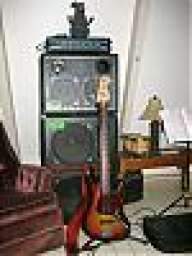
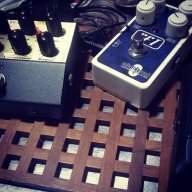
The OP is overwhelmed by too many choices of knobs, switches and buttons on his bass and amp.
A lot of useful advice has been given, however. I agree with the approach of EQing the room with your amp, then tweaking for your sound on different songs with the bass's electronics.
Of course, sometimes one preset or tone knob will get in between the spots that others won't - eg, you have a 125 Hz slider on your amp, and a 100 on your bass preamp. Maybe one has a wider curve, etc.
I think "flat" is an excellent place to start, simply to learn the effect each control has on the overall sound. Remember too, that your equipment has its limits. It kills me when people run a 50 watt amp with an 8" speaker and crank the lows, expecting it to shake the room. All it does is distorts.
I'm not sure I consider "Tone is in the fingers" irrelevant in the context of this thread, but I get your drift; it's a statement that - while true - may not be particularly helpful to the OP.
I learned to play upright bass and PBass in an era in which bassists had far fewer choices than they do today; equipment was simpler, and bass playing styles and tonal variety were far more limited. As a consequence, we paid attention to technique; as equipment improved and new playing styles emerged, most of us were ready because we'd become well-grounded in the basics.
In contrast, today's beginning bassist is assaulted with myriad choices in music styles, equipment, and bass playing styles. Tweaking gear seems to have becomes the norm, and electronic solutions are sought as common expedients. I've taught several young bassists who possess pedals galore, and own basses and amps that would have made pros envious 40 years ago - these are kids who don't know the names of the notes played on open strings, and couldn't find a major scale if you gave them a flashlight and a road map: times have changed!
Eventually, most of us finally came to understand the importance of mastering the previous before leaping to the subsequent; a lesson that is often reduced to expressions like "Tone is in the fingers."
Do I take advantage of the tone shaping capabilities of the active pre-amp installed in my modern 5-string electric bass, and exploit the abilities of my stage rig to achieve the best possible sound? Of course I do. But my quest, like Bob C and several others who have already posted, began with the ability to produce "my sound" using only my bass and simple gear; now I have the luxury of changing the settings on my amp to accommodate the venue, and changing the settings on my bass to suit the song being played, but my tone comes from my intention and skills; the gear just makes it possible for my band mates and the audience to hear me clearly.
My advice isn't likely to result in immediate gratification, but for those interested in understanding what "Tone is in the fingers" truly means, learn to play an acoustic bass, and do all of your electric wood shedding with the settings flat; learning to coax every musical morsel from your instrument using only your hands and rudimentary equipment can provide an extraordinary growth experience for those more interested in serving the song and becoming proficient musicians than being distracted by the minutiae of gear selection and equipment settings.
I, too, think "'
flat' is an excellent place to start..." Not to "...
learn the effect each control has on the overall sound," but, to learn the effect of one's mind, body, and spirit on the shared miracle we call music. The gear, while important, is really a secondary issue.
Of course, YMMV...