• TalkBass has been independent since 1998. Add your voice.
    Create a free account to reply to discussions, view embedded media, and browse with fewer display ads.
    Join freeLog in
    Want zero display ads or expanded classifieds tools? Compare plans.

Which DI for a between head and cab signal?

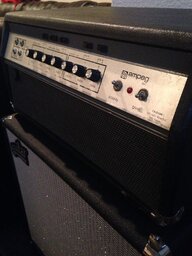
I am interested in a DI that will go between the head and the cab. Which ones do this? I want the pre from my SVT going through to the FOH. I use a passive bass (P-Bass) 100% of the time.

I am also thinking about a mic for the rig, but this DI option of using the SVT pre seems far better than just a bass into a box into the SE hands!

So...Radial JDI? (Passive or Active?), Countryman? Do these do this? I am a newbie to the DI box scene.

HELP!
 
pardon, but a DI that goes between the head and cab..speaker simulation -

those listed are not for that application..correct? The countryman, JDI and Avalon are wonderful DI's but they are not designed to replace a speaker load.
just trying to get clear on the OP's request.
 
Well, here's the thing. They are designed to take the speaker-level output and pad it down to line level. They are not designed to load the amp (much). So for an all-tube amp you need both one of those DI's and a load box or speaker.
 
I've used the JDI for both active and passive basses, and it worked well - I've also used it between the amp and cab, and it worked well that way, too... Apparantly, the JDI's cab pad switch also rolls off highs and lows a bit, resulting in a very useable signal going to the board...


- georgestrings
 
I just pulled out the manual that came with the JDI. It doesn't say anything about using it between head and cab, but rather to take a parallel line from the speaker into the DI box, ie: head ->cab ->DI. The JDX instructions say head ->JDX ->cab.

I have no idea if this makes any difference, as I've never tried using the JDI this way (I should though, it would be interesting...)
A quick email to Radial customer service would likely net you a definitive answer.

Invalid Link Removed
 
I just saw this thread and thought I should make a couple of very important cautions.

1. When using a tube power amp with a speaker level input on a direct box, always be sure that you have a speaker load on the power amp. Running a tube power amp unloaded can damage the output transformer and tubes by causing a condition called flyback (ringing due to essentially an LC tank circuit) and excessive voltages that may break down insulation.

2. Be very careful when connecting any DI up to the output of any amp that operates in any kind of bridged mode. This applies to almost all power amps that use a class D output section, and also to some amps that are internally bridges even if you are unaware. There are ways to handle this but it's very tricky and involves a custom designed solution that can be expensive. My suggestion is to avoid connecting a DI up to the output of any power amp, too many unknowns and the end result could be the destruction of the mixer connected to the DI, because large fault currents can flow through the signal grounding path and vaporize pc board traces that manage the grounding scheme inside the console.

3. The fault currents mentioned above can also destroy the power amp, since it's not a path that the designers account for typically.
 
There is a TON of bad scoop (BS) in this thread. A JDI or U5 will not work in this application. The JDX takes the signal from the amp and sends it both to the cabinet and the board. As others have said, you MUST have a speaker cabinet connected if the head is all-tube. The other two mentioned will take a speaker-level signal and process it properly to be sent to the board, but do not send a signal on to a speaker cabinet. Also, as others have said, they will not provide a proper load for a head with a tube power amp. They're good for hybrid or solid state amps only when taking their input from the amp's speaker output. So the JDX is indeed what you require.
 
my understanding of these non-speaker-loading boxes (suhr has a [Invalid or Expired Link Removed] with a level control), is that they don't so much "pad" the speaker signal as tap off a tiny portion of it, by presenting a really high resistance in parallel with the speakers, so that just about all of the power goes to the speakers like it should, and a tiny portion gets into the box.
 
my understanding of these non-speaker-loading boxes (suhr has a [Invalid or Expired Link Removed] with a level control), is that they don't so much "pad" the speaker signal as tap off a tiny portion of it, by presenting a really high resistance in parallel with the speakers, so that just about all of the power goes to the speakers like it should, and a tiny portion gets into the box.

Correct.

BUT, for some solid state amps, if the output is not referenced to ground on the minus terminal (either the sleeve of a 1/4" connector or 1- on the Speak-On) then 1/2 of the amp will see a short to ground. There are two possible issues that will then present itself to the unfortunate user... they are a blown amp due to the fault current or runaway oscillation from a short to a ground that may not be very solid and the amp's output stage might become unstable and really mess the amp up, or the fault current travels up the snake pair's drain wire and through the mixer's grounding system until it returns to common ground. The problem here is that the mixer's internal ground path is not designed for such fault currents and the damage could be some pretty serious destruction on the mixer. Some (real) pro mixers use a really substantial ground bus and either the drain wire will open or the amp will shut down due to the fault. It's unlikely that many folks here will be using such mixers, they are not all that common.