Enjoy the benefits of a premium membership!
Upgrade Account
-
TalkBass has been independent since 1998. Add your voice.
Create a free account to reply to discussions, view embedded media, and browse with fewer display ads.
Join free Log in
Want zero display ads or expanded classifieds tools? Compare plans.
You are using an out of date browser. It may not display this or other websites correctly.
You should upgrade or use an alternative browser.
You should upgrade or use an alternative browser.
Which is the P? Which is the J?
- Thread starter Coelho
- Start date
More options
Who Replied?
I'm also in the "First is the Precision, Second is the Jazz" club, but everyone who's said that it's *very* close is absolutely right which is more surprising in my case that a Jazz bass can get so close to a good quality P-bass tone - not being a P-bass guy at all, it's (hopefully) good to know that I can always get a close imitation if needed. 



This is a good game, isn't it?
both basses were recorded in exactly the same way, going flat, same levels, everything else the same. For the Jazz bass I soloed the neck pickup.
The strings on both are the same - Rotosound 66.
Both have Rosewood boards.
So, I tried to make "everything else" as equal as possible. It is interesting that although there is a difference, this difference is not as huge as people sell, specially in a musical contest.
That's a really cool test. I totally agree in what you've said, that the sound is very close. Just to confirm something, you rolled the tone off on both basses, right? I find when I roll the tone off on a P, it tends to disguise some of the more distinguishable characteristics of the P tone, mainly that upper mid honk.
Nice playing, by the way.

Full tone and volume on both basses.
The P is an Alleva-Copollo KBP4.
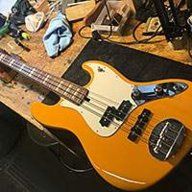
The J is a Pensa J, running passive.
Both basses are considered to be good examples of P and J... The Alleva is usually said to "nail the 60's P sound".
Well, it seems that the Jazz Bass can almost nail it too?
The P is an Alleva-Copollo KBP4.
The J is a Pensa J, running passive.
Both basses are considered to be good examples of P and J... The Alleva is usually said to "nail the 60's P sound".
Well, it seems that the Jazz Bass can almost nail it too?

I have never played my J bass with the neck p/up soloed for any amount of time and I have never owned a P bass but I'm thinking 1= J bass 2=P bass
I assume your point is that they sound an awful lot alike???
I have both J and P basses; my guess is that 1 is the Jazz, 2 is the Precision. But I could easily be wrong. Great tone on both.
Roger
I have both J and P basses; my guess is that 1 is the Jazz, 2 is the Precision. But I could easily be wrong. Great tone on both.
Roger



1 - P
2 - J
Sometimes I am amazed at how much a J can sound like a P. As a P bass lover it baffles me.
2 - J
Sometimes I am amazed at how much a J can sound like a P. As a P bass lover it baffles me.