Thanks for validating my side of the argument. Those coils are the same size, just like the Bill Lawrence solution posted earlier.

TalkBass has been independent since 1998. Add your voice.
Create a free account to reply to discussions, view embedded media, and browse with fewer display ads.
Join free Log in
Want zero display ads or expanded classifieds tools? Compare plans.
Tone deaf.How do you pronounce karaoke?

Thanks for validating my side of the argument. Those coils are the same size, just like the Bill Lawrence solution posted earlier.
You did, I commented repeatedly that for the pickups to hum-buck perfectly that the coils need to be matched. You posted a photo of your instrument with two equal-sized halves, so the coils in each are the same size.
Thanks!
Not really wanting to argue, but I have to disagree with people when they post false statements.

They cancel the hum well enough that you can't hear it. Put some high gain on it & listen again.
The size of the coil & the amount of windings directly affects how much noise is induced by EMI.
If you're shielding the instruments well it shouldn't matter that much, anyway.
There are plenty of asymmetric split-coil pickups in the marketplace that perform superbly. Every split-coil 5-string J pickup and many 5-string split-coil soap bar pickups are asymmetric, and the ones made by quality manufacturers are engineered to deliver great tone. They work, and they work very well. If you played a few 5-string basses with these pickups, you would know, and you would drop your silly pedantic argument. All pickups are a compromise of many things. Yes, even split-coils with same size coils and the same number of windings, even humbuckers, even single coils, even piezos — they all compromise something.You did, I commented repeatedly that for the pickups to hum-buck perfectly that the coils need to be matched. You posted a photo of your instrument with two equal-sized halves, so the coils in each are the same size.
Thanks!
Not really wanting to argue, but I have to disagree with people when they post false statements.
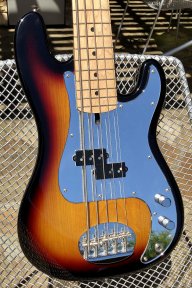
TL;DRreading:
Electromagnetic induction - Wikipedia
how EMI induces noise into a coil
Link Removed
how the Inductance of a coil is measured
directly related to how much noise is generated in the coil by EMI
View attachment 3385617
The number of turns in a coil helps determine how much Inductance it has, but so does the size of the coil.
In a typical 4-string set of p-style split-coil pickups both coils are the same size using the same diameter of wire & the same amount of turns.
In that way the noise is cancelled as perfectly as possible, the coils are physically & electrically matching, but just doppelgangers of one another.
Let's say I'm a new engineer & I'm putting together a 5-string split-coil pickup set.
Before I do any design work, I'm just going to wire up two dissimilar-shaped coils & see what happens.
coil B = 5 cm x 3 cm
coil G = 3 cm x 3 cm
These both have the same amount of turns on the coil & G has two poles while B has 3 poles. The diameter of wire in both coils is the same.
The balance of output between strings is fine, but the noise cancellation is unbalanced, because the larger coil has more noise induced than the smaller coil.
Just to put numbers behind it, let's say B has 16 milliVolts of noise, based on the circumference of 16 cm. Coil G would have a relatively smaller amount of noise induced at only 12 milliVolts.
That leaves 4 milliVolts of noise left over that should be designed out.
The simplest solution is to manipulate the number of turns in one of the coils to make the inductance match that of the other coil.
Here comes the kicker. If you change the number of turns, you in turn change the level of output & the resonant peak of the coil.
Changing the resonant peak means you're changing the timbre of it.
To keep the output the same, the diameter of wire in the coil needs to be changed. Let's say we're going to use larger diameter wire on coil B & less turns.
With the right diameter of wire & the correct amount of turns we can match the output & noise level in both coils, but at the risk of changing the timbre of one coil.
Here comes the compromise. Does the engineer just say to Hell with the timbre & go for perfect noise cancellation or does he or she split the difference by changing the resonant peak a little & leave 2 milliVolts of noise?
If you can live with these compromises, then bully for you.
I'm too OCD & I play with the gain up too high to tolerate unbalanced hum-buckers.


Hey, boss! Buster just got back from the doctor and sounds appropriately burly.There were a ton of single soapbar basses from the late 80's to late 90's that would be a fun mod candidate for an EMG or Bart split coil.
There are enough examples of 2xJ, dual coil, MM, etc that really capture what sold back then.
70's-mid 80's there were enough 2xPs for me to try in the used section that I really like a P bridge for grunt and a J middle for clarity.
Worst comes to worst you get a Warmoth body cut for whatever works best for you and just screw it together yourself.
Hey, boss! Buster just got back from the doctor and sounds appropriately burly.
I keep daydreaming about going the Warmoth route here somewhere down the line, but I think your first option is the more likely one for me.