

Enjoy the benefits of a premium membership!
Upgrade Account
-
TalkBass has been independent since 1998. Add your voice.
Create a free account to reply to discussions, view embedded media, and browse with fewer display ads.
Join free Log in
Want zero display ads or expanded classifieds tools? Compare plans.
You are using an out of date browser. It may not display this or other websites correctly.
You should upgrade or use an alternative browser.
You should upgrade or use an alternative browser.
Why are lined Fretless even a thing?
- Thread starter citizenchris099
- Start date
More options
Who Replied?


The lines are just useful for checking now and again, and when you make large leaps of unusual intervals, especially from down low to up above the octave. i have a 90's thumb fretless with lines up to #26, and I really like having those lines up there if I'm doing some crazy Mingus interval that uses all of the fingerboard ('Jump Monk' comes to mind), so I have a good landing zone; then I don't need to look for a while at least.
I started playing fretless on an unlined Warwick Fortress MM 5-string (what a beast - recently traded for a great old G&L SB-2). It had the 3rd 5th 7th etc. side dots only - right on the money, mind you, where the fret would have been, and I got decent on it after the fretless mind-shift kicked in, where you realize you have to effing KNOW the note you are about to play... not to digress, then I realized 5-string was just not generally for me, so I got a new '97 fretless NT Thumb 4 (still have it)... think I bought it from Beaver Felton aka Bass Central. anyway the word was Dana B. Goods had brought in too many lined ones so I got $500 off vs unlined. Plus he told me the ovankol body on this one was exceptionally nice (true).
So Okay, I was playing regularly then so I made the switch... biggest issue right off was not with the lines (which I couldn't see when standing and playing anyway), but the side dots which were now not 'right on the money', but in the middle of (e.g.) 'fret 6' and 'fret 7', as on a fretted instrument. Was very confusing to my new fretless mindset. I actually taped some little bright yellow triangles on the side of the thumb for a while, again right at 3, 5, 7, etc.
I'll admit that back when I 1st got the unlined Fortress, I rather liked the idea of how intimidating it looked. scary even, especially to guitarists who might have the idea of stepping down to fool with your 'simpler' instrument. I even had black LaBella tapewounds on that ebony fingerboard... "wanna try it out, dude?" "Wow, like that's too much.. ah where's the bar, please show me to the bar..?" Yah.
On the other hand, when I jam I know just enough guitar and piano to be able to get clues from what those players are manually doing. I can't see the lines on my bass whilst performing, but the other musicians can, and it can be useful for them to be able to see you are playing B on the E string and not C.
I started playing fretless on an unlined Warwick Fortress MM 5-string (what a beast - recently traded for a great old G&L SB-2). It had the 3rd 5th 7th etc. side dots only - right on the money, mind you, where the fret would have been, and I got decent on it after the fretless mind-shift kicked in, where you realize you have to effing KNOW the note you are about to play... not to digress, then I realized 5-string was just not generally for me, so I got a new '97 fretless NT Thumb 4 (still have it)... think I bought it from Beaver Felton aka Bass Central. anyway the word was Dana B. Goods had brought in too many lined ones so I got $500 off vs unlined. Plus he told me the ovankol body on this one was exceptionally nice (true).
So Okay, I was playing regularly then so I made the switch... biggest issue right off was not with the lines (which I couldn't see when standing and playing anyway), but the side dots which were now not 'right on the money', but in the middle of (e.g.) 'fret 6' and 'fret 7', as on a fretted instrument. Was very confusing to my new fretless mindset. I actually taped some little bright yellow triangles on the side of the thumb for a while, again right at 3, 5, 7, etc.
I'll admit that back when I 1st got the unlined Fortress, I rather liked the idea of how intimidating it looked. scary even, especially to guitarists who might have the idea of stepping down to fool with your 'simpler' instrument. I even had black LaBella tapewounds on that ebony fingerboard... "wanna try it out, dude?" "Wow, like that's too much.. ah where's the bar, please show me to the bar..?" Yah.
On the other hand, when I jam I know just enough guitar and piano to be able to get clues from what those players are manually doing. I can't see the lines on my bass whilst performing, but the other musicians can, and it can be useful for them to be able to see you are playing B on the E string and not C.
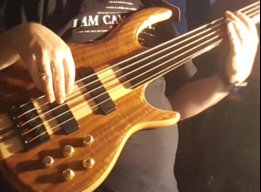
I play mostly upright, but also fretless electric. My upright has no lines, my electric basses do. Some reasons:
1. I de-fretted both of my basses myself, so I had to fill the slots with something. I used "mahogany" colored Plastic Wood. In one case it has held up great for 30+ years. The contrast between the fret lines and the rosewood fingerboards (or mystery wood, whatever) is subtle, but I can see it well enough on stage when I need to.
2. Obviously I can't play while paying full attention to the fret lines, because there is so much else going on. Reading, interacting with the band, looking out into the audience, checking to see who's coming in the front door, etc. But once in a while there's a note in the middle of the board that I just have to grab, so a quick visual reference when I need it is helpful.
3. The upright bass has a host of tactile references: The curves of the neck, touching your arm against the bout, etc. In contrast, an electric bass neck is almost 2 octaves of no mans land. Sometimes I need the help.
The first thing is serving the music, the band, and the audience, not my own vanity. It would be crazy for me to claim to have impeccable intonation on either upright or electric. And in any event, recording myself would quickly settle that matter.
Very late in his life, Ray Brown told a reporter that he still worked on his intonation, every day.
Thank you sir! Very well said - you explained far better what I was trying to point out about upright bass when playing without looking, and the unique-ness of the lack of tactile reference points on the fretless electric bass guitar.

- Dec 21, 2007
- 15,222
- 45,014
- Disclosures
- Lark in the Morning Instructional Videos; Audix Microphones
I kind of hate to summarize this way, but from this and various threads it seems:
Reasons people like or have basses with fretlines:
1. They're available
2. They help the player to play better, especially complex and fast passages
Reasons people prefer unlined basses
1. They look cooler
2. They help the player feel superior to people who play with lines
I have read a few people state that lines confuse them, and that they play better without having the lines. That to me seems like a pretty solid reason.
But IMO at the end of day, play what you like, like what you play, and what another person plays and likes ain't nobody's business but their own.
Reasons people like or have basses with fretlines:
1. They're available
2. They help the player to play better, especially complex and fast passages
Reasons people prefer unlined basses
1. They look cooler
2. They help the player feel superior to people who play with lines
I have read a few people state that lines confuse them, and that they play better without having the lines. That to me seems like a pretty solid reason.
But IMO at the end of day, play what you like, like what you play, and what another person plays and likes ain't nobody's business but their own.


Just a side note. out of all the repetitious fender J and P models. I wish theyd offer both lined and blank boards



The first fretless el bass, I'm guessing, would've been the Ampeg Scroll mid 60's basses. ... Fender didn't make a fretless P-bass till about 1970?, I'm guessing, and they weren't lined and not very popular. Though I do remember Peter Frampton's bass player using one. ... Then in about, 77 when Jaco exploded, that started the lined fretless boards, because Jaco ripped out the frets on his. ... So, blame Jaco, if you're needing a scape-goat.
Aye, but so is this:View attachment 3859047 Because it looks killer
And after just a few hours of knocking around on it, I think the who terror of unlined fingerboards is a bit overblown. I mean I'm a guitar player who dabbles on bass. And while I wouldn't play out just yet, I might actually pull it out at a jam session. (Even though it would probably be educational about just how honest my ear is)

drumvsbass
Commercial User
- Aug 20, 2011
- 1,980
- 4,323
- Disclosures
- I work for Long and McQuade Musical Instruments Canada in Sales.
and yet...Well done, good sir! End of thread, who wants to go grab lunch?
This nails it for me.To help noobies like me learn how to intonate properly. Why you hating on the lines bro?
And the fretless I used to have had its frets ripped out by the previous owner with pliers. It wasnt pretty.


Cause I run all over the place while on stage, headbang, do vocals and play synth, and the lighting is bad. Fretlines are nice to have to look at and make sure that you're where you think you are.
I do wonder if most of the people who say that fretlines are bad/cheating/lazy sit motionless on a well lit stage 90% of the time.
I do wonder if most of the people who say that fretlines are bad/cheating/lazy sit motionless on a well lit stage 90% of the time.

Bryan R. Tyler
TalkBass: Usurping My Practice Time Since 2002
Staff member
Administrator
Gold Supporting Member
Supporting Member
- May 3, 2002
- 28,948
- 20,932
- Disclosures
- Reviewer: Bass Player Magazine
Using your ears only tells you whether you‘ve played in tune or not after it’s too late…
Plus lines become increasingly more valuable the more strings you add and the higher up the neck you go, as parallax makes side dots less and less useful.
I’ve also never had a problem seeing the lines, never had a problem looking away from the lines, and never had a problem being confused by them. I couldn’t play fretted bass if I was confused by them as they’re in the same place.
They are an inanimate visual aid that can help you if you wish to have that extra help. They don’t control or have any negative impact on the player- only the player can be blamed if a fault comes of using lines too much.
Plus lines become increasingly more valuable the more strings you add and the higher up the neck you go, as parallax makes side dots less and less useful.
I’ve also never had a problem seeing the lines, never had a problem looking away from the lines, and never had a problem being confused by them. I couldn’t play fretted bass if I was confused by them as they’re in the same place.
They are an inanimate visual aid that can help you if you wish to have that extra help. They don’t control or have any negative impact on the player- only the player can be blamed if a fault comes of using lines too much.

I need to hear myself. Frets or not. I wouldn't even bother with a session that didn't let me hear myself. That's just silly.
Easier said than done. Believe it or not, sometimes things don't work out on stage or studio the way we envisioned them. Walking out of a session is a good way to make sure you don't get called back. If it's your session, you can do as you please, but as a hired gun, you have to learn to deal with the situations that you're given.


