• TalkBass has been independent since 1998. Add your voice.
    Create a free account to reply to discussions, view embedded media, and browse with fewer display ads.
    Join freeLog in
    Want zero display ads or expanded classifieds tools? Compare plans.

Why are P-basses more expensive than PJ basses?

At almost any level of instrument, it seems like regular P-basses are more expensive, sometime considerably more than PJ basses by the same company, tier-level.

I've just spent a while online, but could not find a single instance where this statement was true.

So my guess is that the thought that P basses are more expensive than PJ basses is uncomfortable because it is not true.
 
  • Like
Reactions: instrumentalist
If you want a new 5 string P bass you'd have to budget $1650. If you are cool with a PJ you have a multitude of choices starting with $200 Harley Bentons, but no Pure P bass until you hit the Fender American Pro price point. There are many P bass-esque instruments, but all seem to have the bridge J pickup.

In my 5 string world you can't even buy a Fender PJ.

I see what OP is talking about, albeit through my rose tinted lenses.
 
If you're seeing this (I havent checked) likely good old supply and demand, in that they CAN be priced higher because consumers will pay extra for a certain "cool" factor. PJs are just "Eh, another bass with both pups." But a P is a P.
 
But, but, but the J pickup is weak, it simply can't match the volume of the P pickup...not even if you keep the P pickup at 3/4 and have the J pickup set on full!

Not if you're using the Geezers Jimmy mentioned, that set has a balanced split coil J to match the P. Certainly if you have a vintage output J (around 7k) it will sound weak with a P (usually around 10k) and that's how many PJ's come. Well matched sets, in regard to output, do exist, or swap out a single coil J for a higher output split coil, it won't sound exactly like a single coil, but it will ballance the outputs better.
 
  • Like
Reactions: JimmyM and jd56hawk
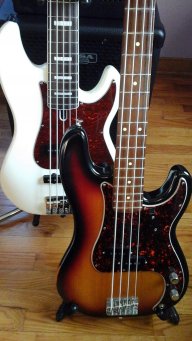
I get my pj fix along with my Block inlay fix with the help of a inexpensive Sire bass. The j pickup adds some definition to the B string. And yes it sounds like a precision bass when I need it to.
20191217_165004-1.jpg
 
usually it depends on what the guitar manufacturer buys in bulk that they feel is the best value for a minimize cost/most value ratio........i dont know for sure, but i can see it very feasible for pickup manufacturers of pickups anywhere in the world offering a basic assembly line PJ set at a cost not too much over just getting a single of either and passing that intended value onto the buyer
 
The [Invalid or Expired Link Removed] will be US$599, and it is a P, not a P/J.

(Or a Keisel PB5 with no upgrades is $1409, but I guess that's not much less than the $1650 you quoted.)

I get what you are saying. The kiesel is the best value if you can cope with the looks.

In my opinion, one bass that is not available and one custom order bass doesn't begin to compare to the amount of pj 5's available from many other manufacturers. I could list them but we'd all get bored.
 
Regardless of the actual evidence or not of this claim, I would say that psychologically, many people are into the "classic", "old school", "original", "vintage", etc thing, so people will actually pay a little more just cuz it looks cooler to them. Also, "more features" doesn't necessarily mean "better bass" to any one particular person or situation.

Here's an analogy that kinda sums up what I'm saying- people will pay $4000 for a Fender custom shop P bass that isn't really functionally any different from their $2000 high end production models. But someone spends extra time making it LOOK old, relic'd, vintage, whatever. I can't imagine why anyone would pay such a premium for the LOOK of an old bass (I'd be especially ashamed that the wear wasn't "earned" over the years, so to speak), but they do. For $4000 there's a lot of other small custom bass luthier type instruments I'd buy instead, but some folks want a damn old looking p bass with the Fender logo on it. lol
 
  • Like
Reactions: Lackey
Here is a question I have pondered over the years. Why are P-basses more expensive than PJ basses? At almost any level of instrument, it seems like regular P-basses are more expensive, sometime considerably more than PJ basses by the same company, tier-level.

What could be the reason for this? You would think that it would be a lot cheaper to build a single pickup P than have to route and supply both a P-pickup and a Jazz pickup. What am I missing here?
Price is determined by the market. It is likely that Ps sell more that PJs, and hence Fender can ask more for them.
 
I have definitely seen this issue.

I've been looking for a very low cost P bass. Beginner's class. ~$200 new or less. Most of what I've found in that price category are dual pickup, PJ configurations. You don't get a single pickup P until you're in the ~$300 range.

PJ may be more versatile, but for a beginner, it is also more confusing, especially if it has multiple knobs.
 
  • Like
Reactions: Basslice
Pricing does not always reflect cost of manufacturing. Often times, the costs and volumes of other items in the same line are included in a weighted margin calculation. It's common to take a slight margin hit on one item and make up for it by making good margins on another.

As long as your cost/volume forecasts are good, it's not a bad way to set pricing tiers and get your customer interested in a product they might not normally be into.
 
  • Like
Reactions: instrumentalist
I stopped at the local big box to buy some screws today. A box of 1 1/4" screws was a dollar more than a box of 1 5/8" screws. Same quantity. I thought the world had gone crazy. Then I thought of this thread I read earlier.

it's a mad world, I tell you. Mad.
Probably quantity by weight, which means more units, and a higher production cost. Seems a steep difference but hardware and lumber are through the roof.