

Enjoy the benefits of a premium membership!
Upgrade Account
-
TalkBass has been independent since 1998. Add your voice.
Create a free account to reply to discussions, view embedded media, and browse with fewer display ads.
Join free Log in
Want zero display ads or expanded classifieds tools? Compare plans.
You are using an out of date browser. It may not display this or other websites correctly.
You should upgrade or use an alternative browser.
You should upgrade or use an alternative browser.
Why are some B strings floppy and some not?
- Thread starter 6stringvince
- Start date
More options
Who Replied?
The B string above doesn't appear to have its witness point set very well. It could be a trick of the photography, but the string does not appear to be straight once it passes the saddle. This can cause intonation issues, IMO. I did the opposite with a bass of mine. The sharp break angle was causing the wraps to separate and making the string sound dead. I drilled a hole in the bridge so I could top load it.


I'm writing this while sitting next to my Carvin LB-20 (nice sturdy & stiff laminated neck-thru bass). It's strung BEAD with the 60-135s from a 5-string set of LaBella Black Nylon Tapewounds. They are top loaded, and IMO, play just fine. But that's just my opinion, and my particular bass. Here is what I know about The Floppies (or think I do, anyway):
- Yes, all other things being equal - and I mean all other things - a heavier gauge string will need more tension when tuned to pitch than a lighter one;
- A string with a higher core diameter/outer winding thickness ratio will behave like a heavier gauge string than one with a lower ratio, even though they are the same nominal gauge. And that ratio can-and does-vary between string brands;
- Yes, a hex core string is generally stiffer then a round core one - all other things being equal;
- Tapewound strings (like my LaBellas) are stiffer than plain strings - again, all other things being equal;
- Yes, if you use a string-thru bridge, the effective overall length (not the scale) of the string will be longer than with a top loaded bridge. Depending on the strings themselves, that may help, or it may not. Maybe I should have tried it on the Carvin. Well, next time..
So, I guess the best string to cure the floppies would be a .130-.140 tapewound, hex-core string, with a thick core and a thin outer winding, on a string-thru bridge. Question is, who makes such an animal?
- Yes, all other things being equal - and I mean all other things - a heavier gauge string will need more tension when tuned to pitch than a lighter one;
- A string with a higher core diameter/outer winding thickness ratio will behave like a heavier gauge string than one with a lower ratio, even though they are the same nominal gauge. And that ratio can-and does-vary between string brands;
- Yes, a hex core string is generally stiffer then a round core one - all other things being equal;
- Tapewound strings (like my LaBellas) are stiffer than plain strings - again, all other things being equal;
- Yes, if you use a string-thru bridge, the effective overall length (not the scale) of the string will be longer than with a top loaded bridge. Depending on the strings themselves, that may help, or it may not. Maybe I should have tried it on the Carvin. Well, next time..
So, I guess the best string to cure the floppies would be a .130-.140 tapewound, hex-core string, with a thick core and a thin outer winding, on a string-thru bridge. Question is, who makes such an animal?

Ric5
Inactive
- Jan 29, 2008
- 29,772
- 30,452
- Disclosures
- I like 5, 8, 10, and 12 string basses
My opinion is that a flatter neck is the best way to get a good B string. Also a lighter gauge strings. The lower action give the B a better feel and the lighter strings give the B more midrange overtones which keeps it from being muddy.
I have 15 5 string basses and none of them have floppy b strings. all of them are 33" or 34" scale and all of them have a .125 or a or a .130 B string. I usually prefer the .125.
I have no 35" scale basses, no string through body basses, no .135 b strings.
I have 15 5 string basses and none of them have floppy b strings. all of them are 33" or 34" scale and all of them have a .125 or a or a .130 B string. I usually prefer the .125.
I have no 35" scale basses, no string through body basses, no .135 b strings.

The B string above doesn't appear to have its witness point set very well. It could be a trick of the photography, but the string does not appear to be straight once it passes the saddle. This can cause intonation issues, IMO. I did the opposite with a bass of mine. The sharp break angle was causing the wraps to separate and making the string sound dead. I drilled a hole in the bridge so I could top load it.
Agreed. The string seems to be taking its time getting around to actually laying flat. It may "feel" a bit tighter, but it's going to wreak havoc on the construction of the string, and it's going to vibrate in all kinds of silly and inappropriate ways. I would say the string pictured is curving too severely over the saddle, and you can actually see the gaps in the windings expand as it goes into the bridge. A tapered-core string would do wonders here.
Unfortunately, the "floppy B" issue involves a lot of very, very boring math. Thankfully, the kind folks over at D'addario have done some number crunching for us, and help explain a few things (this is all c/v'd from here, where you can also find a handy tension chart) :
- String tension is determined by vibrating length, mass, and pitch. The string diameter alone does not determine a string's tension. By using different raw materials (nickelplated steel or phosphor bronze, etc.) or by varying the ratio between the core and the wrap wire, two strings with the same diameter, tuned to the same pitch, could have two different tensions.
- The longer the scale, the higher the tension is for the same string tuned to the same pitch – for example, a standard Fender™ guitar at 25½" scale has more string tension and will feel stiffer than a standard Gibson™ 24¾" scale guitar, even if both are tuned to the same standard pitch. Some players adjust for this by using slightly heavier gauges on shorter scale guitar than on longer scale guitars.
- The flexibility of the instrument top and neck
- The string break-angle at the nut and saddle/bridge
- String height or "action" as adjusted at the saddle.
- Truss rod adjustment (neck relief).
(As an aside, I just slapped on a .175 low F# onto my five-banger, and it sounds/plays fantastic! Even though it's technically below the range of human hearing.)

Between a half-dozen 5 and 6-string basses I gig regularly with a low-B, most 34" scale one 35", they're all great.
Most top-loaded at the bridge, some with humbuckers and some with single-coil pickups. I've no idea what the core of the strings are, some have a tapered B and most do not, and the 35" scale basses do not have any brightness issues on the D and G strings. These are all high-end basses, however a relatively very cheap Ibanez I owned was killer too. Some cheaper basses might have inappropriate pickups or poor construction that makes a difference.
For me it's partly about the strings - find a set and gauge that works for you - and mostly about a proper setup and some time invested in playing appropriately.
Good luck in resolving your issue.
Most top-loaded at the bridge, some with humbuckers and some with single-coil pickups. I've no idea what the core of the strings are, some have a tapered B and most do not, and the 35" scale basses do not have any brightness issues on the D and G strings. These are all high-end basses, however a relatively very cheap Ibanez I owned was killer too. Some cheaper basses might have inappropriate pickups or poor construction that makes a difference.
For me it's partly about the strings - find a set and gauge that works for you - and mostly about a proper setup and some time invested in playing appropriately.
Good luck in resolving your issue.

FWIW
I use GHS Medium Boomers on all my bases and have no issue with the low B.
2 neck thrus and 2 bolt ons.
I also use Pedulla tapered with a .128 low B that feels & sounds good.
Someone on TB listed a procedure for breaking in a new B string.
Maybe he'll chime in.
I use GHS Medium Boomers on all my bases and have no issue with the low B.
2 neck thrus and 2 bolt ons.
I also use Pedulla tapered with a .128 low B that feels & sounds good.
Someone on TB listed a procedure for breaking in a new B string.
Maybe he'll chime in.

Sadowsky makes a set of flats that is very evenly matched in tension across the board, whether in light or medium gauge. Can't speak as to whether their rounds match. I use them on all my basses -- two Lakland fivers with 35" scale, A Lakland Jerry Scheff (34"), a Rick 4001C64 with with 33.25", and an Eastwood Classic 4 with 30". I switched to Sadowskys, which are roughly $90 a set cheaper in five strings that TI Flats, which is what I had used, and I prefer both feel and the sound of the Sadowskys. Light gauge 40-60-80-100-125T, Standard gauge 45-65-85-105-130T. I started with standard and switched to light.

Scale Length: a 35" scale with have a tighter B than a 34" scale.
Strings: a hex core will be tighter than a round core, and tapered/exposed core strings will move more than a standard string. Of course higher gauge strings generally have a higher tension than a lower gauge, within the context of the stipulations I just made about the string's design.
General setup: Too much relief in the neck reduces tension on the string; lower action does as well, where as higher actions increasing tension.
Bridge design: There are a lot of tiny differences in bridges that can add or subtract just a little tension from the strings.
Strings: a hex core will be tighter than a round core, and tapered/exposed core strings will move more than a standard string. Of course higher gauge strings generally have a higher tension than a lower gauge, within the context of the stipulations I just made about the string's design.
General setup: Too much relief in the neck reduces tension on the string; lower action does as well, where as higher actions increasing tension.
Bridge design: There are a lot of tiny differences in bridges that can add or subtract just a little tension from the strings.
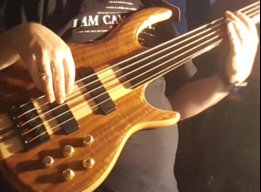
Strings: a hex core will be tighter than a round core
Stiffer, not tighter, but yea feels the same as being tighter.
Just for accuracy though...

The more rigid the beam the tighter the string. It's not hardcore science.
If the bass has a loose pocket assembly with a loose neck you get a bad B.
If the bass has a loose pocket assembly with a loose neck you get a bad B.

Why floppy B? Always tough to answer.
First, you have to define floppy feel versus floppy tone. The OP specified tone.
The biggest cause IME is the string itself:
Then there's the bass:
Lots of different variables: what works with one bass might not work for another. Of course it's cheaper to experiment with strings than with basses. If string experiments continue to fail with a particular bass, even after a pro setup, then consider a different bass. Just keep in mind that the thicker the string, the trickier it is to get good tone... and because of the thicker windings, thicker strings tend to go dead more quickly than thinner ones
First, you have to define floppy feel versus floppy tone. The OP specified tone.
The biggest cause IME is the string itself:
- Gotta start with a fresh string (some folks miss the obvious)
- String must be installed properly: don't twist when wrapping around the tuning post
- String must be set up properly: height and intonation
- Experiment with string types: hex vs round core, tapered vs non-tapered
- If using a round core string, bend it sharply before clipping the excess beyond the bend. Some say do this with hex core strings too
- Silk wrap (if present) should not extend over saddle or nut
Then there's the bass:
- Must be set up properly, especially pickup height (strings should not be too close to the pickup)
- Neck must be attached tightly (not always adjustable by user)
- Neck should be nice and stiff (gotta rely on builder for this)
- Should have nice quality bridge (bent plate OK if not flimsy)
Lots of different variables: what works with one bass might not work for another. Of course it's cheaper to experiment with strings than with basses.
If string experiments continue to fail with a particular bass, even after a pro setup, then consider a different bass. Just keep in mind that the thicker the string, the trickier it is to get good tone... and because of the thicker windings, thicker strings tend to go dead more quickly than thinner ones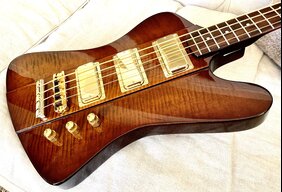
When dealing with floppy B strings I would think addressing the bass first would be important. Then find the right string.
From a physics standpoint the best B string will only be as good as the weakest link of the bass its on.
Using that logic, consider all the anchor points first. A bridge with locking saddles, tight neck screws, a tight neck pocket, properly cut nut groove, a stiff neck. Those are all variables even within the same model of bass that could impact how tight or floppy a B string you have.
Then address the string size and style - hex core, taper wound and proper gauge will all add to stiffness and further reduce the floppy feeling.
From a physics standpoint the best B string will only be as good as the weakest link of the bass its on.
Using that logic, consider all the anchor points first. A bridge with locking saddles, tight neck screws, a tight neck pocket, properly cut nut groove, a stiff neck. Those are all variables even within the same model of bass that could impact how tight or floppy a B string you have.
Then address the string size and style - hex core, taper wound and proper gauge will all add to stiffness and further reduce the floppy feeling.

Not necessarily true either...Yeah I realized what I was trying to say. A thicker string can be tighter because it has less tension than a thinner string. In order for it to have the same tension, the Thickness of string to neck length ratio would have to be the same.
- On the same scale length, a higher gauge string tuned to the same pitch will have higher tension.
- Different strings have different flexibility. Flats are stiffer, rounds are more flexible. This is not to be confused with tension, but will also be affected by tension.
- As a comparison, on a shorter scale a 145 B string will have less tension than on a longer scale (given that it's the same string, of course)
The second part is a misconception.
In reality they're somewhat inversely proportional. The shorter the scale, the thicker the strings must be to achieve the same tension (and all other things being equal).
A string's tension will depend on scale length, and construction (thickness, core type, material used).
The method of finding the frequency of a string is based on the length, mass of the string and the tension on the string. Although the original math involved from which the equation for a vibrating string is derived can be challenging, the final form is a simple equation. Check out these refs if interested.
Link Removed
https://en.wikipedia.org/wiki/Vibrating_string Check the 'frequency of the wave' section
[Invalid or Expired Link Removed]
The following link is from a lecture approaching the vibrating string as a boundary value problem in one dimension for those who might be interested:
http://isn.ucsd.edu/classes/beng221/lectures/beng221-lecture17-notes.pdf
Enjoy,
Lloyd Howard
Link Removed
https://en.wikipedia.org/wiki/Vibrating_string Check the 'frequency of the wave' section
[Invalid or Expired Link Removed]
The following link is from a lecture approaching the vibrating string as a boundary value problem in one dimension for those who might be interested:
http://isn.ucsd.edu/classes/beng221/lectures/beng221-lecture17-notes.pdf
Enjoy,
Lloyd Howard
Ya know what? Many of us bassists (including myself) know a lot more about science than many guitarists.
;-)
IMHO yadda yadda
;-)
IMHO yadda yadda


Latest posts
-
-
 Future Impact now available!! WAS: deep impact reissue!!! interested?
- Latest: Quatschmacher
-

-

-
