• TalkBass has been independent since 1998. Add your voice.
    Create a free account to reply to discussions, view embedded media, and browse with fewer display ads.
    Join freeLog in
    Want zero display ads or expanded classifieds tools? Compare plans.

Why are standalone preamplifiers a dying breed?

What do you think about standalone bass preamps

  • I wish there were more options for standalone bass pre's

    Votes: 89 28.3%
  • I think there are plenty of options for standalone bass pre's

    Votes: 70 22.2%
  • I get everything I need from integrated heads

    Votes: 91 28.9%
  • I used to use bass pre's, now I used studio channels

    Votes: 12 3.8%
  • I went fishing once. I like ice cream. Durr Hurrrrr....

    Votes: 53 16.8%

  • Total voters
    315
In fact, you guys are actually making my point. That point is that with the majority of PA systems, what the audience hears is not what you hear on the stage. To me, this is unfortunate. And in my opinion, can be corrected without too much difficulty. Others may not share my viewpoint, and in fact may not even believe it to be unfortunate.

Now maybe I'm being entirely too anal here, but I'm obsessed with hearing what the audience hears. While I'm fortunate in that I do happen to control the PA we use, including exactly how my bass channel strip is setup... I actually do get to hear almost entirely what the audience hears on stage. I get to verify this repeatedly week to week, and also with a bandmate who helps during setup and who's ears I trust. Or is it the other way around, that my audience hears what I hear on stage? Either way, it instills a confidence in the way I play. The same for all our bandmates.

See, I think this actually points to a deeper, and perhaps greater tangent in this conversation. The original post was about preamps being a dying bring, and why.

The deeper tangent is "Where does my bass tone come from?"

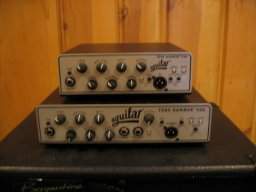
My answer to that question is 1) My bass and its electronics (if active) and 2) My preamp (Aguilar Tone Hammer). Other people add a 3) My Amp + Cabinet. I don't want my amp and cabinet to color my tone. So I purposely utilize transparent monitoring on stage (Acme), which is EQ'd flat with an RTA and a 31-band EQ. We also utilize a transparent PA system, purposely setup to not provide coloration. Any coloration I may need as the bass player, I can dialin directly on my bass and my preamp and because of the way I/we have setup our PA, I can then feel confident that the audience hears what I hear, and vice versa.

Why can't I do this with a combo amp and/or an amp head? Why can't I just mic the cab like JimmyM says? I've done this, and the results were not as close to the 'perfection' I'm attempting to achieve the way I do it now. I have failed to find a mic that doesn't color my tone in a way that is not pleasing to me (and furthermore, making my point from earlier, the mic is altering the signal making what my audience hears different than what I hear on stage). Furthermore, most DI outs on most amps and combos that I've tried and had the pleasure to own were not putting out the same tone and signal as what was being fed to the local speaker cabinet (whether built-in or a seperate cab). This is not the case with the Aguilar Tone Hammer. The XLR out sounds exactly the same as the 1/4" out in my experience.
 
To echo your own point it seems entirely to anal to me. Are you using the RTA mic on every gig with a room and if so is it with or without a room full of people?

I have an RTA mic that we use with our Drive Rack PA, I find it semi useful, the problem is the acoustics change when there is a room full of people and it's only flattening the system at a fixed point in the room based on where the mic is placed. Where do you put the RTA mic to flatten your bass rig?

I find it very interesting that you go through all this trouble...
 
(...)Are you using the RTA mic on every gig with a room and if so is it with or without a room full of people?(...)

I find it very interesting that you go through all this trouble...

As a matter of fact, yes. We use the PAA3 handheld unit, do an average of 10 measurements in the area and then adjust EQ accordingly. I do the same for my Acme B-4 4x10, which is angled towards me. We then fine tune after the crowd has arrived and the first few songs start.

We go to the trouble, which isn't that much trouble once you figure out how to do it efficiently, because of the results. Our goal is to get the live sound as close to our studio and album sound as possible.

Granted their are a lot of rooms out there you can't do a whole lot about and just sound horrible, but at least we tried! But that really doesn't have much to do with the preamp/poweramp vs combo amp type setup we are talking about in this thread (and similar tangents).
 
Again I use a DBX drive rack and an RTA mic for my bands PA. When we first got it we had tuned a bunch of different rooms and saved them as patches in the unit. I have found that a few minutes of fairly loud white moise doesn't go over to well with the management of any particular room even if it is empty. So we usually attempt to choose the closest saved patch.

EDIT FOUND IT ....I'm not familiar with the PAA3 handheld unit can you point me in the right direction?

I give you credit for going through all that trouble...
 
Again I use a DBX drive rack and an RTA mic for my bands PA. When we first got it we had tuned a bunch of different rooms and saved them as patches in the unit. I have found that a few minutes of fairly loud white moise doesn't go over to well with the management of any particular room even if it is empty. So we usually attempt to choose the closest saved patch.

The Peavey VSX 26 does more accurate "pinks" (or whites) than the Driverack PA and does them at moderate levels in a very short time span. Less intrusive, and it will average multiple readings and even sum that result with an overall tonal preference curve that has already been saved, or with any other saved reading. One should always treat the bass region as an operator-adjusted area though, unless they are extremely canny about where to measure... Just sharing ; }

For quickie bar gigs I seldom would use RTA though, only for feature gigs.
 
I'd say it's the better/lighter cabinets taht are causing all of us to reconsider size.

I'm one of the few nuts that still likes a big box moving tons of air...

I do also lust afer a small 1-12 setup that can be thrown in my VW bug.

PA gear is also much better along with the DI boxes available.

Add to this the smaller cars...

Tons of reasons.
 
We then fine tune after the crowd has arrived and the first few songs start.

We go to the trouble, which isn't that much trouble once you figure out how to do it efficiently, because of the results. Our goal is to get the live sound as close to our studio and album sound as possible.

I understand getting the room EQ set for some semblance of flat response but how do you use the gear to get closer to album sound especialy if the source material is the band playing live?
 
I understand getting the room EQ set for some semblance of flat response but how do you use the gear to get closer to album sound especialy if the source material is the band playing live?
It's not nearly as hard as you seem to think it is. A very small part of it is the gear, but the main thing is that it'll be the same band playing it that recorded it. They know what they need to do to get similar sounds, and more importantly, they'll play the same way. Of course, room issues always enter into it, but it's just not that hard to cop the sound of your recordings. And what little difference there is, who cares? It's a party!
 
I've used an RTA many times and understand the concept.
I thought that bassbrock was suggesting that by using an analyzer during a song they could had the ability to compare live vs. recorded.

Have used an analyzer in the studio with Go Go bands to compare the overall low frequency signature of a recording they loved to current CD mixes; not an absolute but an interesting and helpful comparison.

Certainly setting the PA for flatish room response and then using the same instruments, amp settings, and one's ears, is pretty common fare when using your PA in a different room each night.

Thought they had something else going on.
 
Two other factors we have kind of passed over:

1) PA systems are much better and good PA support is much more common at gigs then it was 15-20 years ago. In playing churches the differences are serious. When I first started Shure Vocalmasters were common (yes I know Noah used one to call the animals to the ark) and almost all of us depended on our rigs not just for stage volume, but to cover the club or church.

2) Built in Di's have gotten much better. Years ago when I was playing places with a good PA, I wanted a Demeter or Alembic pre, as much for the high quality DI as the tone. For years I carried around an Avalon U5 with my Eden rig to send a good tone to the board. Now the built in DI on my Thunderfunk is just fine.
 
I run a pre/power set up with an SVP-BSP. I run an old 1000W Carver Power amp that has been modded to be mono at 4 ohms. I have head room for days. My pre has both a big tubey ampeg warm sound, and a nice dirty nasty side that I can run as a blend. The BSP is a split channel pre and each side has an fx loop. This gives you three options for where you want to run pedals. You can run pedals on the clean side, the dirty side, or in front of the preamp, or any combo of all three.

I love my sound so much that I rarely wander over here. I have no GAS for a new sound. The reason, I found this thread however, was because I was doing a search, because my SVP-BSP has become buzzy. I thinking its tube needs to be replaced. So naturally when one is faced with the prospect of a repair, one also starts looking at other options.

Sadly I found this thread, and while I think there needs to be more pre's, I don't see manufacturers stepping up to make them because there's simply not enough of a market for them. So now, how do I get my SVP-BSP fixed?
 
I've used separates in the past, run bi- and tri-amp rigs and I wouldn't go back to that for anything. I get better tone, ample volume, much better portability and no reason to ever revisit that era again.

Sometimes things can be that simple.
:cool:


My 1x12 gets the most gig time, but my dsp tri-amped 4x15 is a great stress reliever. Love living outside of town.
 
i havent read the thread at all, but i feel like the evolution of class D power amps has made the power thing NOT an issue. a little baby markbass can put out what.. 500 watts?

now we can get a good sounding pre and a LOUD fairly transparent power amp in a smaller package. the 300 watt head doesnt HAVE to be 80+ lbs.