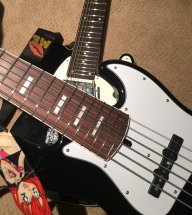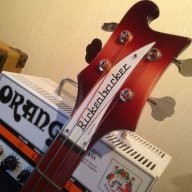
JPJ was on Letterman where he said his very first bass was made from one board. Nothing fancy like what we see here. Just a bass cut out of a plank of wood.

TalkBass has been independent since 1998. Add your voice.
Create a free account to reply to discussions, view embedded media, and browse with fewer display ads.
Join free Log in
Want zero display ads or expanded classifieds tools? Compare plans.
Ritter Roya Concept
[Invalid or Expired Link Removed]
[Invalid or Expired Link Removed]


A true genius would be able to make a hollow body bass from a single piece of wood.
Yeah, but think of how you cut up those blanks. Let's say you've got a couple 16" x 48" x 2" blanks that came out of a tree. Sure you could carve two basses out of those blanks, but you could also get at least two sets of body wings (maybe more) out of one blank and four neck-through blanks out of the other. Economically it makes more sense to cut parts rather than whole basses because you're not wasting the wood you have to cut away to get from the edge of the blank to the edge of the neck.What's a typical bass blank width? 16" ? Speaking as a tree owner with a sawyer that does work for me, there are a lot of trees that would have zero such basses, but the ones that would have "any" would have quite a few. i.e. the 24" wide boards I have stacked are a stack of 12 planks cut at 2 inches (not 8/4 - it's a matter of not fudging for kerf/shrinkage) from a 24" square section after we sliced off the waney bits from a 30" (or so) log. So I'd expect 7 or 8 from any log that would have the 16" width, and you might get several such logs from a decent sized tree. And those are 8-16 foot logs, so several basses per plank, and more planks if you went more towards the typical 6/4 thickness more commonly used for basses.
But, grain orientation on the neck and potential neck movement - ugh.
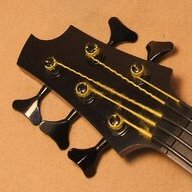


And they are stupendously good as well as lightweight! I have a headless 4 string Stealth that I love. Eventually must order a 5 string...


My god, that's ugly.