• TalkBass has been independent since 1998. Add your voice.
    Create a free account to reply to discussions, view embedded media, and browse with fewer display ads.
    Join freeLog in
    Want zero display ads or expanded classifieds tools? Compare plans.

Why are there no pickups in this location?

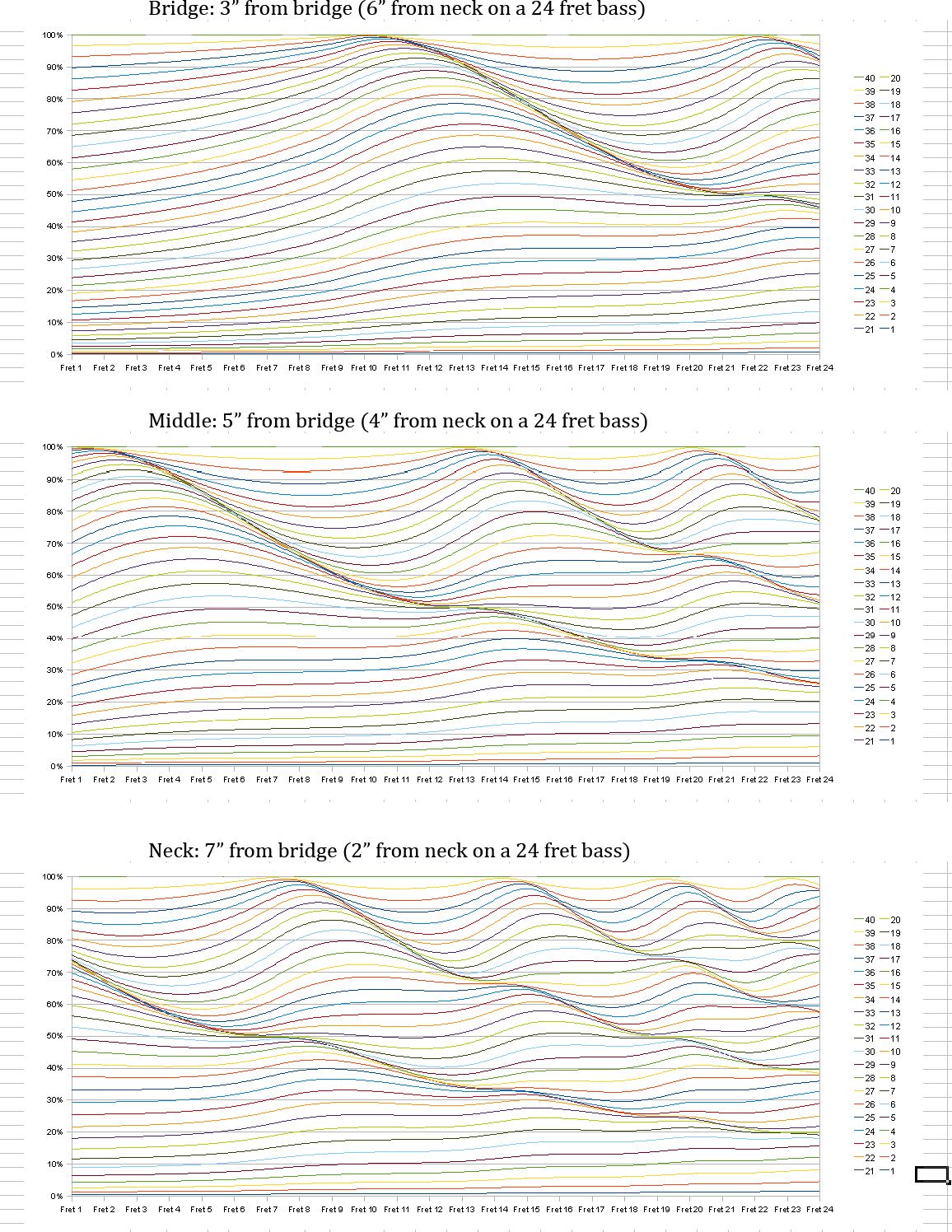
Ok I've worked out a better way of presentation- I'm stacking up the values and normalizing so for every fret, you can see right off the graph which harmonics form a larger percentage. Spreadsheet as attached.

So how do you interpret this? Well, the closer squeezed together the lines are, the less of that harmonic exists. And the higher up the lines are, the higher the harmonic (I've only bothered to calculate up to the 40th harmonic, it's easy to do more but I'm lazy).

What does this mean? Nearly absolutely nothing! We can say the bridge favours upper harmonics, and I guess this is kinda true since quite consistently there's almost nothing from the fundamental and the first harmonic and so on. But we can't say much about the harmonic makeup of the upper harmonics since it shifts across the different frets! Anyway, moving the pickup closer to the neck increases the strength of the fundamental to twice as much as the bridge.

Do note that this is just what percentage of each harmonic is picked up by the pickup, not the output. The fundamental and lower harmonics are by nature stronger than the upper harmonics, so if you want to see the output I'll have to multiply these values with the expected strength of the harmonic...
CtJht.jpg
 

Attachments

I guess I could do that also, but what I'm doing now is plotting for various scale length (obtained by fretting different frets) for a given pickup position.

String type is really too much work... honestly speaking, I don't think I can even get close to calculating the frequency mix as long as I'm still working on a spreadsheet. It's been pretty long since I last touched acoustics, especially for strings, but I recall it's not as simple as that.

Very nice, Nic. So your spreadsheet will show the amplitude of a given fret and harmonic, for a given pickup location (and hence what the sound will be!

I was actually thinking kind of the reverse of that, where you would plot the node locations for a much smaller number of harmonics (wouldn't a pickup's frequency response be limited to 10 or so?). Then you could see if there are any big black "clumps" of nodes in a particular position, which would indicate that that position should be avoided. It would be a one-dimensional plot, the axis being distance from the nut...
 
Ok I've worked out a better way of presentation- I'm stacking up the values and normalizing so for every fret, you can see right off the graph which harmonics form a larger percentage. Spreadsheet as attached.

So how do you interpret this? Well, the closer squeezed together the lines are, the less of that harmonic exists. And the higher up the lines are, the higher the harmonic (I've only bothered to calculate up to the 40th harmonic, it's easy to do more but I'm lazy).

What does this mean? Nearly absolutely nothing! We can say the bridge favours upper harmonics, and I guess this is kinda true since quite consistently there's almost nothing from the fundamental and the first harmonic and so on. But we can't say much about the harmonic makeup of the upper harmonics since it shifts across the different frets! Anyway, moving the pickup closer to the neck increases the strength of the fundamental to twice as much as the bridge.

Do note that this is just what percentage of each harmonic is picked up by the pickup, not the output. The fundamental and lower harmonics are by nature stronger than the upper harmonics, so if you want to see the output I'll have to multiply these values with the expected strength of the harmonic...

CtJht.jpg

So as you get closer to the neck, there are more frets where the amplitude of more harmonics are suppressed ("waves" in the graph)?
 
It didn't occur to me to see it that way before, but I guess you're right!

On the other hand, surpressing these frequencies is what gives it the tone.

Give me a while, after I do up the cluster thing I'll go multiply these to the expected relative strength of the harmonics... damn there goes my peaceful afternoon, I was gonna spend it leisure reading.
 
T5JWH.jpg


For the first few harmonics. As you can see it's quite nicely spread out. I don't think nodes are enough to affect, as mentioned by someone else earlier. Dead spots comes from resonance, not from nodes.

Please remember, this is just a mental exercise that does not really mean anything! Yes, placement affects the balance of the harmonics, and which harmonics are affected depends on which fret you're playing on, but this is just an "envelope" that you multiply to the original mix of frequencies that comes from a mixture of where/how you pluck/pick and the tensile qualities of the string. It's a lot more complex than whatever I'm putting out now. And a flat response isn't necessarily good... and I don't think piezos have perfect output either. A piezo inevitably will respond differently to different frequencies too and have its own "natural EQ". The sterility is probably from a lack of resonating chamber coupling with the strings to give a certain EQ that we recognize as an "acoustic sound"
 
Yes, that is more useful, since it shows that there are no glaring "bad spots" to put a pickup. Though you might be tempted to pick one of the microscopically small areas between groups of nodes, I'm sure that string characteristics and plucking location would make things even more distributed.

Any pickup system, like piezo, will have response characteristics, of course. I think in the case of an upright bass, the character of the sound is so strongly determined by the mechanical characteristics of the instrument that a more accurate pickup system like piezo will sound really good, whereas on a solid body instrument, the design and placement of the pickups is at least as important as the resonant characteristics of the instrument. Of course it all matters in the end, since we also have amps and speakers to consider!

So I'll put the pickup where I want, and keep my fingers crossed that the whole package has a nice sound!

P.S. We have a very good violin maker in Salt Lake, and a local radio interviewer asked him how you make a violin sound really good, to which he replied: "Give it to Hillary Hahn".
 
I'm waiting for all the stuff to come in to build this bass, and I couldn't stand it any more, so I went to a few pawn shops after work and picked up this P copy for $70. The MFD pickup did come in, and this is a pic of potting it with wax last night (I've heard they can be microphonic, so preventive measures).

Now I'm going to rout out the P to allow placement in a range of positions from the bridge to the neck. I'm also going to play around with the electronics and try to dial in what I want before I build the real bass.
 

Attachments

  • IMG_0021.jpg
    IMG_0021.jpg
    35.4 KB · Views: 46