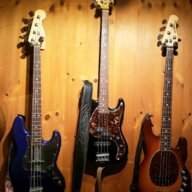
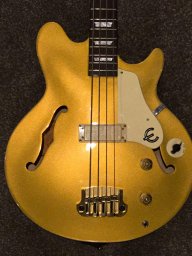
It allows you to road-wear your new bass within weeks!
But seriously, there’s nothing wrong with basswood. Heck, poplar is also not a very hard wood.... but it has been used by some very upscale builders, so it is considered by many to be a ‘tonewood’. Such that it landed on your list. Tone is tone, and if basswood gives you great tone then use it.
Basswood 410 Janka Hardness (sometimes a lot lighter than Alder)
Poplar 540 Janka Hardness (supposed to be slightly heavier than Alder)
Alder 590 Janka Hardness
My basses heaviest to lightest:
Squier 2019 Indo CV '50s Precision Bass - Pine 9.70 lbs
Peavey 1983 Fury - Ash 9.28 lbs (old Peavey ash was heavy)
EBMM 2003 SUB Bass (Slab body) Stingray - Poplar 8.95 lbs
Yamaha 1990 Attitude - Alder 8.90 lbs (lots of heavy hardware and pickups)
Squier 2011 '72 Tele Bass Reissue - Basswood 8.80 lbs
Peavey Patriot - Mahogany 8.50 lbs (small body)
White Peavey Fury - Poplar 8.51 lbs
Crean Peavey Fury - Poplar 8.25 lbs
Blue Peavey Fury - Poplar 8.24 lbs
Guild Pilot - Poplar 8.24 lbs
So, clearly body size/shape matters, what country the wood comes from matters, what year the body wood came from matters, hardware weight definitely matters.
The Basswood Squier screws were all stripped when I got it used, lots of toothpicks in the pickguard screw holes now and some glue in the bridge mount holes.
The Pine Squier holds screws fine but Asian Pine is obviously heavy, don't know what kind of pine it is.
The Poplar basses all hold screws and seem a lot like Alder, Peavey bought good Poplar in those days.
Alder is good old Alder.
The Mahogany Peavey body is awesome.
The Ash Peavey body is awesome and hard.







 .
.