
If you play live, as soon as the drums and guitars kick in, all nuances are mute. If it is intended for recording it might be a bigger difference, but on a live stage it’s not going to matter.

TalkBass has been independent since 1998. Add your voice.
Create a free account to reply to discussions, view embedded media, and browse with fewer display ads.
Join free Log in
Want zero display ads or expanded classifieds tools? Compare plans.

Not finding anything on the subject is no guarantee that there isn’t some concise information about it.I hear that a PJ (or any other combo with a P) wont sound the exact same as a single P bass, even with the pup solo'd.
Is this true? If so, why? And how different will it sound?
I really like the way a P fits in the mix and i regret selling mine... but while GASing for a new P, i might just convert my J to a PJ but id want to know if the above statement is correct.
Edit: Sorry if this has been answered before but ive done a search with no findings.
If you only reduce the output you only reduce the level.A PJ bass in the VVT or VBT arrangement will not sound like a true P bass because of the presence of a second volume pot in the circuit, which decreases the resistance from signal to ground, reducing output.
Aside from issues of string pull, as long as you are able to remove the extra pot, the tone should remain the same.
Another issue is that sometimes matched PJ sets can be wound differently to sound better blended, at the expense of the authentic tone when soloed.
This thread explains it:
Do P/J's have output level issues?
I believe he believes it.Sorry but I don't believe that for a second. All my basses with PJ's have the same output as any P I own or owned. I'd say there was a difference with the pickups themselves more than an extra volume pot.

But isn’t a P vol pot set to 10 (aka zero resistance) and a J vol pot set to 0 (aka 250k or more) just a 250k in parallel with 0 Ohms? Negating the resistance of the pickups of course because they were not considered in this post.Ok say you have a volume pot wired with the first terminal as an output, the second terminal as an input and the third terminal as a ground.
Regardless of the volume setting, you are always placing a resistance equal to the value of the pot from the output to ground.
Now you add in a second pot, which gives you a second resistor across from signal to ground...
When you place resistors in parallel, their resistance decreases.
So say you had a 250K pot in your P bass. That's 250K ohms from signal to ground. Now you add in a second 250K pot, and that is now two 250K ohm resistors from signal to ground, which drops the resistance to 125K ohms.
Isn’t that reduction when both pots are on full a slight cancelation due to a bit of phase difference because the two pickups aren’t collocated and therefore cannot hear the same sound coming from different places on the string?Or even when you roll the J off slightly, say to 90%
BTW... My current project bass is to remove the J pickup from a PJ bass. Fill in the J route, wire it as a standard config P. When I’m done, I’ll be glad to A/B it with the same stock bass, if I can find someone that has such a beast. Pretty rare bass being it’s a Squier VM Jaguar short scale.Well regardless, I hear little or no difference at all in output when I switch between a P and a PJ with the J off. Maybe others do, but I don't.
Go down to Radio Shack.Alright Jimmy, I'll give you the challenge then.
Go down to RadioShack and pick up a couple of 250K (or 500K if that's what's in your P bass) resistors. It should only cost a buck or two.
Solder one of them across terminals one and three of the volume pot on your P-bass. (The P, not the PJ)
If you can't solder, then just wrap the lead around real tight and make sure it's making good contact for the test.
Now play your bass and tell me if it sounds different to you.
Do you notice any less output?



All my Ps and PJs have Geezers with the stock quick connect pots they come with, 250k, no idea what the cap is. And only one tort guardBTW... My current project bass is to remove the J pickup from a PJ bass. Fill in the J route, wire it as a standard config P. When I’m done, I’ll be glad to A/B it with the same stock bass, if I can find someone that has such a beast. Pretty rare bass being it’s a Squier VM Jaguar short scale.
Please let me know what pickup you have in the P position, string type, values of the pots and cap, and if you have a tort pick guard or not.

Yes. Given the same load impedance a drop in current will produce a proportional drop in voltage.Current is proportional to voltage, though. Yes?
Understood about the 250K. Pretty high compared to the internal resistance of the pickup. And what you say would, of course, apply even if you took the J pickup out of the circuit completely.
I was talking about the amount of signal from the P that would get to the output if it was on its own, and how that changes when you introduce a J pickup turned down to zero. The answer seems to be - hardly at all.
There's a bass players' joke in here somewhere...
"What do you call a PJ with the J turned down?"
"A P."
The audience won’t notice.Well guys, I really don't feel like arguing about this anymore.
If you add a second volume pot to a P, it's still mostly going to sound like a P.
The question is exactly how accurate you want that to be when comparing to a regular P bass.
If you're like me, you will take it to levels of utter ridiculousness to get it to match the exact tone and vibe of a regular P bass, but I guess most of you guys don't care enough for it to matter.
I am working on a PJ bass right now with a VVT arrangement plus a 3 way switch.
That seems to be the most flexible option for me at least, because even if you don't think the extra pot makes a difference, at least you can switch between the pickups a lot quicker than fiddling with the volume controls.
If the 3 way switch isn't your cup of tea, you can put a simple bypass switch for the Jazz volume on a push/pull pot.
If nothing else, you could switch between P and P+J quicker than dialing in the volume knob where you liked it on the J.
Finally! A response that’s back on point with the OP’s question.Nice timely thread.
Im hoping to get a Nordy NP5 put in my Lakland DJ5 at some point very soon. Im not in to the Jazz tone at all, at least, not this one.
Ive been wondering if it will make a difference and will indeed sound like a "proper" P bass.
I love my Fender P5 tone but the neck on the Dj5 is way better.
So, just to recap (ive not read every single post yet) putting the NP5 in will give me a P thump/tone ect and will sound very different to how the bass sounds now. Is that right?
Ill decide later if i want to get rid of the bridge pup or change the pot layout as has been suggested. I might not even bother having the back pup wired in. All i want is a 5 string P with a great neck.
Sorry if thats going over old ground. Just want to be clear before i spend even more money and possibly mess my new bass up.
Moot? But in this case mute works too.If you play live, as soon as the drums and guitars kick in, all nuances are mute. If it is intended for recording it might be a bigger difference, but on a live stage it’s not going to matter.

OK! Let’s Rumble! Oh wait. You can’t.All my Ps and PJs have Geezers with the stock quick connect pots they come with, 250k, no idea what the cap is. And only one tort guard

Moot? But in this case mute works too.
To be fair, I thought hard about this and I think it really does work either way in a clever turn of a phrase sort of way.Auto correct had its way with me once again. I stand corrected.
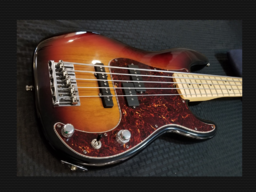
My PJ is P with an added J, and it sounds like a P, so I'm not sure what the problem is.
I've got a 3-way tele-type switch in there, so no blending, no loading, none of that stuff. Just P OR P+J OR J
View attachment 3172805


In a recent blind listening test I did here, many people thought a Peavey Forum with GZR pj pickups was a Fender P. Many also thought a BC Rich ST with Dimarzio pj pickups was a Fender P. It was almost an even three way tie with a MIM Fender P.I hear that a PJ (or any other combo with a P) wont sound the exact same as a single P bass, even with the pup solo'd.
Is this true? If so, why? And how different will it sound?
I really like the way a P fits in the mix and i regret selling mine... but while GASing for a new P, i might just convert my J to a PJ but id want to know if the above statement is correct.
Edit: Sorry if this has been answered before but ive done a search with no findings.


