• TalkBass has been independent since 1998. Add your voice.
    Create a free account to reply to discussions, view embedded media, and browse with fewer display ads.
    Join freeLog in
    Want zero display ads or expanded classifieds tools? Compare plans.

Why cant a PJ sound like a real P

BTW... My current project bass is to remove the J pickup from a PJ bass. Fill in the J route, wire it as a standard config P. When I'm done, I'll be glad to A/B it with the same stock bass, if I can find someone that has such a beast. Pretty rare bass being it's a Squier VM Jaguar short scale.

Please let me know what pickup you have in the P position, string type, values of the pots and cap, and if you have a tort pick guard or not.
You can a/b it. Record prior to the mod and again after it. That even removes a boat load of variables. Like individual winding variances, different strings, style of playing etc.
 
You can a/b it. Record prior to the mod and again after it. That even removes a boat load of variables. Like individual winding variances, different strings, style of playing etc.
To late. Mods started.
Since I can't, I can only offer to compare it with another stock brother from the same mother.

But yeah! That's a good way to go also.
Even identical twins can develop differences as they age.
 
To late. Mods started.
Since I can't, I can only offer to compare it with another stock brother from the same mother.

But yeah! That's a good way to go also.
Even identical twins can develop differences as they age.
If you were so inclined, you could temporarily disconnect the J pickup and its associated pot(s) from the circuit on the stock P/J and see what difference that made.

Good point about the twins!
 
  • Like
Reactions: Old Garage-Bander
This! ^^^


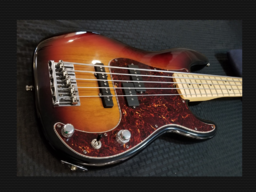
View attachment 3173078

I use a Les Paul (Swithcraft) 3 way P/PJ/J switch, with a Super 55 Hum Cancelling Jazz PU and stacked VOL/VOL knobs with a master tone. I never blend the pickups. The P is absolutely P and the J is close enough for the 5% of the time I use it. Sounds very near a both full on J/J tone. I have 3 other P basses, so I am at least familiar with the tone. I like this so much that I am 90% complete on a fiver version.

And it's done!

My PJ5 Full.jpg
 
  • Like
Reactions: saabfender
FWIW I was just at GC Thursday and was playing MIM Fender P's
The sales guy handed me a PJ (with a noiseless J) and the P pup sounded different
We tried this on a few different basses and the ones with the J pup did not allow the P to sound as good alone.
If 500K pots are the fix, than this is a non issue, but is this as good as a switch to take the J out of the circuit mechanicly?
Would you keep the standard 250K tone pot?
 
FWIW I was just at GC Thursday and was playing MIM Fender P's
The sales guy handed me a PJ (with a noiseless J) and the P pup sounded different
We tried this on a few different basses and the ones with the J pup did not allow the P to sound as good alone.
If 500K pots are the fix, than this is a non issue, but is this as good as a switch to take the J out of the circuit mechanicly?
Would you keep the standard 250K tone pot?
If you can hear the difference, a switch won't help. As long as the J is there, it's magnetic field will still be affecting string movement.
 
If you can hear the difference, a switch won't help. As long as the J is there, it's magnetic field will still be affecting string movement.

Others have said the P (on a P/J) is unafected with a switch
Others say 500K pots help/fix the loading issue.
All I know is the straight P vs. the JP, had a mch nicer P tone.
Understood different pieces of wood, string age, etc.
The P's all sounded very similar; the JP not so much
 
This isn't much of a problem for me bc I like really gnarly bright PJs.

I want 500k vol pots straight to jack or use an OBP3.
I'll do stuff like run EMG PJ thru a Haz, deep dark Barts thru a Tonepump or OBP.

My P can just sound like a generic off the wall stocker, but I'm just not going to like using it too much.

I could cheat by using a Tonestyler and isolate the P in a PJ, but why not just dedicate a vintage esque P with flats to the task?

Ps are kinda like right angle drills for me, it's the right tool for a job I tend to avoid.
 
Last edited:
FWIW I was just at GC Thursday and was playing MIM Fender P's
The sales guy handed me a PJ (with a noiseless J) and the P pup sounded different

That's because they were different basses made out of different pieces of wood and not least had different P pickups, not because it would have sounded any different without the J pickup from with it when not dialed in.
 
Intersting that there are such vast differences of opinion on this.
While my test was solo without a band, it sounded like a big deal.
Not so much tone but resonance and presence; the P just sounded bigger.
I think I had 3 P's and 2 PJ's and the difference was repeatable.
No matter how you hear it these new MIM Fenders are really great instruments at any price point.
 
Intersting that there are such vast differences of opinion on this.
While my test was solo without a band, it sounded like a big deal.
Not so much tone but resonance and presence; the P just sounded bigger.
I think I had 3 P's and 2 PJ's and the difference was repeatable.
No matter how you hear it these new MIM Fenders are really great instruments at any price point.

Resonance and presence is part of what makes the tone of an instrument.

Also your can't conclude anything from 5 different basses with 5 totally different pieces of wood and pickups, even less if it was 3 P basses made of the same type of wood with the same pickup model and 2 PJ basses made from the same type of wood but different from the P basses and same type of P pickups but also different from the P basses.

Either way it is a way too small sample to draw any general conclusion from.
 
Last edited:
We disagree

We disagree, that is true.

But also you disagree with educated scientists on how to draw statistical conclusions and the general consensus of language that make people able to understand what other people mean when they use certain words.

I for one have no idea what you are talking about when you say similar tone but different presence and resonance.
 
Last edited:
Look pal,
I'm reporting on what I heard.
There are plenty of threads where others feel there is some loading with a change to the pure P tone.
I am not talking about statistical calculations or conclusions; just what a pile of Fenders sounded like in a guitar store last Thursday.
I assume you have tried this and hear it differently; great.
 
Look pal,
I'm reporting on what I heard.
There are plenty of threads where others feel there is some loading with a change to the pure P tone.
I am not talking about statistical calculations or conclusions; just what a pile of Fenders sounded like in a guitar store last Thursday.
I assume you have tried this and hear it differently; great.

I am not saying that I couldn't possibly have heard some of the same similarities and differences that you did from those 5 basses you tried, though I still don't know how to subtract presence and resonance from the tone of an instrument, just that no logical conclusion can be made from it.
 
Last edited:
I go towards this:

Other people towards this:

Then you have guys that love this:

I don't think anyone in the audience will notice one way or the other.

For the most part I will throw together some parts, slap in the electronics I like, and hope for the best.
 
No two actual P-basses sound the same really, but here's what we know for sure about a P-bass vs. the P-only pickup on a P/J bass:

On a passive P bass, the signal path goes from the pickup, through the volume pot, through the tone pot, to the jack. Very simple.

If the PJ bass is active, it sounds like the preamp more or less, so all bets are off on comparisons.

If the PJ bass is passive, and wired Volume/Blend/Tone, the signal path from both pickups comes together in the blend pot before heading to the tone pot, and it's possible that the blend pot may make a mark on the outgoing signal regardless of the pot's position. Think of it as similar to a faucet like this one:

delta-100lf-wf-165.jpg

^ When you have this faucet all the way to the "cold" position, the valve inside might still be allowing a tiny bit of the hot water through. It's hard to know for sure. On this P/J bass, maybe the P pickup soloed does sound different than if the J pickup weren't there at all, because of the effect of combining the signal paths in the tone pot. Or, maybe not. Its hard to know for sure.

But, if the passive P/J is wired Volume/Volume/Tone, the signal comes from each pickup to its own volume pot, then through the single tone pot and out to the jack. More like this kind of faucet:

pfister-lf-wl8-snpc-49.jpg

In the V/V/T wiring approach, the signal path for the P pickup is pickup--->volume--->tone--->jack, which is exactly the same as it would be if the J pickup were not there.

So, on that particular bass, it's pretty much a guarantee that the P pickup soloed sounds the same as if that same bass only had that P pickup.

Exactly as in how the water coming from the "cold" valve on the second faucet, if the "hot" valve were entirely shut, would taste exactly the same as if the "hot" valve weren't there at all. There's simple nothing in the chain that would make it any different.
 
Well you guys can continue to pick nits whilst I don't give stuff like this a second thought. My PJ's P pickups sound just like they do when everything is wired up as when I disconnect everything else but the P.