• TalkBass has been independent since 1998. Add your voice.
    Create a free account to reply to discussions, view embedded media, and browse with fewer display ads.
    Join freeLog in
    Want zero display ads or expanded classifieds tools? Compare plans.

Why did Leo do this?

On Jan 5th 1965 I believe the deal was done so virtually all 1965 Fenders are transitional Fenders and technically post-CBS.
Here's a not so known fact. At the beginning of 1965, CBS installed large frets on Strats for a few months. Some players really prefer this but I think most didn't.
 
Here's a not so known fact. At the beginning of 1965, CBS installed large frets on Strats for a few months. Some players really prefer this but I think most didn't.


I don't like large frets even on basses, I was even thinking of trying LeLand Sklar's trick of using mandolin frets, I asked a guy out here to install them on a Rickenbacker but he thought the slots on the bass would be too wide for them. It was refretted years ago before I bought it and I never liked the frets. He did point out though that the neck had remained unvarnished and painting it with clear would make the frets seem not so high, I haven't gotten the bass back yet so we'll see.
 
  • Like
Reactions: Jim C
Here's a not so known fact. At the beginning of 1965, CBS installed large frets on Strats for a few months. Some players really prefer this but I think most didn't.
I also heard Leo stabbed Les Paul during a rumble. And Mary decked him with a Flying V. It was before Twitter, that’s why most people didn’t hear about it. They worked it out and became guitar bros.
 
I also heard Leo stabbed Les Paul during a rumble. And Mary decked him with a Flying V. It was before Twitter, that’s why most people didn’t hear about it. They worked it out and became guitar bros.
What a wonderful holiday story!
Was that before or after Leo caught George sleeping with Phyllis?
 
  • Like
Reactions: Killing Floor
My understanding is that Leo spent a lot of time experimenting with pickup placement. Supposedly he placed the pickups at specific points relative to the harmonic nodes (for example the neck pickup of a Fender guitar is above the 4th harmonic node) to get specific sounds.

Moving one pickup for cosmetic reasons would not have occurred to him.

The positions of the nodes change as you fret different notes. If this is true it would be for some specific notes, not for the full set of notes you can play. My guess it is way too complex to try to engineer it and they went with what sounded the best to them.

Edit: looks like I'm a bit late to this party...
 
  • Like
Reactions: bobyoung53
While post-CBS Fender was moving their bridge pickup closer to the bridge (thus creating decades of debate), Leo Fender was designing something that would come to be known as the StingRay.

But, to answer the question, moving the bridge pick up closer to the bridge definitely resulted in a slightly different tone. A tone that was a little more high-mid forward.
 
  • Like
Reactions: Ric Vice
To be clear. Yes, I did say that I think the P-Bass is a one-trick-pony. I did not say that it isn't a good trick.
How can a PBass be a one trick pony when it worked equally well for James Jamerson, Steve Harris, Louis Johnson, Carol Kaye, Bernard Odum, Geezer Butler, Joe Mauldin, Duck Dunn, Phil Lynott, Paul Simonon, Roy Estrada, John Deacon, Suzie Quatro, Jet Harris, Billy Sheehan ... ad infinitum? That's a lot of different tricks.
 
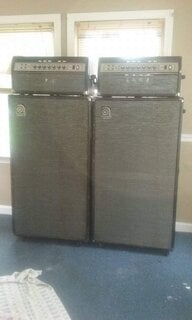
I maybe bias, but I love the sound of the 70’s pickup spacing better then the 60’s. I find you get that killer mid punch. No coincidence the Fodera’s with split coil pickups when set to single coil mode, the pickups are the same as a 70’s Jazz bass. Killer tone!

Again, I am a bit bias. Love my ‘72!

image.jpg
 
How can a PBass be a one trick pony when it worked equally well for James Jamerson, Steve Harris, Louis Johnson, Carol Kaye, Bernard Odum, Geezer Butler, Joe Mauldin, Duck Dunn, Phil Lynott, Paul Simonon, Roy Estrada, John Deacon, Suzie Quatro, Jet Harris, Billy Sheehan ... ad infinitum? That's a lot of different tricks.

Yep.

It's a good trick if it can make all those players happy.

And don't forget JJ Burnell, Wilton Felder, Francis Rocco Prestia, Sean Hurley, Willie Weeks and Pino Palladino, oh. . . and me! The list goes on and the magic in that one trick is limitless.
 
How can a PBass be a one trick pony when it worked equally well for James Jamerson, Steve Harris, Louis Johnson, Carol Kaye, Bernard Odum, Geezer Butler, Joe Mauldin, Duck Dunn, Phil Lynott, Paul Simonon, Roy Estrada, John Deacon, Suzie Quatro, Jet Harris, Billy Sheehan ... ad infinitum? That's a lot of different tricks.

Actually what you are pointing out is a lot of different riders.
I was talking about the pony, not the riders.
 
Actually what you are pointing out is a lot of different riders.
I was talking about the pony, not the riders.

Doesn't "one trick pony" imply that the pony is only capable of one trick, regardless of who's riding it?

If a different rider gets a different trick out of the same pony, how is it a "one trick pony"?

Usually when I hear someone call a Pbass a one trick pony, they mean it does one trick in their own hands. That's on the rider, not the pony.
 
Doesn't "one trick pony" imply that the pony is only capable of one trick, regardless of who's riding it?

If a different rider gets a different trick out of the same pony, how is it a "one trick pony"?

Usually when I hear someone call a Pbass a one trick pony, they mean it does one trick in their own hands. That's on the rider, not the pony.

Yes it is true that "the trick is in the hands" and a few players have more than one "hand trick". Most don't.
 
  • Like
Reactions: Jim C