• TalkBass has been independent since 1998. Add your voice.
    Create a free account to reply to discussions, view embedded media, and browse with fewer display ads.
    Join freeLog in
    Want zero display ads or expanded classifieds tools? Compare plans.

Why do people like complicated basses?

I'm wondering why you people need all those strings too! Woe unto you, you wasteful people! I like one string on a bass. That's how real men do it.

I think one of the biggest advantages, as others mentioned, is when you go direct, you have a lot of options to adjust your tone right at your hands.
 
Why do some bassists only have 4 strings? Why do some bassists only have a volume and tone knob? Why do some bassists have passive electronics? Why do some bassists use stock pickups? Why do some bassists use 34" or smaller scales? Why do some bassists use parallel frets? Why do some bassists use strings with uneven tension? Why do some bassists use single-coil pickups?


The obvious answer is because they are not real bassists and still use outdated gear because they haven't made the switch yet to a 37"-34" fanned fret 6-string with active EQ, custom wound humbuckers, and even-tension strings.

:rolleyes:

I hate all-passive basses. I have no tonal control. If I desperately need a passive sound, I'll switch to passive mode. If I want to sound good, I'll stay in active mode where my ears think I belong.
 
My two main "first-call" basses are poles apart. One is a P bass- alder body, quarter-sawn maple neck with rosewood board glued on, one pickup, one knob to make it less loud, one knob to make it less trebley. The other is a Lakland Deluxe 4-94- ash body with maple cap, flat-sawn maple neck with maple fingerboard glued on, on jazz-style PUP, one MM-style PUP, and a pre-amp with a volume, a pickup blend, and active bass, mid, and treble. Plus it has a toggle switch to select either or both coils of the MM PUP, and there are three switches in the circuit board to select the center of the mid range control, AND a switch built into the volume pot to by-pass all the active stuff. So that's five switches and five knobs.

First, I didn't buy either bass based on the number of controls. I bought them because they both simply sounded great. That's all. Second, I've never "knocked" any knobs around on any of my basses. My hands are on the strings, unless I'm tweaking a setting. And that's it- tweaking is subtle. I have a default setting on my Laklands (all EQ flat, pan centered, volume wide open, and the bridge PUP selected to the neck coil of the MM PUP). I set my amp so it sounds good in the room with that setting. And I don't change my amp when I switch to the P bass. That's because I want my amp to translate the sound of each bass separately. I use the P when its character and sound is what I want, and I use the Lakland when that's what I need.

Plus I don't find it at all complicated. If you know what each knob does (that is you've played with it enough to know how far you need to move a knob to get what kind of effect, and you know what to expect when you move a particular knob) and you're listening to your sound as you play, it's really easy. This one makes it quieter (but that's what fingers are for too), this one makes the mids come out or go away, this one makes it either sparkle or clank depending on how far I turn it, this one makes it fatter or muddier (or less fat or less muddy), and this one alters what part(s) of the string I'm focusing the sound from. Five minutes and you should know your bass enough that it's no longer complicated.

On stage I don't move knobs a lot. And I don't have precise settings for certain songs. Sure, I'll boost the mids for something like "Born Under A Bad Sign", or switch to the neck PUP only on "My Girl", etc. But it's not like I have to worry about the difference between the mid knob at 3 and at 3.5.

John
 
My two main "first-call" basses are poles apart. One is a P bass- alder body, quarter-sawn maple neck with rosewood board glued on, one pickup, one knob to make it less loud, one knob to make it less trebley. The other is a Lakland Deluxe 4-94- ash body with maple cap, flat-sawn maple neck with maple fingerboard glued on, on jazz-style PUP, one MM-style PUP, and a pre-amp with a volume, a pickup blend, and active bass, mid, and treble. Plus it has a toggle switch to select either or both coils of the MM PUP, and there are three switches in the circuit board to select the center of the mid range control, AND a switch built into the volume pot to by-pass all the active stuff. So that's five switches and five knobs.

First, I didn't buy either bass based on the number of controls. I bought them because they both simply sounded great. That's all. Second, I've never "knocked" any knobs around on any of my basses. My hands are on the strings, unless I'm tweaking a setting. And that's it- tweaking is subtle. I have a default setting on my Laklands (all EQ flat, pan centered, volume wide open, and the bridge PUP selected to the neck coil of the MM PUP). I set my amp so it sounds good in the room with that setting. And I don't change my amp when I switch to the P bass. That's because I want my amp to translate the sound of each bass separately. I use the P when its character and sound is what I want, and I use the Lakland when that's what I need.

Plus I don't find it at all complicated. If you know what each knob does (that is you've played with it enough to know how far you need to move a knob to get what kind of effect, and you know what to expect when you move a particular knob) and you're listening to your sound as you play, it's really easy. This one makes it quieter (but that's what fingers are for too), this one makes the mids come out or go away, this one makes it either sparkle or clank depending on how far I turn it, this one makes it fatter or muddier (or less fat or less muddy), and this one alters what part(s) of the string I'm focusing the sound from. Five minutes and you should know your bass enough that it's no longer complicated.

On stage I don't move knobs a lot. And I don't have precise settings for certain songs. Sure, I'll boost the mids for something like "Born Under A Bad Sign", or switch to the neck PUP only on "My Girl", etc. But it's not like I have to worry about the difference between the mid knob at 3 and at 3.5.

John
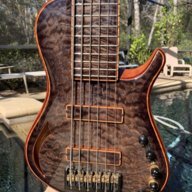
The defense rests, your honor.
 
It's all a matter of preference... For me, I like a few more controls for versatility when in combination with different types of pickups (i.e. dark star + a humbucker). If it's put together right, you can do with one bass what others can do with two. To me owning two nice basses isn't a good idea, because I'll only end up using one (the favorite) and I won't be able to justify owning two. But that's just one argument. I also understand if someone would rather just have a p-bass with vol and tone.
 
I actually agree. Your amp has an EQ - - why does a bass need it too?

When I'm using my amp, my bass stays set flat. But I don't always get to use my amp. With one of my bands, I haven't used my own amp in quite a while. It's not that I couldn't find 'my' sound with the usual Ampegs and SWRs that are so popular down here; it's that I don't want to mess with the amp settings as either it's a house amp, set to the sound guy's specs, or it's the other band's amp, set to that guy's specs.
 
Good answer.

Ya know what knob setup I liked best of all? Vol...Tone...mini switch to bypass everything straight to jack. Everything else I'd try to vary via technique, thumb, fingers, pick, over the pickup, back by the bridge, up close to the neck. That was about all the "options" i really wanted.

"Hey, I'm only fiddling with this to please myself with what I'm hearing up here, sound dude...sorry if it's screwing up the mix that everyone ELSE in the room is hearing!"
 
Why are people afraid of complicated basses?

People manage to figure out complicated amplifiers all the time... gain, master volume, 7-band graphic EQ, etc.; but don't you dare put an EQ on the bass. :rollno: Just leave set flat if you don't like them, who cares? I love a simple, passive bass as much as the next guy, but I don't understand what the big deal is with a 3-band EQ w/ sweepable mids, active/passive switches, etc. Just because they are there doesn't mean you HAVE to use them. I would rather judge a bass on what it sounds like than how many pots it has. The ability to get a multitude of good tones on one instrument is a pretty compelling argument IMO.
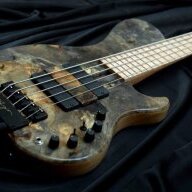
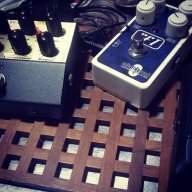
 
there's also the other approach to 'complicated' and that's having as few knobs that have as many features as possible...

Like this:

Master Volume/Blend stacked knob
mini switch bypass (straight to jack)
rotary pickup selector
Mini switch to change Tone knob to Bill Lawrence Q-Filter (like a 1 position varitone)
Master tone on a pushpot for a second tone cap

It all fits on a Jazz Bass control plate and aside from the mini switches, looks pretty normal.

I like a simple, uncomplicated look and feature set.
 
I keep my EQ and my filter switches/boosts/phase selection/toaster dials on my bass because I don't like to mess with or worry about my onstage rig, and I like a variety of sounds. I change my tone almost every tune, even knowing that very few people will notice anything but the most extreme change.

My next bass amp won't have anything but a volume knob attached, and I like it just fine that way. I'll just change the bass' tone when I want something different. Also, I don't have to worry about anything more complex than how much signal the FOH guy wants; miking, pre/post EQ, etc don't come into the equation anymore once all the tonal options are on my axe.