When I play 5 string I tend to use the B string the same way I use the others; where I would go up to find the Eb or D I can reach low and find it on the lower string instead; it's nice to have that option. Some songs feature the low sounds, so it's nice to have them, but often it sounds wrong if the song actually doesn't call for that octave. A low B is pretty intense so you don't really want to use it unless it's musically appropriate.

Enjoy the benefits of a premium membership!
Upgrade Account
-
TalkBass has been independent since 1998. Add your voice.
Create a free account to reply to discussions, view embedded media, and browse with fewer display ads.
Join free Log in
Want zero display ads or expanded classifieds tools? Compare plans.
You are using an out of date browser. It may not display this or other websites correctly.
You should upgrade or use an alternative browser.
You should upgrade or use an alternative browser.
Why do so many 5 & 6 string players NEVER use their low B?
- Thread starter foothilla
- Start date
More options
Who Replied?

Again, it could just be a matter of personal comfort. I'm used to playing fives. Fours feel like toys in my hands (well, in my left hand at least) and I don't want to have to deal with adjusting to an instrument with that much difference. Sure, I can do it if I must but why? Unless the four string in question has a really particular sound that I can't coax out of my five then I'm just going to keep it simple and use the five.For sure, it would be in a small gig scenario. But I am seeing it in well rehearsed recording sessions (the first vid I posted, for example),...and on big stages where bass switches are handled by the crew.

I listen to a lot of music and plenty use the B string
Alain Caron
John Patitucci
John Myung
Dominique Forest Lapointe
Juste to name a few...
Just use the damn bass and be happy instead of focusing over insignificant stuff like that
Alain Caron
John Patitucci
John Myung
Dominique Forest Lapointe
Juste to name a few...
Just use the damn bass and be happy instead of focusing over insignificant stuff like that

Maybe the guy in the first clip prefers the sound of that bass in that context. The last time I did any slap in the studio I used a five string, not because I needed the B string (I didn't and it would have been easier without it) but because that bass had the sound I wanted for that track. The second clip? It's NAMM. Who knows why that guy is playing that particular bass. Could just be because Ned wanted it showcased. Or maybe the payer just liked the sound or playability of it, or maybe it was the colour, or... Really, I wouldn't lose any sleep over it.
Good points.
And don't worry, not losing sleep over it. It's just something I would like to really understand. I'm OCD like that.

Now you're talking! I didn't even have to be drunk. I'd just get lost sometimes....Maybe they're drunk and reverting to the four-string positioning that's imprinted in their brain stem (?)
Just use the damn bass and be happy instead of focusing over insignificant stuff like that
Well I don't have a 5 with a low B,...it's just something I'd like perspective on. I'm just curious, and there is no better place to get the perspective of other players that know much more than me about the Low B string.
No need to get snappy at me.


"So many"?
"Never"?
I'm not buying it.
Well, I showed you two good players that never even touched the low B. How many do you need to see until you are buying it?


I notice a lot of piano players don’t use the lowest note on the keyboard very often. What’s up with that?
Certain songs in certain you can keys make good use of the B string. Other tunes, other keys - it’s not musical - you’re forcing it if you use the B string in the wrong places.
Certain songs in certain you can keys make good use of the B string. Other tunes, other keys - it’s not musical - you’re forcing it if you use the B string in the wrong places.

A lot of Gospel music, which I play myself, makes full use of that low B. Other than that, and metal and maybe country, it's as much or more about flexibility of position than hitting those low-low notes.
To the original question, sometimes skilled players who use 5-string basses are playing songs that they originally mastered on 4 strings, and don't feel the need or desire to relearn their technique on the same songs just to accommodate that B string.
To the original question, sometimes skilled players who use 5-string basses are playing songs that they originally mastered on 4 strings, and don't feel the need or desire to relearn their technique on the same songs just to accommodate that B string.

First? I've been playin Low B strings on 5 an 6 string basses since the early 90s. Learning how to string and set up a B string is huge. Back then, it was an art. Today, most instruments and strings are excellent. I play a 5 string exclusively now, for a lot of reasons. To avoid Downtuning my instrument for songs tuned down on records, or sitting in with bands who tune flat. Second, for more range in one position. Less looking at my fretboard. Third, to save my wrists. Songs played in first position on a 4 string's fretboard can be moved to 6th position on a 5. Less stretching, less hand fatigue. And last but not least? I love the power and authority of my B string.
But, much as I love it, it isn't always applicable in all situations. I play in an Alice and Chains tribute. Guy only played a 4 string. So I only use 4 strings. I only own 5s, and I'm not the kind of guy who runs out and buys new basses for a project. But I do approach each tune as a separate entity. I try to think in the way the original player did at time of recording, and try to match, philosophically, the intent.
On my original shows, tho, I use my B far more. It's part of my style after 30 years, and I use it naturally I don't go in thinking, "I must use my B today.", it just happens. I don't see it as a separate thing. That's my bass. I just play it. I love lows, using my B instead of low octave pedals, I can play key and sax lines, it adds freedom for me. Exactly what it was designed for. I imagine the pros you see not using their B have reason. If it isn't necessary? I leave it alone, too. But it's nice to have when I want it.
Also, some guys believe Mass equals Tone. 5 strings are a bit bigger, and that can lead to bigger tone. Plus, if only playin 4 strings of a 5, the B is a GREAT fingerstop to keep your plucking fingers from getting too far away after a pluck. When I play a 4 today, that's something I have to account for. My fingerstop is gone. Heh.
Yea, I considered that. But I am seeing guys that are primarily 4 string players (like the guy in that first video I posted) using a 5/6 for a recording,...and then they don't touch the B string at all. I used to not pay much attention to how players used their low B, but now that I been really studying it, it seems like it's mostly only metal players are using the thing with any regularity.
if you guys play japanese rock or even pop genre,...almost all of that could use low B.....now i am starting to want buy 5 string bass because of it
Just to be clear,..not talking about the open B string (i.e. "the lowest note"),...talking about the entire string.I notice a lot of piano players don’t use the lowest note on the keyboard very often. What’s up with that?
Certain songs in certain you can keys make good use of the B string. Other tunes, other keys - it’s not musical - you’re forcing it if you use the B string in the wrong places.
The whole string? It doesn’t feel or sound that great past the 8th fretJust to be clear,..not talking about the open B string (i.e. "the lowest note"),...talking about the entire string.

I think you maybe just haven't seen a representative sample of 5 string players? I'm pretty sure most of us use the B string for economy of motion on the left hand, not just to play notes lower than E, and we use the B string frequently. I rarely play below E but use my B string on easily more than half of the songs I play... in the key of c, for example, i usually prefer the warmer sound playing up the neck. I still have that low F and G though without having to jump all the way down the neck.
I think you maybe just haven't seen a representative sample of 5 string players? I'm pretty sure most of us use the B string for economy of motion on the left hand, not just to play notes lower than E. I rarely play below E but use my B string on easily more than half of the songs I play... in the key of c, for example, i usually prefer the warmer sound playing up the neck. I still have that low F and G though without having to jump all the way down the neck.
I guess. When I am trying to cop technique I do mostly study 4 string players (just because that's what I primarily play). Really watching the use of that low B is just something I've only been hyper focused on recently.
A drummer friend of mine said "if you want to see a bass player that really uses the low B, watch Mike Gordon". I just watched 3 tunes, and he barely touched the low B!
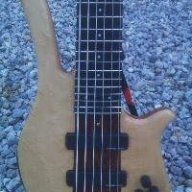
I can't imagine not using my B string. I usually play an octave lower on tunes in any of the keys of B to E and I use it for easier fingering on a lot of other tunes. It adds a lot more girth to songs usually played in C or D on the A string. Me love my B string.

I think the B string is used as a teaser to ripple your spine. You just don't want to over use it. When you drop that B it wakes people up. like rich chocolate, you don't eat the hole box.

The whole string? It doesn’t feel or sound that great past the 8th fret
I think that's more to do with strings and setup and maybe personal preference than anything else. I doubt I'd ever choose to hit mine at the 24th fret, but I use it at and slightly above 12 pretty regularly.
My next show isn't until January but you're welcome to come check it out!
Ha! Trust me, I have seen a ton of guys that use the low B,...particularly in metal. And I've seen plenty of Phil Lesh types that go to the low B once in a while. But, outside of that, I am seeing a lot of players that almost never touch it. I have been finding myself watching guys now and going "what's the point, he could have done the same thing with a 4 string". "Does he just like how the wide neck looks, because he isn't even touching that string". Even 6 string players, seems like I see the high C getting way more use.
....but, maybe that is just my brain focusing on the high C, because I occasionally play with a high C, and therefore I am trying harder to cop what they are doing on that string?


