• TalkBass has been independent since 1998. Add your voice.
    Create a free account to reply to discussions, view embedded media, and browse with fewer display ads.
    Join freeLog in
    Want zero display ads or expanded classifieds tools? Compare plans.

Why do so many 5 & 6 string players NEVER use their low B?

Because the upright, dog-house bass originally had four (4) strings as was designed as an extension of the violin, viola and cello.


3 strings were the norm before about 1900. There are honest debates as to whether the Bass is more of a viol family or violin family instrument. It doesn't follow the geometry of the other instruments in the violin family very closely.
 
  • Like
Reactions: SiliconElle
Ever watch Ross Valory of Journey He plays a four-string bass, but it's tuned B-E-A-D. He goes lower than E occasionally, but mostly he just plays higher on the neck, where the frets are closer together. I'd presume that lets him get around the "shorter" E-A-D strings a little faster, without stretching his left hand quite as much ... and that sounds like a good thing to me. Does he miss the G string? apparently not, on Journey songs. I'd consider doing the same thing, if I had a spare bass and was willing to recut the nut.
 
  • Like
Reactions: murph7489
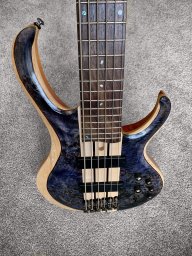
congrats on your new 5 string instrument! (pics would be nice!) and good luck with your low B! :thumbsup:

Thanks! I'm actually enjoying the low B on this bass much more than my previous 5 strings. I'm trying to employ a lot of the B string technique that's been discussed here.

My first headless bass, 35" scale:
20191220_084601_resized.jpg
 
But at the end of the day... WHY do you care what I’m doing??? Do your thing. Others will do theirs.

One of the best ways to learn is to ask others about their personal experience.

If you choose not to share your experience and philosophies, that is fine. But, as you can see by this thread, many are glad to share their experience and perspectives. From those people, I gratefully learn.
 
/because the

---------------
Because the upright, dog-house bass originally had four (4) strings as was designed as an extension of the violin, viola and cello. Anymore than (4) strings is heresey re: Mozart, Beethoven, Wagner and other classical composers. If a bass player cannot get to the notes he/she needs by downtuning, drop tuning or going to another octave the creativeness of that player is hindered.
Actually the double bass is in a different family from violin, viola and violoncello, and is not an “extension” of the other three. Look at the body shape. It’s different from the other three on the upper bout. It also employs tuning in fourths rather than fifths. The bass is in the viol family. The others are in the violin family.
 
Actually the double bass is in a different family from violin, viola and violoncello, and is not an “extension” of the other three. Look at the body shape. It’s different from the other three on the upper bout. It also employs tuning in fourths rather than fifths. The bass is in the viol family. The others are in the violin family.
Although early ones were basically converted violones, the modern double bass is descended from both the viol family and the violin family.
 
5-stringer checking in belatedly. No 4's among my collection.

Just finished practicing "Runaway Baby". You gotta drop the octave for the pre-chorus to get that growly low version of the riff on the Ebm chord. Can't make that sound right on a 4!

Also, I NEVER ever learn a song using an open string because a) the open string has a different sound to a fretted note, and b) when the vocalist asks you to take it up (or down) 2 semis, I don't want to have to re-learn the song!
 
5-stringer checking in belatedly. No 4's among my collection.

Just finished practicing "Runaway Baby". You gotta drop the octave for the pre-chorus to get that growly low version of the riff on the Ebm chord. Can't make that sound right on a 4!

Also, I NEVER ever learn a song using an open string because a) the open string has a different sound to a fretted note, and b) when the vocalist asks you to take it up (or down) 2 semis, I don't want to have to re-learn the song!
Except that open B! :)

My 6 ha a zero fret. The opens sound real close to fretted. It’s a nice touch. But I usually opt for fingerings in the middle of the fretboard, and the extended scale keeps me from having to shift.
 
I use it a lot and it's rarely in the low end. Most bass players don't "get" that the B string is less about going below the E than making it easier to move *across* the fingerboard. It's a huge help playing in oddball keys. Most players never get past the idea of the E string being home base.
Wait! Are you telling me I can play my B string ABOVE the fifth fret?

Wow, that opens up all kinds of new possibilities.:D
 
  • Like
Reactions: DrMole and Humbled
Although early ones were basically converted violones, the modern double bass is descended from both the viol family and the violin family.

Yes this - there are elements of both VIOLIN AND VIOL families in the double bass. It's like a manly violin and a sexy little viol had a romantic encounter and we ended up with a very large developmentally disabled love child.
 
My 2018 Warwick $$ 5-string has adjustable string width, plus/minus about 1mm. The A doesn't move, the E and D move 1 mm, and the B and G move 2 mm. Total change is plus 1 mm between each string. It does make it feel different. I have tried it and personally didn't 'like' it. I could have played it but it just didn't feel right. Oh, my Warwick is about 10 lbs. Heavy - I guess it is - I"m used to it so I don't mind. Also, I sit during Sunday services so the weight doesn't matter then. And to the above comment about playing the low B above the fifth fret - I do it all the time. Feels fine and sounds fine. You can do it - you can do it! You have my permission.
 
5-stringer checking in belatedly. No 4's among my collection.

Just finished practicing "Runaway Baby". You gotta drop the octave for the pre-chorus to get that growly low version of the riff on the Ebm chord. Can't make that sound right on a 4!

Also, I NEVER ever learn a song using an open string because a) the open string has a different sound to a fretted note, and b) when the vocalist asks you to take it up (or down) 2 semis, I don't want to have to re-learn the song!

I use open strings interchangeably with fretted notes. Again, it's about control.
 
I've been playing with the low B for hours today. One thing that is tripping me up is that I have been anchoring my thumb on pickups since I was a kid, and I find you can't do that with the low B. You have to use the low B as a thumb anchor when playing on the other strings, or else you get a constant low resonance rumble out of the B string (only noticeable at higher volumes). This kinda sucks when your spent 30+ years using pickups as thumb anchors.

I find myself constantly thumb jumping from: pickup-to B string-back to pickup-back to B string-etc.etc.

Is this normal? I don't find this at all necessary when playing a 5 string tuned E-A-D-G-C
 
I've been playing with the low B for hours today. One thing that is tripping me up is that I have been anchoring my thumb on pickups since I was a kid, and I find you can't do that with the low B. You have to use the low B as a thumb anchor when playing on the other strings, or else you get a constant low resonance rumble out of the B string (only noticeable at higher volumes). This kinda sucks when your spent 30+ years using pickups as thumb anchors.

I find myself constantly thumb jumping from: pickup-to B string-back to pickup-back to B string-etc.etc.

Is this normal? I don't find this at all necessary when playing a 5 string tuned E-A-D-G-C

Muting problems.

Now you're ready for floating thumb. Basically...

Anchor your thumb on the pickup to pluck the low B.

Anchor your thumb on the B to pluck the E string.

Anchor your thumb on the E to pluck the A string.

And so on. Once you get in the habit of this you won't even think about it. And you'll find that when you go to the higher strings you can mute multiple strings with your thumb.

If you're plucking the D string you can mute the A string with the tip of your thumb and the E with the side of your thumb at or near the joint). It gets easier the more you do it.

I also use a relatively flat fretting hand so I can do a lot of muting with my left hand. Combined with my right hand muting I have a ton of string control available.

Bonus: I wear my bass at the same height seated or standing. Because of that I can use my final muting technique... my forearm. It allows me to get a palm mute vibe while not tying up the side of my hand, allowing me to pluck normally. It also allows me to vary how much I can choke the B string so I can go anywhere between wide open and a percussive ghost thump.
 

Latest posts