• TalkBass has been independent since 1998. Add your voice.
    Create a free account to reply to discussions, view embedded media, and browse with fewer display ads.
    Join freeLog in
    Want zero display ads or expanded classifieds tools? Compare plans.

Why do so many 5 & 6 string players NEVER use their low B?

I started to read through the first page or two of responses and unless I missed it I think there is one obvious answer atleast from my perspective).
Often the Low B doesn't sound great or feels sloppy to the fingers. I have owned and played 4/5/6 strings as well as 7 string fretless.
I currently play (when I play electric) a 5 string MTD Saratoga.
This bass is pretty nice, and when setup plays sounds and feels nice.
However on past 5 string instruments the Low B was hard to control (sloppy) and did not sound great in the first few positions on the neck. That was a problem because all the other strings sounded best in the "money" positions on the next. So while your playing and getting good sound on all the other strings in the first 3 or 4 frets, the Low B just wasn't as useful in those same locations on the neck. My current bass is relatively smooth and even but the Low B is dominatingly powerful. I suspect some EQ and volume adjustments can make this better. Maybe even a different choice of strings or just a different Low B string will remedy this. It's not that complicated but also not that simple. Having a Low B is valuable but at times its not as useful as it is just desirable.
Even the best dudes like Marcus, Stanley Victor etc etc play 5 or 6 strings but when its time to get down they grab their 4 string.
 
Last edited:
  • Like
Reactions: FullumMusic
Even the best dudes like Marcus, Stanley Victor etc etc play 5 or 6 strings but when its to to get down they grab their 4 string.
I don't know whether that's because of a "sloppy" B string because... well, there's a 4 string bass within pretty much every 5er or 6er out there. Maybe it's just their preference for thinner necks. You can always choose not to play the B string. It's possible.

(I'm Cpt. Obvious here because you played all these. But your last sentence is a total non-sequitur.)
 
First, let's establish that 5 strings are less about how low you can go and more about economy of motion. How about a descending run in some diva's preferred key of Eb? OP may not even be aware of a 5 string player moving *across* the board at the 12th fret so he thinks that most 5 string players don't use the B string. Since little of my time is spent playing I-IV-V quarter notes on the root, 5 string is my secret weapon, the reason my bass lines are clean and tasty.
 
There are plenty of songs where I won’t go below the A string especially if playing with an acoustic guitarist; many others i will. I don’t lose anything having the low B and I often use it doubled with its octave at the end of a song if nowhere else. And for many of the other uses mentioned previously.
 
If I’m playing a 5 or 6 instead of a 4, it’s probably because I’m trying to get a spot in the mix. That’s harder with “not-so-savvy” keyboard players stomping all over bass parts ( because they “ play in church” or “ by ear”). Not knocking church or playing by ear: I’m knocking keyboard players or dense charts where “ someone “ forgets that a bass player is present.

If I’m playing with a conventional 4/5 piece guitar based band, I’m less likely to even take anything but a 4 with me unless something specific is going to need a certain critical extended range.

That’s just me: do what you’re comfortable with. If I only had one bass, it’d probably be a 5, but doubt I’d get on the B during a Rolling Stones or Beatles number. You can laugh at or with me, if you want, but I’m still trying to figure out why I’m occasionally playing a gorgeous custom Brewbaker Malcolm Hall 6, except: (1) I like it’s sound and ( 2) I got a killer deal on it ! My regular band mates groan when I pull it out and I sure ain’t taking it to a blues jam!
 
In those 52 years have you noticed many guys like I've shown in those videos? Guys playing 5 strings that never even touch the B string once? Because they aren't a rarity. Maybe not the norm, but not rare either.
No, but I imagine there are songs I don't play many---or maybe even any---B string notes on. Probably the same with the G string.
And, as I'm typing this response, it occurs to me that I probably won't use the Q or Z keys on my keyboard. (Crap -- I just used 'em!)
Or my 00 key on the ten-key ... Or 10% of the apps on my cell phone. Or 95% of the channels on my TV.

Guys -- I think we're onto something here!!
 
On a bass you have a set of notes and positions where you can play those notes. On a 5 string you have more notes and more positions. There are no downsides to having more choices.

Why not play a 5 string bass on Beatles and Stones songs? What does it matter what gear was used on the original? "You can't play a Beatles song unless you have a Vox back line" makes as much sense as, "They used 4 string basses for those songs, so that's what we'll do". Did anyone tell Paul McCartney that he shouldn't be playing Beatles songs in Wings on his Wal 5 string bass? He only stopped playing the Wal because of the weight, not because he was breaking a rule!!

We have enough hurdles to jump over, and hassles to overcome, when trying to play a bass, play in a band and play gigs, for us to be inventing more restrictions to place on ourselves.
 
Why not play a 5 string bass on Beatles and Stones songs?
.

There is no reason not to. But if you only play songs that require only 4 strings I don’t see a point of using a 5 string. You only make it harder for yourself because you need to be extra careful about muting.

Also if you never use the B string I don’t see the point of having a B string. That string is there for being used.
 
  • Like
Reactions: Watchootognbout
The 5 string has become my main instrument because I really like the sound of this particular bass. I don't always use the B string. But I'm not switching to a 4 string if I don't need the B on a song because that would mean dealing with a bass that sounds different. Perhaps those players got attached to how their 5 or 6 string sounds and feels and don't mind about using it on a tune that could be done on a 4 string bass.
 
My No.1 use for a 5 string is the low Eb - usually when playing with horns or when adapting for vocal range. 4 string means you get stuck with those two awkward Ebs

Sure, there’s the power of the B - D notes but they need decent context to sound right. That means that often I might not play the B for a bit. The other use is when I’ve been caught up the neck - there are great low notes to get out of jail.
 
There is no reason not to. But if you only play songs that require only 4 strings I don’t see a point of using a 5 string. You only make it harder for yourself because you need to be extra careful about muting.

Also if you never use the B string I don’t see the point of having a B string. That string is there for being used.

If you only want to play 4 string basses then that is a perfectly good choice.

The context of my comment was someone saying they wouldn't use a 5 string bass for Beatles songs, but if you are using a 5 string bass anyway there is no problem using it on Beatles or any other songs.
 
  • Like
Reactions: Les Fret
In those 52 years have you noticed many guys like I've shown in those videos? Guys playing 5 strings that never even touch the B string once? Because they aren't a rarity. Maybe not the norm, but not rare either.

I haven't noticed the trend you cite, but that may say more about me than it does about you; I'm old and likely listen to different music than you do. It could also be a case of confirmation bias on your part. Who knows?

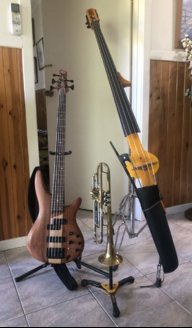
Although I have about a dozen basses, I almost always grab one of the same two basses when called for a gig; a double bass, or a five-string electric. My reason is simply that I am more comfortable playing these two basses "for the money" than any of the other basses I own. They are like the hiking boots that fit me well and save me from foot pain on long hikes. They are predictable and versatile. They get the job done in a way that allows me to focus on the music instead of the instrument.
 
  • Like
Reactions: Les Fret