• TalkBass has been independent since 1998. Add your voice.
    Create a free account to reply to discussions, view embedded media, and browse with fewer display ads.
    Join freeLog in
    Want zero display ads or expanded classifieds tools? Compare plans.

Why do the session legends all use P basses? (SBL Video Discussion)

"Sorry, you're going to have to rewrite the lyrics of your song ; I can't get hard consonants, or plosives to work in a mix".

I was in a session where the producer asked the songwriter to change a word in his song because of a consonant sound and the way it made the phrase sound... something or other like that.
They discussed, and the songwriter kept it as he wrote it.

That producer liked my Jazz Bass. I had a few basses i brought with (not including a P), and we talked about them. He basically told me, a jazz or p bass and you are good to go.

I used my jazz on 8 tracks, and a short scale hollow on two tracks.
 
Standard SBL video "script" goes something like this: "Here I am just getting home from the shops. Now here's my daughter - say hi to the viewers. Now I'm going into the kitchen. There's my wife doing something or other. Now I'm in another room and I've actually picked up a bass, but wait: my kid wants to watch TV in here, so let's go into yet another room where, OK, now we can actually talk about the thing the video title said we'd talk about. Wait, I forgot something, let me get it. OK, seems we're at the five-minute mark, so *now* we can talk about bass."

At that point there often is some useful information.


I don't bother watching the ones with over-the-top click-bait type titles. Obviously five-string and fretless don't suck, even when combined in one instrument, and obviously he's not really going to make that claim once he gets into the details.

So do *all* session legends use P basses? Of course not. But I think it's fair to say *most* session legends have a P bass as an option.


I couldn't have possibly liked this summary any harder. Excellent description of his video format. Despite Scott being a very skilled player and conveying some quality information, I refuse to watch any more of his videos because of this exact formula. I used to enjoy some of his content, but he's essentially defaulted to Youtube's version of power chords with the gain turned to 11 and the mids scooped out.
 
I enjoyed the SBL video. Saw it yesterday.
The guy he interviewed was a pro, and I liked hearing his experience and perspective.

SBL had a video a while back with a lady bass player (can’t remember her name) and she talked about how she was a stingray player, and how she’s changed her tone over time. Also how when she got a gig with Lenny Kravitz, she had to switch to playing a jazz bass - I think.

Another good video with a pro, who I enjoyed hearing from.
 
I don't know if anyone has said this yet, but Jazz basses were invented in the 1960's, right? So why then, is there the constant statement that P basses were the only thing producers and engineers were/are used to? The jazz bass is almost as old as the p bass. Then you hit the 70's and 80's and all these great new basses were being made, etc. Its not like there was only the p bass for 40 years, and then boom, somebody tried bringing something different to the studio and got shot down. There are likely millions of records out there that don't feature a p bass. What about those? Serious questions, not trying to troll here.
 
Ignoring your hyperbole, what's your point here? If we're going to look to Leo Fender to see what is "right", well, he designed a number of different basses, so I guess he didn't think any one design was best for everything.

Right or wrong, I always looked at it as his design evolution. First the slab p (tele) bass, then the classic p bass, then the jazz bass, then the stingray, then the G&L stuff, etc. It seemed like he was always moving forward in bass design. Why wouldn't he keep designing, assuming he always thought he could come up with something better?
 
  • Like
Reactions: Clark Word
I enjoyed the SBL video. Saw it yesterday.
The guy he interviewed was a pro, and I liked hearing his experience and perspective.

SBL had a video a while back with a lady bass player (can’t remember her name) and she talked about how she was a stingray player, and how she’s changed her tone over time. Also how when she got a gig with Lenny Kravitz, she had to switch to playing a jazz bass - I think.

Another good video with a pro, who I enjoyed hearing from.

Gail Ann Dorsey. She also played with Tears For Fears and David Bowie. A fine example of how a pro adapts to the gig.

Rhonda Smith did a similar thing when playing with Prince. She came in with an MTD, Lakland etc. Prince liked the Lakland. But it wasn't long before Prince had her playing a Jazz.

I liked this video as well. He brought up Pino on D'Angelo's record as being a moment where the focus shifted, I thought that was cool.
 
I don't know if anyone has said this yet, but Jazz basses were invented in the 1960's, right? So why then, is there the constant statement that P basses were the only thing producers and engineers were/are used to? The jazz bass is almost as old as the p bass. Then you hit the 70's and 80's and all these great new basses were being made, etc. Its not like there was only the p bass for 40 years, and then boom, somebody tried bringing something different to the studio and got shot down. There are likely millions of records out there that don't feature a p bass. What about those? Serious questions, not trying to troll here.

Jazz basses have been around for a long time, but none of the studios I went into back in the day had them lying around as studio gear. The default was always the P, and it was there to be put into the hands of anyone who came in with a crap instrument. If you walked into that studio with a Jazz bass you might not have immediately been met with furtive eyerolls from engineers who were wondering if you were going to expect them to make a piece of crap sound good, because at least a jazz was also a known quantity. These were the days of incredibly shoddy knock-off basses with very poor components and horrible intonation, and I can only imagine the face palm reactions of engineers everywhere who were dealing with people who wanted to play those instruments in the studio.
 
  • Like
Reactions: dpaulb and Tony G
Of course, the people who are P bass players don’t have an issue with it, it’s no skin off their back. But not everyone likes P basses nor likes being told what instrument to play.

I agree that a simple bass part often works best!
I wouldn’t think of it as being told what instrument to play. It’s just a simple consequence of the type of instrument you’ve chosen. There aren’t a whole lot of harmonica players doing symphonic gigs. Your opportunities will be shaped by your choices. No bassoon players in metal bands as far as I know. I don’t mean that to be sarcastic and I realise it may. If your goal is to be a session player for other peoples projects then you will have to play the session game.
Where I come from there used to be an unwritten rule that you’d have a drink with the producers after the session or play tennis with them on weekends. If you didn’t, the session gigs would dry up after a while. It’s all a game - you have to learn more than how to play bass.
 
Last edited:
Imagine a sound engineer who could only make a Stratocaster work in the mix. And if anyone turned up with a Tele or a Les Paul or something... "Oh dear... How are we gonna fix that in the mix? Why can't you just play a Strat like all the other guys do?"

Now, how long would that engineer stay in business?
No sound engineer ever says that. He says "extra work needs some extra time and that takes money". Then everyone agrees that using the instrument that generates a sound fitting the mould is cheaper and no one cares for bass tone but bass players anyway.
 
Right or wrong, I always looked at it as his design evolution. First the slab p (tele) bass, then the classic p bass, then the jazz bass, then the stingray, then the G&L stuff, etc. It seemed like he was always moving forward in bass design. Why wouldn't he keep designing, assuming he always thought he could come up with something better?

in some indirect way, this thread is a bit of a reminder of the "retro trend" among the bass community thats been going on for about ten years --- I grew up in the era where the bass guitar instrument was still evolving -- tones were getting away from fundamental and going stringy, more articulation and 'cut' by using multiple pickups (even Precison players back in the 70s were adding Js to the bridge for more modernized articulation which started the whole PJ thing to begin with), active electronics came about and started evolving, roundwound piano-like strings........somehow, in the last ten years, the bass community (at large) started devolving: passive basses came back more in demand, player's electronics are going back simpler (theres plenty of threads on TB over the past few years about folks turning their actives off and just playing their Sires or G&Ls in passive mode), less pickups, flatwounds and tapewounds became trendy (stores couldnt give those away in the 80s or 90s), and even shortscales are on the rise......because there is no such thing as right or wrong concerning taste and trends are just what they are, I keep this huge paradigm shift in mind when these types of threads appear
 
Last edited:
Some sound engineers are lazy, a P is easy to work with.
They are appreciated for being efficient. The less work they have to do, the more output they can create. Hard work is not a value to those who pay for it.
A P-bass is not easier to work with, it is ready to work with because it is omnipresent. It's the one they worked with yesterday, so they don't have to change anything when it is used today.
 
Gail Ann Dorsey. She also played with Tears For Fears and David Bowie. A fine example of how a pro adapts to the gig.

Rhonda Smith did a similar thing when playing with Prince. She came in with an MTD, Lakland etc. Prince liked the Lakland. But it wasn't long before Prince had her playing a Jazz.

I liked this video as well. He brought up Pino on D'Angelo's record as being a moment where the focus shifted, I thought that was cool.

Yes! Gail Ann Dorsey. Great interview. I really enjoyed that one.

I also liked hearing (in both interviews) about how tone and style have changed over time. Like the Pino/ D’Angelo example.

They also make the point that even though style and tone have changed over time, the P Bass has been a constant that has never gone out of style.
 
Jazz basses have been around for a long time, but none of the studios I went into back in the day had them lying around as studio gear. The default was always the P, and it was there to be put into the hands of anyone who came in with a crap instrument. If you walked into that studio with a Jazz bass you might not have immediately been met with furtive eyerolls from engineers who were wondering if you were going to expect them to make a piece of crap sound good, because at least a jazz was also a known quantity. These were the days of incredibly shoddy knock-off basses with very poor components and horrible intonation, and I can only imagine the face palm reactions of engineers everywhere who were dealing with people who wanted to play those instruments in the studio.

Indeed. Though it doesn't even have to be about "better", it can just be about having different tools for different jobs, or different options for the same job for people with different tastes.

in some indirect way, this thread is a bit of a reminder of the "retro trend" among the bass community thats been going on for about ten years --- I grew up in the era where the bass guitar instrument was still evolving -- tones were getting away from fundamental and going stringy, more articulation and 'cut' by using multiple pickups (even Precison players back in the 70s were adding Js to the bridge for more modernized articulation which started the whole PJ thing to begin with), active electronics came about and started evolving, roundwound piano-like strings........somehow, in the last ten years, the bass community (at large) started devolving: passive basses came back more in demand, player's electronics are going back simpler (theres plenty of threads on TB over the past few years about folks turning their actives off and just playing their Sires or G&Ls in passive mode), less pickups, flatwounds and tapewounds became trendy (stores couldnt give those away in the 80s or 90s), and even shortscales are on the rise......because there is no such thing as right or wrong concerning taste and trends are just what they are, I keep this huge paradigm shift in mind when these types of threads appear

Wow! I got three amazing and rational responses! Thanks guys! There is hope for the future of talkbass! :D
 
  • Like
Reactions: LBS-bass
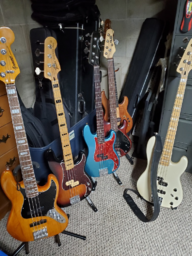
The P style bass has a natural sonic footprint. It sits in the mix of guitars, keys and drums without a whole lot of tweaking. Here you go Hennessy, Thanks!
PJNatural.png
 

Attachments

  • WP_20181225_003.jpg
    WP_20181225_003.jpg
    515.9 KB · Views: 18
  • PJNatural.png
    PJNatural.png
    10.4 MB · Views: 31