
Careful for the grammar police. I own too many basses, because of a period when I just went nuts, and could afford it. No valid reason other than that. But I tried to tell myself that I needed all of them. Now, after collecting over 20 very nice basses, I realize I play exactly one of them. I never touch the rest of them, nor do I desire to. So, I wait patiently for the economy to improve, and will sell all of them except for one vintage jazz and one vintage precision, both of which will go to my kids.

Enjoy the benefits of a premium membership!
Upgrade Account
-
TalkBass has been independent since 1998. Add your voice.
Create a free account to reply to discussions, view embedded media, and browse with fewer display ads.
Join free Log in
Want zero display ads or expanded classifieds tools? Compare plans.
You are using an out of date browser. It may not display this or other websites correctly.
You should upgrade or use an alternative browser.
You should upgrade or use an alternative browser.
Why do you own more then one bass?
- Thread starter ics1974
- Start date
More options
Who Replied?

Ric5
Inactive
- Jan 29, 2008
- 29,772
- 30,452
- Disclosures
- I like 5, 8, 10, and 12 string basses
Why do you own more then one bass?
--------------------------------------------------------------------------------
Because I can
--------------------------------------------------------------------------------
Because I can
Different values (an Alembic isn't a dive bar bass)
Different concepts (a fretless is not a fretted)
Different sounds (a hollowbody is not a solid body)
Different spectral range (an 8 string (doubled) is not a 4 string)
Different look (a new Carvin has not the same mojo as a true relic)
Different note range (a 7 string has more notes than a 4 string)
Different strings (Flats don't sound like rounds)
Different colors/finish (Coffee table bass has different look from black paint)
Different pickups (Soapbars not the same as true single coils)
Different string spacing and neck profiles (G&L chunky not same as Ibby neck)
And so on. And of course different tones, tunings and keeping them at different locations is in there too.
Try explaining that logic to my wife....

I owned several basses until today, because I couldn't decide which one I wanted to play. Now I have only one. Well, I have another one but I'm keeping it so I can learn to soldier pickups & stuff.

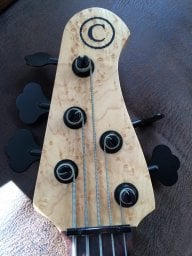
#1 - Fretted 5 bolt-on, active/passive, soapbars, ebony board, mahogany/koa, rounds. Most modern sounding, great axe. To me, too valuable to take to certain gigs or to fly.
#2 - Fretted 5 bolt-on, active/passive, same model but "Japanese" rather than US, alder/morado, Nordstrand big single pickups, TI Jazz Flats. Used in passive mode about 85% of the time. I'm OK using this in pretty much any context, and it sounds great in virtually all contexts - can't go wrong with it, anywhere (yes, I don't slap much).
#3 - Fretless 5 neckthrough, lined, rounds. P/J, Active only.
#4 - Fretless 4 neckthrough, unlined, flats. Reverse P/J, Passive only.
Truth be told, I could probably do everything I'm interested in with #2, and most everything with either #1 or #3. #4 is on the scene because it's hip, I got it cheaply, and I'm exploring whether I really want/need lines on the fretless. I also like having flats on it so I can cop more of an upright bass sound.
But the basic idea is to cover anything I'm likely going to do with a mix of frets/fretless, soapbar/single-coil, flats/rounds, and option of active or passive on the two fretted axes. Otherwise strongly committed to 5-string. And I'm not in a context where I have to slavishly seek a "P" or "J" sound or look, but can otherwise maximize for what I want to hear.
During a gearhead phase I've had as many as 7-8 basses in the house, and I've been through about 40 instruments in the last seven years, but this current stable promises to be pretty stable - #2 has been my main axe for most of the last 4 years, with incremental changes.
If push came to shove, could live with #2 and #3 only. If could have only one, would go with #2. This bass is dramatic proof that Sadowsky's Japanese "Metro" axes are just as good as the NYC axes, unless you need lighter weight or custom look/features.
#2 - Fretted 5 bolt-on, active/passive, same model but "Japanese" rather than US, alder/morado, Nordstrand big single pickups, TI Jazz Flats. Used in passive mode about 85% of the time. I'm OK using this in pretty much any context, and it sounds great in virtually all contexts - can't go wrong with it, anywhere (yes, I don't slap much).
#3 - Fretless 5 neckthrough, lined, rounds. P/J, Active only.
#4 - Fretless 4 neckthrough, unlined, flats. Reverse P/J, Passive only.
Truth be told, I could probably do everything I'm interested in with #2, and most everything with either #1 or #3. #4 is on the scene because it's hip, I got it cheaply, and I'm exploring whether I really want/need lines on the fretless. I also like having flats on it so I can cop more of an upright bass sound.
But the basic idea is to cover anything I'm likely going to do with a mix of frets/fretless, soapbar/single-coil, flats/rounds, and option of active or passive on the two fretted axes. Otherwise strongly committed to 5-string. And I'm not in a context where I have to slavishly seek a "P" or "J" sound or look, but can otherwise maximize for what I want to hear.
During a gearhead phase I've had as many as 7-8 basses in the house, and I've been through about 40 instruments in the last seven years, but this current stable promises to be pretty stable - #2 has been my main axe for most of the last 4 years, with incremental changes.
If push came to shove, could live with #2 and #3 only. If could have only one, would go with #2. This bass is dramatic proof that Sadowsky's Japanese "Metro" axes are just as good as the NYC axes, unless you need lighter weight or custom look/features.


Because the do different things well. If I can get away with it, I rock my USA Jazz for pure comfort and slapability. Most gigs I use the 5 string, which is the main axe, and I have an electric upright for the 1/4 of each set that needs it.
Do you need say, eight 5 strings? Probably not; but to a bassist, more is always better
Do you need say, eight 5 strings? Probably not; but to a bassist, more is always better
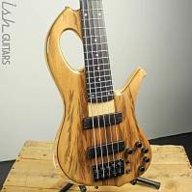
My wife keeps asking that same question everyday... :sly:
Fell free to use my standard reply: why do you own more than one purse?


Fell free to use my standard reply: why do you own more than one purse?
I love free falling. I fell free just today.
Wow, this thread delivers.
Because Essex's are cheap and can be really, really good.
Excellent platform if you want to learn how to work on your own stuff; ie: change finishes/color, swap out pups, necks, bridges etc, without blowing a bunch of cash.
Plus different tunings.
My main is a modified Fender Jazz; though I have an Essex SJB 75 (Jazz bass, natural body finish, maple neck w/ black blocks) that I've tuned BEAD for some grungy stuff we do. Growls for days.
To have a P in the stable, (to understand what that's all about).
Excellent platform if you want to learn how to work on your own stuff; ie: change finishes/color, swap out pups, necks, bridges etc, without blowing a bunch of cash.
Plus different tunings.
My main is a modified Fender Jazz; though I have an Essex SJB 75 (Jazz bass, natural body finish, maple neck w/ black blocks) that I've tuned BEAD for some grungy stuff we do. Growls for days.
To have a P in the stable, (to understand what that's all about).


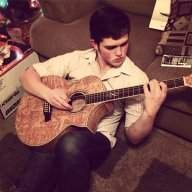
I own two. One is a Fender Mexi-Jazz and the other is a Squire P. I don't think ever part with the P, since it was my first bass and I tend to hold onto my "firsts." But the Fender serves as my main. I usually only have my fender with me as well as two older sets if spare strings if needed. However, if it got too the point where I would be playing and broke a string, I would like to have the spare be ready to go so I could make a seamless switch as opposed to having to stop the song, swap strings and restart. Having the second one is nice too because as of most days of the year, my jazz bass is locked at my school, so it's pretty convenient have the other when I'm not at school.

Bought an acoustic (EAB) in the hopes that I would play more at home. I did, but for shows the pickup didn't cut it. So, after borrowing for a few performance runs, I bought my first Fender. Now, I keep the acoustic at our rehearsal room, and it's perfect for unamplified singing. I practice with the electric at home, and bring it in when we get to the theater.
Me personally, I own two because one has a more well rounded tone for the various covers my band plays. The other is the tone that I would want if/when I decide to start a band of my own. At that point, I'm not trying to cover a lot of tones, I'm only trying to add "my" tone...


