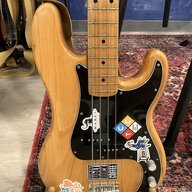
A lot of great advice in this thread, but I also wanted to add that you have a great sounding bass!

TalkBass has been independent since 1998. Add your voice.
Create a free account to reply to discussions, view embedded media, and browse with fewer display ads.
Join free Log in
Want zero display ads or expanded classifieds tools? Compare plans.

Do you have anything you can rub in front of the DI?
 )
)

I agree with this. A parametric eq is great for moulding tone. And never have to replace 'bad' pickups again.I'm going to sound like a broken record with my recommendation…try a para eq pedal. A para eq pedal can reduce dominant unwanted frequencies while boosting desired frequencies that are lacking. You'll be surprised by how much you can alter the tone of an instrument.
But…if you want to go with just the stock instrument, you really have only two options.
1) Adjusting pickup balance, height , etc.
2) Experiment with different strings.


I know this is a typo, but i love the visual so much i'm adopting the term.
"Don't like your tone? What are you rubbing it with?"
"Have you tried rubbing with a QStrip?"
"I'm having an issue rubbing my signal with the Cali76. Does anyone have suggestions?"
(Yes, i understand this is skirting the line between funny and a call from HR, but i like to live dangerously.
This right here. Unless you're only going to be playing solo bass, it's all about the bass in a mix. I bet in a mix with drums, guitars, keys, whatever, just standard-fare bass processing i.e. a little compression (mix-dependent on how aggressively to compress of course) and if needed a little EQ to taste (to dovetail with the drums, etc - also mix-dependent) and that DI'd bass will sound great and do its job.That is the sound of a direct recording of an electric bass. It's pleasing but a bit sterile.
Add some compression and Eq and you will get very nice sounding tones that will sit in a mix nicely.
Want more character? Use and amp modeler or record a mic'ed amplifier.
Add some harmonic distortion, or over drive for thicker tones.
You might a add an EQ, medium Q @500hz if you want some midrange beef.
Nothing wrong with the sound of you pickups, its up to you make some creative choices on how to enhance the sound to work for your application/genre/style.
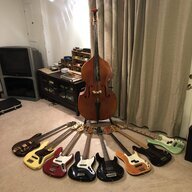
Strats and Teles of different ages/eras/years sound different even if on their face or spec sheet saying they are specified the same. No reason to believe this phenomenon doesn't accrue to all types of Fender basses too.A while back I bought a secondhand made in japan geddy lee jazz bass, and it plays well but after a while I realized that it sounds quite different from the previous one I used to have years ago. That one sounded great, it had the midrange that a typical geddy lee or 70s jazz does. While this one resonates better than the old one I had, this one sounds glassy and quite scooped, it lacks the midrange presence and warmth that pretty much every other geddy lee sig has that I've heard. I'm confused by this since everything is original on it, pickups and electronics, and I'm aware that small fluctuations in sound are normal even between identically built basses but this is more than that to my ear.

When I had a CIJ Geddy (incidentally, the last Jazz Bass that I owned) I put Model Js in it.If you want a very mid-heavy sound hard to beat the Model J


Perhaps because the bridge pickup is a bit low, reducing output? Noticed that too...What I find odd about the sound samples is that the middle positions doesn't sound "different enough" from the neck position. It's almost like an active bass. The resonance peak should shift more when you have both pots open.
(I realize you don't have active pickups in there)

Perhaps because the bridge pickup is a bit low, reducing output? Noticed that too...