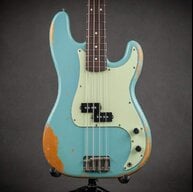
If a bassist brags about his bass, without a sound demo, does it make a sound?
Oooooh! Can anyone take up that gauntlet?

TalkBass has been independent since 1998. Add your voice.
Create a free account to reply to discussions, view embedded media, and browse with fewer display ads.
Join free Log in
Want zero display ads or expanded classifieds tools? Compare plans.
If a bassist brags about his bass, without a sound demo, does it make a sound?

I have seen those MIM '50s P Basses cited as good basses for the best part of two decades online. I've seen them cited as a step up from regular MIM P Basses and, even, the first tier of workable, good-out-the-box Fender basses, leading into the MIJ and MIA ranges.
I think having a chunky maple neck helps those basses along. They are stable, rigid necks and I think this influences the tone of these basses in a positive way. I doubt the anodized pickguard imparts anything into the mix, and I bet the bodies and electronics are stock MIM gear, unless the pickup specs are tweaked subtly.

Sitting well in the mix is a funny thing. Agreed that the P is always a good bet. Sometimes though I think I find the pb tone 'indistinct.' Not sure if that makes sense.I have three great basses in my stable:
1996 Carvin BB70 all Koa body with ebony board.
1999 Sector Q4 with EMG soap bars
2017 MIM Fender Classic 50's P-bass black lacquer, gold anodized PG and maple neck
In my studio, the Carvin and Spector sound great, but out on the gig there's no balls.
The P-bass on the other hand sounds great in my studio, and blows me away on gigs.
The Koa Carvin is so light, and I would prefer to play it because of that fact. The spector and my P-bass weigh the same.
I feel like I should just get rid of the carvin and the spector since the P-bass does everything better.
Anyone else have these same thoughts about their own bass collection?
 Depending on the genre, a jb, mm, or soap bars sit in the mix quite well, if EQ'd properly, with more 'character' than a pb. Sometimes I prefer that. Other times, only a pb will do. Genre and EQ are as important as the pickups.
In my experience with P basses, it's because you've got a good sounding pickup, that's put slap bang in a position that just works in a band mix.
Opinion is subjective & it’s your bassI have three great basses in my stable:
1996 Carvin BB70 all Koa body with ebony board.
1999 Sector Q4 with EMG soap bars
2017 MIM Fender Classic 50's P-bass black lacquer, gold anodized PG and maple neck
In my studio, the Carvin and Spector sound great, but out on the gig there's no balls.
The P-bass on the other hand sounds great in my studio, and blows me away on gigs.
The Koa Carvin is so light, and I would prefer to play it because of that fact. The spector and my P-bass weigh the same.
I feel like I should just get rid of the carvin and the spector since the P-bass does everything better.
Anyone else have these same thoughts about their own bass collection?
P-Bass tone is pretty much what was heard on almost all hit songs from the 50’s to at least the 90’s. Kinda’ explains why it’s a popular tone…..I have three great basses in my stable:
1996 Carvin BB70 all Koa body with ebony board.
1999 Sector Q4 with EMG soap bars
2017 MIM Fender Classic 50's P-bass black lacquer, gold anodized PG and maple neck
In my studio, the Carvin and Spector sound great, but out on the gig there's no balls.
The P-bass on the other hand sounds great in my studio, and blows me away on gigs.
The Koa Carvin is so light, and I would prefer to play it because of that fact. The spector and my P-bass weigh the same.
I feel like I should just get rid of the carvin and the spector since the P-bass does everything better.
Anyone else have these same thoughts about their own bass collection?
Don't almost all Fenders have a maple neck?2017 MIM Fender Classic 50's P-bass black lacquer, gold anodized PG and maple neck

Amen to all of this. But, for some reason, I just don't like Js. Wish I did, but I can't bond with them. I own every thing from a Harley Benton to Fodera. I even have a Dano Longhorn because it looks so different and cool.Same. But, the look of a vintage J sure is attractive. If a bass looks beautiful, I'm more likely to play it. And, I'm a firm believer that a bass player worth their salt can get their sound out of any bass, usually with just hand positioning & volume and tone knob tweaks. And those that say they don't care how a bass looks?? Come on! We're in the entertainment business! Play beautiful instruments! People in the crowd appreciate it. When I leave my flashy basses at home, I always get asked by audience members where they are and why. Life is too short to play boring or ugly basses.
Yes, psychoacoustics is realWe also can't negate how the feel of an instrument affects our perception of how it sounds. If a bass feels like a cactus in our hands, we'll perceive it sounding worse than it actually does. Where as, if a bass feels like our favorite comfy lounge around the house clothes, we'll swear that it sounds better than reality.
This may be true up until the mid to late 70s. By the mid 70s, brighter and stringier with more articulation was the up-n-coming flavor cemented in the 80s. P-Bass players were adding J position mods to their basses trying to roll with these changes and the PJ was born (unless if the P pickup is soloed, a PJ and P are not the same animal even if the PJ began life as a P). By the 80s (the overproduction era), folks were using rounds and trying to make whatever bass they had to sound like an Alembic and the single split P was just another color on the tone palette if the production goal was more classic (hair metal bands often recorded with straight Ps or PJs even if the video showed them playing a bass that looked like a ninja throwing star). I remember PJs like Spectors and Yamaha BBs were definitely in demand back then, but I also remember Stingrays were being favored in studios a lot at the time because of how they seem to sit phat on analog 2" tape. The genre was also important: late 70s/80s Dayton Style funk hits (Lakeside, Pleasure, etc) were mostly Jazz basses as one exampleOpinion is subjective & it’s your bass
P-Bass tone is pretty much what was heard on almost all hit songs from the 50’s to at least the 90’s. Kinda’ explains why it’s a popular tone…..


It's called midrange.


I hate P bassesSounds like you've discovered why everyone likes P basses.