• TalkBass has been independent since 1998. Add your voice.
    Create a free account to reply to discussions, view embedded media, and browse with fewer display ads.
    Join freeLog in
    Want zero display ads or expanded classifieds tools? Compare plans.

Why does my P-bass sound so good?

I have three great basses in my stable:

1996 Carvin BB70 all Koa body with ebony board.
1999 Sector Q4 with EMG soap bars
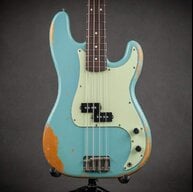
2017 MIM Fender Classic 50's P-bass black lacquer, gold anodized PG and maple neck

In my studio, the Carvin and Spector sound great, but out on the gig there's no balls.

The P-bass on the other hand sounds great in my studio, and blows me away on gigs.

The Koa Carvin is so light, and I would prefer to play it because of that fact. The spector and my P-bass weigh the same.

I feel like I should just get rid of the carvin and the spector since the P-bass does everything better.

Anyone else have these same thoughts about their own bass collection?
This is why I now own 3 p basses (1 fretted with flats, 1 fretted with rounds, 1 fretless with flats) and one jazz. I like to have a jazz for practice at home and when I don't have one I miss it. But honestly, I only need a p because it just works. You could score a lightweight Warmoth body and swap out the tuners and get to 8lbs. All of mine are a hair under 8lbs.
 
Last edited:
I think it's an accident.

The thing that seems to affect the tonal profile of an electric string instrument the most, to my ears, is the pickup - how it's made and especially where it's placed along the vibrating length of the string.

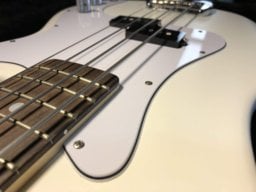
A Precision Bass has a single pickup positioned perfectly such that the result is a tone that occupies a predictable and controllable part of the sound spectrum and does not compete with the other instruments - guitar on the upper end and drums on the lower. Therefore, P basses seem to sound great with minimal fuss.

But I've not read that Leo Fender intended that, and based on his subsequent designs I can't think that he felt it was "superior."

And by the way I don't either. I don't actually think P basses sound as pleasing as other bass designs, but I do think they work more readily into a situation. This is why all of our sound engineers gripe when we show up with anything else - anything else makes work for them.
 
Last edited:
  • Like
Reactions: N Scott Shaw
Just a suggestion:
  • The great Rick Turner (Alembic, Gibson Labs R&D, etc.) used to have a Bass Magazine column.
  • He mentioned on more than one occasion that his favourite fix for affordable active basses, was to bypass the preamp.
  • In his opinion, the pickups were often better than the rest of the active electronics.
I know I'm in the minority on TB in this, but I've never been a fan of Carvin electronics.

I would try a minimally intrusive testing program, starting with this:
  • Disconnect the neck J pickup from the preamp on your Bunny.
  • Use test leads to connect a regular passive volume and tone harness to the output leads of the J pickup.
  • Plug that into your amp, and see how close you can get to your P-Bass in terms of a giggable tone.
If you don't like the Carvin pickups, there's no shortage of good Jazz and MM pickups out there.

I'm not a Music Man guy, but my favourite passive Jazz bass pickup is the Dimarzio Area J...
 
This is why all of our sound engineers gripe when we show up with anything else - anything else makes work for them.

Sound engineers, both live and the studio, always compliment my tone (even if Im playing my PJ Ibanez Destroyer like I did in Orlando a few months ago). What I do is setup my basses well and (most important) change strings very often so that they are as new as possible, no matter what bass I use. I also send them a clean DI with occasional sparse effects only used on select songs lkike fretless emulation (except compressor, which I use as a Limiter, and stays on 100% of the time). Everyones mileage may vary
 
Last edited:
  • Like
Reactions: One Way and in tune
Sound engineers, both live and the studio, always compliment my tone (even if Im playing my PJ Ibanez Destroyer like I did in Orlando a few months ago). What I do is setup my basses well and (most important) change strings very often so that they are as new as possible, no matter what bass I use. I also send them a clean DI with sparse effects only used on select songs (except compressor, which I use as a Limiter, and stays on100% of the time). Everyones mileage may vary
Nicely done!
 
As someone who mixed club rock shows for many years - I never had any negative or positive opinion about a bass someone brought until I head it. I've heard great Rics and dumpy Rics, lively and dull p basses, twonky and brilliant Js. Plenty of nice basses played indifferently and some players killing on cheapo gear.

Anyone who claims to be a sound guy and groans when they see something other than a P needs a kick in the nuts.
 
Anyone who claims to be a sound guy and groans when they see something other than a P needs a kick in the nuts.
This^^^
I have only once experienced a technician expressing his opinion of types of bass guitar.
Upon seeing me lift my Pedulla Buzz from it’s case, the engineer at a recording session said “The only thing I don’t like about actives is how hot they are into the board”.
After I plugged in, he said that my bass sounded really great, and there was nothing more said about it.
 
Basically, it's a combination of pickup location and simplicity:

Pickups closer to the neck sound fat and less punchy while pickups closer to the bridge sound thinner and punchier.
The P-Bass pickup sits right in the middle; not too fat, not too thin - punchy, yet still with some "bloom" to the notes.
Other pickups in that spot will sound pretty close to a P-Bass ('51 Precision, G&L L-1000, etc)

The other thing is phase cancellation - a bass with multiple pickups will have phase cancellation that scoops the midrange when those pickups are used together.

A split coil P-Bass has phase cancellation - but only between the two halves of the coil, which sense different strings, so the cancellation decreases noise without scooping the produced note.

That's the basic recipe - you can tweak it with string selection, body and fretboard woods, pickup selection and make it sound brighter, more thuddy, more open - but the basic sound of a P-Bass is a single split coil pickup in that spot.

If you want your other basses to sound closer to a P-Bass, turn their bridge pickups all the way down and just play with the front pickup.

It won't sound the same as a P-Bass, but it'll sound closer.
I've always wondered why split pickups are not more popular. They sound like single coils because each string is only picked up by one coil but they don't hum. Basically only the Fender XII and some G&Ls use them. I believe wide range humbuckers are basically that, also not popular.
 
I've been thinking about this since I got my MIJ P bass after years of PJs and similar and perhaps the real reason is that most of the music we love has been made with P's and J's (often the J's EQ'd as P's) and we're not hearing those tones as the instrument, we're hearing it as part of the structure and tone of the song and no matter how you build your technical and musical knowledge on top of your emotional response, those responses particularly your original ones, are the building blocks of your idea of what bass is and untangling that from your intellectual response is, well, nigh impossible. You've already made that choice. Having said that, you can still react to the individual instrument and its "take" on the sound .
 
I've never cared for my P-basses in a live context. Gets lost in a busy mix. I play hard rock so there's that. Maybe works if you're playing with quiet or clean tone guitarists. But heavy guitars I always dissapear.
 
I've never cared for my P-basses in a live context. Gets lost in a busy mix. I play hard rock so there's that. Maybe works if you're playing with quiet or clean tone guitarists. But heavy guitars I always dissapear.
Probably how you EQ.

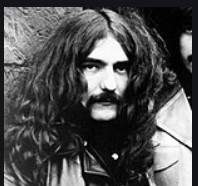
Harris and Geezer don't seem to have a problem, neither of those guys are playing with quiet, clean guitarists.

The list of P players in a loud rock context is long...