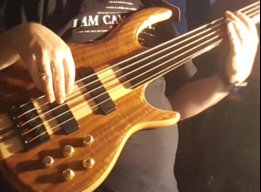
He does? Really?So why does Sadowsky use a triple or even a quad string tree on all of his basses?

TalkBass has been independent since 1998. Add your voice.
Create a free account to reply to discussions, view embedded media, and browse with fewer display ads.
Join free Log in
Want zero display ads or expanded classifieds tools? Compare plans.
He does? Really?So why does Sadowsky use a triple or even a quad string tree on all of his basses?

I think the more realistic view is it would be terrible judgement for a product manager at Fender to try to suggest changing the iconic Fender headstock.Niche market and I guess nobody is going to die because a company didn't properly address the correct string angle behind a fingerboard nut.
He does? Really?
View attachment 4162315
Sadowsky uses three and four string retainers on all of their high end basses.

No, tensile force can be measured as downward on the nut toward the slot as well. That’s just a literal interpretation of the word tension rather than a musician’s expectation of the vector being along the string length.No, not the same. Tension is along he axis of the string, it cannot be at right angles to it.

A 2012 Sadowsky and I'm "not with the times"? That's kinda funny.Is that one from 20 years ago? Get with the times, here's a link to their current offerings. Note the three string retainer!
[Invalid or Expired Link Removed]
A 2012 Sadowsky and I'm "not with the times"? That's kinda funny.
If you mean all current production Sadowskys then say so. But don't come on with schoolboy condescension for calling you on a blatant inaccuracy you threw in to support a weak argument....especially an argument about freakin' string retainers.
Jeez dude, consider the possibility that instead of fighting it you may be happier just living with the fact that not everyone shares your blazing passion for more efficient string trees. Your happiness is important to me.

You don't give a product returning 1000% profit away for free, you bump the guy who suggested it up a level.So it's super cheap to make and doesn't add much to the fixed expense of the instrument. Why not make it standard on every model it can accommodate and then market it for more sales?
They could eliminate even the placebo need for extra hardware by angling the headstock.

The problem is that the "musician's interpretation" gives rise to a lot of false ideas and claims. You don't increase tension on the nut by increasing tension on the string, you increase pressure. If you don't use the right word to describe something it can and does lead to lots of misunderstandings.No, tensile force can be measured as downward on the nut toward the slot as well. That’s just a literal interpretation of the word tension rather than a musician’s expectation of the vector being along the string length.
I owned an Alembic Elan Five that had an inline-style headstock, built, as all Alembics are, with an angled headstock. And as for as long as I owned it, it always felt just the slightest bit wierd to look down there and see a Fender-ish or Thunderbird style head . . . . . bent away from the fingerboard.

Not on all of them actually...So why does Sadowsky use a triple or even a quad string tree on all of his basses?

This thread is comical.