
• TalkBass has been independent since 1998. Add your voice.
    Create a free account to reply to discussions, view embedded media, and browse with fewer display ads.
    Join freeLog in
    Want zero display ads or expanded classifieds tools? Compare plans.

Why have a nice rig just to be run direct?

Status
Not open for further replies.
OK, so this 4th option...I'm sure it's "the bass player's sound sucks." But who decides that? The soundman or the musician? I keep going back to Fieldy on this because he's often considered to have a sound that sucks by most bass players and soundmen. But without that sound, it doesn't sound like Korn, and that's the sound Fieldy wants and strives for at all times. So a soundman should tell him that he's wrong just because he doesn't like it? Like I said, take it away and it's not Korn anymore.
 
OK, so this 4th option...I'm sure it's "the bass player's sound sucks." But who decides that? The soundman or the musician? I keep going back to Fieldy on this because he's often considered to have a sound that sucks by most bass players and soundmen. But without that sound, it doesn't sound like Korn, and that's the sound Fieldy wants and strives for at all times. So a soundman should tell him that he's wrong just because he doesn't like it? Like I said, take it away and it's not Korn anymore.

His sound fits though. The biggest sin I've always seen when I was behind the board were guys who's sound didn't fit or fit too well so to speak and got buried. Its normally a bigger problem with guitar and keys but bassist do it to. Lots of guys walk into gigs with sounds that sound good to them at home or at practice and it doesn't translate out front. Its just like lots of the isolated tracks you can find on youtube. People are always surprised at what their favorite lines sound like solo'd. Rarely is it what they had in their head.
 
The other night I was house sound for a gig that was one of the partial PA partial instrument amps for FOH. The biggest trouble I had was our own hand drummer. Great guy, but he seemed to think he needed 6 mics for his setup. He has a submixer and was sending just a single line to the board, but in this case there were multiple problems. He was using a couple really nice (and sensitive) condenser mics. They sound great for recording. For live, with mostly amps behind them pushing room volume? Not so much. Of course there was no convincing him that maybe 2 or 3 mics with a tight pattern would be a better choice. And because the condensers picked up everything, he was just not in the mix or monitors. Just couldn't get him loud enough without feeding back. The sub-mix is also a problem because I'm not sure he understands how to eq appropriately.

Second of 3 sets I convinced him to remove one of the condensers and use a 57 which was a big improvement over a 'really nice' mic.

...so sort of the same discussion, but for drums.
 
I could not disagree more.
With all due respect, likewise. :D


Like the vast majority of bass players, I'm not doing national tours with pro grade sound systems. I'm yet to find a provided system on the local level that has a spare parametric to assign to the bass guitar channel. So how is the system operator, with his 3 or 4 knobs, better able to EQ my bass than I am with the 6 bands (4 of which are semi-parametric) in my amp?

It's my job to make my bass guitar "fit the mix" with the other instruments. It's the system operator's job to make the entire system "fit the room".

If what I'm sending to the board doesn't "fit" with just minor tweaks at the board, we need to talk because one of three things is happening:
Room anomalies are causing me to hear something different than the operator is.
The system isn't set up properly.
The operator and I have very different concepts of what my "sound" should be.
I don't know that what I'm saying is very far from what you are suggesting. If the PA is well adjusted to the room, and the signal you are sending him already fits well in the mix, then the basic EQ adjustments on the board are likely enough to make the bass sit just were it needs to in the mix. Maybe a little dip or boost in two bands, three at most. Nothing major at all, but you want the sound guy to be able to skillfully do that at a minimum.

Still, you are very misguided here. There could be some more serious EQ'ing that needs to be done to make the bass and drums play well together given some room acoustics...even if the PA has been adjusted for the room. If you don't know or understand this, then no amount of explaining that I can do here in a thread will help with that. This becomes especially true in a venue where different bands come through. This should be readily apparent simply by the fact that all shows usually involve a sound check. There's a lot more going on with a sound check than just getting slider levels set. Adjustments are always made. There can often be huge issues with feedback that occur because of variances in the instruments being used. A certain mic that works well on a snare drum on one kit might have big problems fitting in with another snare a different band uses. A kick drum is too woolfy in the room and doesn't sit right with the bass. The list of potential variances goes on and on, and having a PA fit for the room doesn't mean you avoid all that.
 
Expensive means better.

I'm probably not a very sophisticated soundman, but generally I don't think of a wide pattern condenser has much use on a crowded stage at live band volume. Besides maybe throwing one or two up over the kit to add in just a touch of 'air' to the drum sound. Close mic'ed and tight pattern is what I want. We don't nor will we use any barriers for any of the gear. And I'm not one to get caught up in bleed...I like a bit of it to tie everything together and make it sound natural.

At one point I recorded a singer (in my last band) with a condenser for all his lead vocals. I used a crap-ton of compression on him too. Sounded great and he loved it and wondered why we couldn't do it live...and I showed him that you could hear me snapping my fingers loud and clear from 15 feet away...and that doesn't work on stage.
 
OK, so this 4th option...I'm sure it's "the bass player's sound sucks." But who decides that? The soundman or the musician? I keep going back to Fieldy on this because he's often considered to have a sound that sucks by most bass players and soundmen. But without that sound, it doesn't sound like Korn, and that's the sound Fieldy wants and strives for at all times. So a soundman should tell him that he's wrong just because he doesn't like it? Like I said, take it away and it's not Korn anymore.

That reminds me on a funny story in the very past. There is a very well known bass player in Germany who is known for his virtuous playing style. At the show I had some conversation with the sound engineer about the bass players playing style...
"...I'm not allowed to use a compressor insert, so I have to control his extremely dynamic levels with the channel-fader"

After the show ended I had a conversation with H***** H******
"...I dislike compressors because these kill my dynamic fashion how to play"
 
That reminds me on a funny story in the very past. There is a very well known bass player in Germany who is known for his virtuous playing style. At the show I had some conversation with the sound engineer about the bass players playing style...
"...I'm not allowed to use a compressor insert, so I have to control his extremely dynamic levels with the channel-fader"

After the show ended I had a conversation with H***** H******
"...I dislike compressors because these kill my dynamic fashion how to play"

Often times players get confused when it comes to compression and dynamics. Compression often can give the appearance of dynamics to players but in fact, true dynamics of un-compressed tone are not what that player REALLY wants. Its one of the reasons that tube amps are popular with guitar players.

The truth of perceived dynamics vs. the real thing can be a surprise to some. Often times, needing loads of compression may be the sign that a player needs to work on their technique.
 
By whose standards?
While I don't disagree that a compressor isn't always a sign of poor technique, sometimes it is. I see it all the time in the Technique forum..."My slap playing and my fingers playing are different volumes." "Get a compressor." Well, no ;) Work on your technique so that you can use them interchangeably without it. I can...everyone can if they work on it.
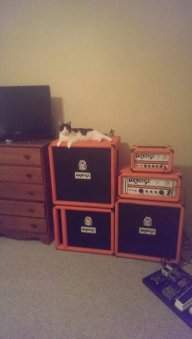
 
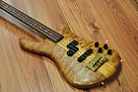
You know, if this thread proves anything it's that everyone has their own unique tone and a way of acheiving that tone for whatever style music they are making. You can talk about frequencies and room differences, but I think the correct answer to my original question (I'm the OP of this giant ass thread) is that I should have been more knowledgeable about why I needed to be mic'd and been prepared with a good mic of my own. Those are the variables in the situation that I can control myself. For me, my Spector is way too damn brittle and treble heavy by itself. I run everything full on the bass and adjust it on my amp based on what I hear coming out of the speakers. For someone that plays a passive P bass it may not be a huge deal to run direct, BUT FOR ME it is. I need to be mic'd. I've played 3 gigs since I posted this thread and I brought a mic to all of them, and guess what? I was mic'd at every show. Some were in larger venues, and one in particuar was at a very small room where the sound guy plugged in a DI when I was still setting up but had no problem using a mic once I explained to him how I got my tone, and everything sounded great. Both the other venues, which were bigger, used a mic from the get go. So the argument that mic's are way more problematic than DI's just don't hold water to me. I get so much more low end from a mic and I'm not worried about my tone coming out as too abrasive to the crowd. Plus after watching live video people took of a show where I was mic'd versus a show where I was run direct (I'm sure there were other variables, such as camera position, but the rooms were the same size), the mic'd sound was MUCH closer to what I was going for than the DI tone.
 
Plus after watching live video people took of a show where I was mic'd versus a show where I was run direct (I'm sure there were other variables, such as camera position, but the rooms were the same size), the mic'd sound was MUCH closer to what I was going for than the DI tone.


I've also found this to be true every single time I've had the chance to see video or hear an audio recording of my band live. I mean, absolutely 100% of the time with ZERO exception. This is why I'll never be convinced DI is better. At this point, I just tolerate it for the sake of keeping the peace. Like I said earlier though, if I have to use provided backline, I'm totally cool with a DI.
 
By whose standards?

Here, let me clarify that for you.

The truth of perceived dynamics vs. the real thing can be a surprise to some. Often times, needing loads of compression may be the sign that a player needs to work on their technique.

Who said that? I DID. And look, it wasn't an absolute either. And look, it's not even applied to just bass players.

I'd be happy to stand by that statement.
 
Properly used compression in the house makes for a better sound...every single time. No if's, and's, or but's about it. To argue otherwise is really...a whole 'nother can of worms. Anyone care to start a thread? (I won't be participating in it.) :D
 
Properly used compression in the house makes for a better sound...every single time. No if's, and's, or but's about it. To argue otherwise is really...a whole 'nother can of worms. Anyone care to start a thread? (I won't be participating in it.) :D

I agree. It protects your sounds system and smooths out vocals and other instruments that get peaky and difficult.

When I record, I use it several times in the process...to tape on individual tracks, in production, then on the output. I have a rack that's filled with them then some piled in the corner. :)
 
I agree. It protects your sounds system and smooths out vocals and other instruments that get peaky and difficult.

When I record, I use it several times in the process...to tape on individual tracks, in production, then on the output. I have a rack that's filled with them then some piled in the corner. :)
Careful. You'll get people that want to tell you that good technique doesn't need smoothing, or that compressors are useful for recording but aren't necessary for live use.

Thread derail warning. :D
 
Careful. You'll get people that want to tell you that good technique doesn't need smoothing, or that compressors are useful for recording but aren't necessary for live use.

Thread derail warning. :D
Hasn't that happened a million times already?

Compression and limiting are important for things like protecting your speakers in a live situation. they also make it possible to run healthy levels while also making sure you're not clipping out channels. Rarely do I need it on my bass because I have a fairly standardized technique and right hand action but particularly with players who switch tones and techniques often. It also doesn't have to be a soul sucking heavy handed 'effect'. Good compression isn't noticeable.

I learned early on when doing recording that while people don't ever claim to want lots of compression, stuff often doesn't translate they way they think to 'tape'. And when you DO use it effectively people tend to like it way more...because that's what most modern recordings have in some part or form (even the lesser compressed 'classic' era.
 
Status
Not open for further replies.