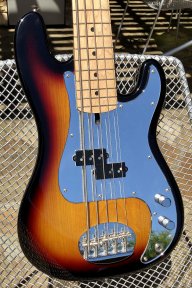
If you look at the semi-custom string makers who offer balanced tension sets, the B string usually comes in around .140 or .145 to keep it in line with a G string of .040 or .045 and an E string of .105 or .110.

TalkBass has been independent since 1998. Add your voice.
Create a free account to reply to discussions, view embedded media, and browse with fewer display ads.
Join free Log in
Want zero display ads or expanded classifieds tools? Compare plans.

Depends on the construction and setup. Ken Smiths have incredible Bs, and they're 34" scale with .125-.130, usually. My used $650 Schecters have unreal Bs, both with tapered .130s.So I've been messing around with D'addario's string tension pro calculator thing, and after taking a look at the various tensions for B strings, .130 seems to consistently be much lower tension than the rest of the strings. Stepping it up to .145 brings it right in line with the others, so it leaves me wondering why .130 ended up being the standard B string gauge?
Switching to the multiscale calculations, the 37" .130 is closer to the tension from other strings, which would go some way to explaining why Dingwall's and other multiscale's with a 37" tend to have such good B strings. Should us 5 string players have been using .145 B strings all along? Or am I missing something?

Yes. The low B does works better on a 35" scale than a 34" scale.Both my Schecter 5 strings are 35” scale. Is that the sweet spot, comprise for tone/ tension without going to multi scale?

Longer scale length makes for a better B string, but it does make the rest of the strings tighter. If you play a lot on the B string with your Schecter, that seems to me like a good trade-off, but if you play mostly traditional E-G stuff with the occasional trip down to the B string, it might not be ideal. Like anything else, it's a trade-off.Both my Schecter 5 strings are 35” scale. Is that the sweet spot, comprise for tone/ tension without going to multi scale?
Thicker strings allow for more tension.sorry for my lack of knowledge... I run a 130 on my 5. I see people commenting about using 120's and 145's. Which one would give more tension? Sometimes my B seems to floppy.


What tension do you consider too floppy?In my case they would be too floppy

The 130 I have on it now is too floppy for my tastes.What tension do you consider too floppy?
Clearly it works for a lot of people but I am starting to think 34" scale is just too short for solid low B. Not unlike how 25.5" is too short for a low B on a guitar. 26.5" works much better.IME (30 years with B-strings), higher tension B-strings have a lot more problems with overtones and intonation issues. Maybe that works better on a longer scale, but for typical non-37" scales, I get much better and more in-tune results with lighter gauge B-strings relative to the other 4. I honestly don't pay attention to matched string-to-string tension; it's mostly irrelevant.
Clearly it works for a lot of people but I am starting to think 34" scale is just too short for solid low B. Not unlike how 25.5" is too short for a low B on a guitar. 26.5" works much better.
Its certainly possible my touch on the instrument is not all it could be and that is the issue... Won't rule that out.That's not been my experience with basses. I've had longer scales with weak B-strings. My G&L, Muckelroy, Yamaha BB5000A, mutt-P5, and Regenerate Guitar Works 6 all have very good B-strings. It's far more about setup and how you play than the scale length, IME.
But YMMV and all that.
I don't think it's really a black-and-white issue. Some basses work and sound great for some people, while other people have a totally different perception based on their own experience, which includes a lot of different factors. It is very much a personal thing, so find what works for you and enjoy it.Its certainly possible my touch on the instrument is not all it could be and that is the issue... Won't rule that out.

I'm fine w 34" too. I had a very early Dingwall AB1. It sounded awesome, the fanned frets no problem, but the reach was just too much for me.I made peace with the floppy B's years ago. It's quite the compromise at these scale lengths.
I've played 34.5" fives virtually exclusively since the mid-80's and from this bass to that bass, this gage or another, this string brand or another, the B for me has always felt more loose than the other four. It's just the way it is at this scale length. I don't want 35 or 36. I am keen to try a fanned-fret axe sometime, but this just has never kept me up nights, my hands simply don't know any better. And the advantages of a five over a four for me make this a very minor disadvantage.