
Enjoy the benefits of a premium membership!
Upgrade Account
-
TalkBass has been independent since 1998. Add your voice.
Create a free account to reply to discussions, view embedded media, and browse with fewer display ads.
Join free Log in
Want zero display ads or expanded classifieds tools? Compare plans.
You are using an out of date browser. It may not display this or other websites correctly.
You should upgrade or use an alternative browser.
You should upgrade or use an alternative browser.
Why is .130 the standard for a B string?
- Thread starter Barghest
- Start date
More options
Who Replied?

Ooh, string tension nerditry, totally my jam.
If, like me, you prefer the feel of consistent tension across all of the strings, the B string on a 5-string can be kind of problematic. As you noted, with D'Ad rounds, if you want something that matches (or kind of matches) the tension of a 105 on the E, the right gauge is a .145.
I've strung my 5 with the EXL170BT and a .145 to get balanced tension and... I hated it. The .145 string is just grossly huge. Hard to get it strung, too big for most nuts, feels like it should be supporting a suspension bridge, not on a bass guitar.
Dropping to a .130 leaves you with about 32lbs of tension (assuming 34" scale), where the other 4 strings are a bit above 40lbs. That's a 20% drop, which is a big enough difference that a lot of players will feel like it's way off, which I think is where the "floppy" label comes from.
Going to a .135 improves the situation at little, up to 35lbs tension. A .140 would be even better, but (1) that's getting pretty heavy, and (2) D'Addario doesn't make a .140. No idea why. So, if you're committed to D'Addario and a .045 on the G string, none of the available solutions are great.
Part of the problem is that for some reason D'Addario string weight per gauge starts to decrease a little at higher gauges, which means you need a larger gauge to achieve the same tension. This is kind of sucky. StringJoy strings don't have this problem, and back when you could get them to do custom sets, a 45-60-80-105-135 StringJoy set was pretty close to balanced. This is what I currently have on my 5 and it's great but StringJoy doesn't offer this anymore. I am putting off changing strings on my 5 because of it.
There are solutions. As someone said, going lighter on all the other strings works reasonably well. 40-55-75-100-130 is pretty evenly balanced, but D'Addario doesn't sell a set like this, you'd have to assemble from singles. Close but a little worse is 40-55-70-95-125, which is just the EXL220BT set with a .125 on B. However, the overall tension from these is considerably lower, so you'll probably need to do a truss rod adjustment if you go to a set like this from a heaver set. And some people just don't like lighter strings.
People have mentioned going to a 35" scale as a solution. This does increase the tension on the B string, but it also increases the tension on all the other strings, so this doesn't solve the differential tension problem. The better way there is multiscale. These have become much more popular in the last few years. I don't know if this is why, but it's a good solution to the problem, and if I ever buy another 5-string bass, it will be multiscale for exactly this reason.
If, like me, you prefer the feel of consistent tension across all of the strings, the B string on a 5-string can be kind of problematic. As you noted, with D'Ad rounds, if you want something that matches (or kind of matches) the tension of a 105 on the E, the right gauge is a .145.
I've strung my 5 with the EXL170BT and a .145 to get balanced tension and... I hated it. The .145 string is just grossly huge. Hard to get it strung, too big for most nuts, feels like it should be supporting a suspension bridge, not on a bass guitar.
Dropping to a .130 leaves you with about 32lbs of tension (assuming 34" scale), where the other 4 strings are a bit above 40lbs. That's a 20% drop, which is a big enough difference that a lot of players will feel like it's way off, which I think is where the "floppy" label comes from.
Going to a .135 improves the situation at little, up to 35lbs tension. A .140 would be even better, but (1) that's getting pretty heavy, and (2) D'Addario doesn't make a .140. No idea why. So, if you're committed to D'Addario and a .045 on the G string, none of the available solutions are great.
Part of the problem is that for some reason D'Addario string weight per gauge starts to decrease a little at higher gauges, which means you need a larger gauge to achieve the same tension. This is kind of sucky. StringJoy strings don't have this problem, and back when you could get them to do custom sets, a 45-60-80-105-135 StringJoy set was pretty close to balanced. This is what I currently have on my 5 and it's great but StringJoy doesn't offer this anymore. I am putting off changing strings on my 5 because of it.
There are solutions. As someone said, going lighter on all the other strings works reasonably well. 40-55-75-100-130 is pretty evenly balanced, but D'Addario doesn't sell a set like this, you'd have to assemble from singles. Close but a little worse is 40-55-70-95-125, which is just the EXL220BT set with a .125 on B. However, the overall tension from these is considerably lower, so you'll probably need to do a truss rod adjustment if you go to a set like this from a heaver set. And some people just don't like lighter strings.
People have mentioned going to a 35" scale as a solution. This does increase the tension on the B string, but it also increases the tension on all the other strings, so this doesn't solve the differential tension problem. The better way there is multiscale. These have become much more popular in the last few years. I don't know if this is why, but it's a good solution to the problem, and if I ever buy another 5-string bass, it will be multiscale for exactly this reason.


String timbre is factor that many can’t get past. Perhaps after many years of trial and error between feel/tension, 130 may have been the most successful gauge and marketing figured it out. You have to start somewhere so for someone who is beginning on 5 strings, perhaps 130 worked best to get to timbre and feel right.
Timbre applies to all strings at anytime.
For example, playing an open note versus the octave on the adjacent string has a different texture/timbre. So why just center out the B because people think they don’t use it or better, don’t have their bass setup right with the pickup height properly set for their playing style. Saddle height can vastly affect the tone and feel of a string too. It’s another subjective area but once you’ve got setup right for you, it’s a big deal. Sure you can have a professional do it for you, but setting up your bass yourself and truly understanding what you’re doing is a big deal.
The more you play, the better you get.
The better your bass plays, the more you want to play it. The more you understand how your bass works, the more you can adjust it to suit you!
Then you can understand what gauge
string gauges make sense for you.
The beauty of 4 strings is that they just work in many ways, 5 strings change how you play and it’s subjective if you prefer using 4 or 5. Many players choose 4 strings over 5s for this reason. 6 strings changes the game further and I believe even less players play 6 as opposed to 4 or 5.
Just like on a B just doesn’t sound right on a 5, I’ve played many 4s where the E string “sucks”, yet the A string sounds better. Sucks as in bad output, doesn’t sound as loud as the A, has very little texture. B strings get “tarred with same brush” or treated in a similar manner.
That’s why before judging the B (or E on a 4), try to understand the string gauge, setup, bass construction. Some small changes (new strings with lower or higher tension) can make a big difference.
Timbre applies to all strings at anytime.
For example, playing an open note versus the octave on the adjacent string has a different texture/timbre. So why just center out the B because people think they don’t use it or better, don’t have their bass setup right with the pickup height properly set for their playing style. Saddle height can vastly affect the tone and feel of a string too. It’s another subjective area but once you’ve got setup right for you, it’s a big deal. Sure you can have a professional do it for you, but setting up your bass yourself and truly understanding what you’re doing is a big deal.
The more you play, the better you get.
The better your bass plays, the more you want to play it. The more you understand how your bass works, the more you can adjust it to suit you!
Then you can understand what gauge
string gauges make sense for you.
The beauty of 4 strings is that they just work in many ways, 5 strings change how you play and it’s subjective if you prefer using 4 or 5. Many players choose 4 strings over 5s for this reason. 6 strings changes the game further and I believe even less players play 6 as opposed to 4 or 5.
Just like on a B just doesn’t sound right on a 5, I’ve played many 4s where the E string “sucks”, yet the A string sounds better. Sucks as in bad output, doesn’t sound as loud as the A, has very little texture. B strings get “tarred with same brush” or treated in a similar manner.
That’s why before judging the B (or E on a 4), try to understand the string gauge, setup, bass construction. Some small changes (new strings with lower or higher tension) can make a big difference.
It's an interesting point. Also remember strings have two end points. Bridge. Tuners. Pass through the hole. Wrap around. The bigger the string, the more difficult these two things are likely to become? Dunno. But that is a really interesting point you bring up.So I've been messing around with D'addario's string tension pro calculator thing, and after taking a look at the various tensions for B strings, .130 seems to consistently be much lower tension than the rest of the strings. Stepping it up to .145 brings it right in line with the others, so it leaves me wondering why .130 ended up being the standard B string gauge?
Switching to the multiscale calculations, the 37" .130 is closer to the tension from other strings, which would go some way to explaining why Dingwall's and other multiscale's with a 37" tend to have such good B strings. Should us 5 string players have been using .145 B strings all along? Or am I missing something?

More than once have I had to drill the bridge, even on 4-string basses, so the end windings will pass through the anchor hole, without drilling the hole so large that it doesn't hold the ball.It's an interesting point. Also remember strings have two end points. Bridge. Tuners. Pass through the hole. Wrap around. The bigger the string, the more difficult these two things are likely to become? Dunno. But that is a really interesting point you bring up.
Yes, I'd envisioned someone would have that scenario to deal with. Thanks.More than once have I had to drill the bridge, even on 4-string basses, so the end windings will pass through the anchor hole, without drilling the hole so large that it doesn't hold the ball.

The thicker the B, the more I hate it. I use a 120 B because thicker B’s don’t even sound like they’re from the same set to me. They sound instantly dead to me, and while I don’t object to dead strings, I’d like to have a say in the matter. So I’ll put up with lower B string tension.

Along with the B string gauge, setup is a huge part of it. Raise the B, perhaps a bit more than you might expect at least to check it out, and see where it takes you. Pickup height as well. Some tiny adjustments can be a love/hate difference between results. Plus give time to settle into a setup adjustment.
On the other end, I wish there were more in-between gauges available for the G.
On the other end, I wish there were more in-between gauges available for the G.

Thomastik-Infeld has been making strings for over a hundred years. If they design a 5 string set of light gauge, low tension strings but with a .136 B, there must be a good reason. If that set or just the B doesn’t work out, I’d wager it’s more of a bass-specific thing as well as preferences of the individual player.
As to gauge and intonation, I’ve had very good results with both .118 and .136 B strings.
As to gauge and intonation, I’ve had very good results with both .118 and .136 B strings.

This exactly!I feel like there's a juggling act between core stiffness and tension at pitch, and when you're at the lower end of pitch for a given scale length the useful sweet spot gets narrower.
Heavier B strings can sound powerful at the lower end of the neck, but there's a sour, inharmonic property (caused by the stiffness of the string putting the harmonics out of tune with the fundamental) that gets more noticeable as you play higher up the string.
So you have to pick a point between the floppiness of a lighter gauge and the inharmonicity of a heavier gauge, and the best compromise will vary depending on how you play. Personally I like .120 to .125 with rounds, I use the B string more to cut down on shifts than blasting low root notes a lot.
The thinker the string, the shorter the scale, the stiffer the string get exponentially, at the same tuning, which at a certain point introduce thuddyness.
Tension is only one variable, of a much more complex equation.
Last edited:
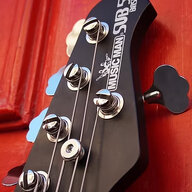

Have you got a 080 and a 065 laying around? Do both of them fit in the slot at the same time?Hey, does anyone know if 145 gauge string (D'Addario XLB145) will require a Musicman compensating nut filing? I'm using 135 now and it fits perfectly, and I would like to avoid nut filing due to such an experiment
Daaaaaamn man, this is genius!Have you got a 080 and a 065 laying around? Do both of them fit in the slot at the same time?

However I don't have these exact gauges, but I appreciate the idea


Depends on the bass. I like .130 on my Stingray 5's and Ibanez SR Multi-scale 5. My ESP fretless and Ibanez ATK5... I like the .125.
Hmm, wonder what I should expect from the .118 B coming tomorrow with the set of LaBella LT flats-5 I ordered. Not sure on what bass yet but it will be a 34" scale. Usually use.125 or .130 B's.


