
Enjoy the benefits of a premium membership!
Upgrade Account
-
TalkBass has been independent since 1998. Add your voice.
Create a free account to reply to discussions, view embedded media, and browse with fewer display ads.
Join free Log in
Want zero display ads or expanded classifieds tools? Compare plans.
You are using an out of date browser. It may not display this or other websites correctly.
You should upgrade or use an alternative browser.
You should upgrade or use an alternative browser.
Why is P-Bass still the best?
- Thread starter tonyciv
- Start date
- Status
- Not open for further replies.
More options
Who Replied?




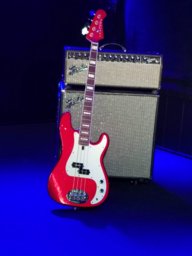
For some reason, this axe just seems to evoke the spirit of the bass for me more than any other model I've ever played. As they say, Leo got it right the first time!
Agree or disagree. Why?
Agree. I feel better knowing I'm using a P because no matter which note I play, it's solid.
I know it's all really quite subjective. However, when Leo and the boys set out to electrify the bass, they were very aware of the traditional role of that instrument, and tried their best to stay loyal to the essence-as they perceived it at the time-of the bass. I truly believe they did a pretty good job!
Disagree. Its a great platform, but it's just a bass not a "solution" to all "problems" the bass presents.

There are good and bad P Basses, and Fender's quality control is spotty, even among its most expensive models (Squiers often are better made). The P Bass and the J Bass are what they are, iconic and diverse in their own ways, but check out some of Ibanez basses--tonewise they rival the best Fenders and have a lot of great build qualities. Check out some of the Gibson basses, the Music Man, and even Reverends et al. There are a lot of great basses out there. Fender trumps many of them by virtue of corporate size and massive marketing (getting Fenders into the hands of young players and into the mass media).

No offense, but I have NEVER like the sound of a P-bass... EVER. I just don't find it useful nor good sounding at all! I honestly don't know what all the appeal is all about. I guess a lot of people have a strong affinity for Fender. I never have. The only Fender I ever liked was a candy red Jaguar bass. That was it. And that bass is a Jazz bass.


The frequency response of a good P bass fits well in almost any mix. If you have one with good wood and a good neck pocket, a P bass is total money. Jazz basses are the same way, just in a different frequency area, and with the flexibility to emphasize one pickup or the other. I'd say with those two instruments, Fender nailed the entire range of what sounds good in the pitch range in which the instrument operates.

I'm primarily a Precision player, but I have to say there's more nonsense written here about this bass than I could adequately refute in my remaining years.
People spout stuff about this bass because other bubbas say it and if they say it enough it becomes true even if it makes no sense.
This "sits in the mix" trope is a perfect example.
With which strings?
With which pickups?
Why can't the mix engineer make a different bass "sit in the mix"?
All these obvious questions and about a dozen more objections make nonsense of a claim that just won't go away, though it's long outdated -- if it was ever true in the first place.
The P has its own problems, particularly dead spots -- which I can assure you your P has. Put some flats on it if you don't believe me. Some are better, some are worse.
I like the Precision because it isn't full of clutter and nonsense. It works. "As simple as possible, but no simpler" about gets it, and that's what I'm always after.
They're reasonably quiet. You can always sell them. Nobody wonders about what it is when you're onstage. It's the default setting, which is a good thing.
But other basses will work, and work just fine.
People spout stuff about this bass because other bubbas say it and if they say it enough it becomes true even if it makes no sense.
This "sits in the mix" trope is a perfect example.
With which strings?
With which pickups?
Why can't the mix engineer make a different bass "sit in the mix"?
All these obvious questions and about a dozen more objections make nonsense of a claim that just won't go away, though it's long outdated -- if it was ever true in the first place.
The P has its own problems, particularly dead spots -- which I can assure you your P has. Put some flats on it if you don't believe me. Some are better, some are worse.
I like the Precision because it isn't full of clutter and nonsense. It works. "As simple as possible, but no simpler" about gets it, and that's what I'm always after.
They're reasonably quiet. You can always sell them. Nobody wonders about what it is when you're onstage. It's the default setting, which is a good thing.
But other basses will work, and work just fine.
I don't think the word "best" applies. And not everyone necessarily likes them. But I think they remain popular and so widely used by so many because they are iconic, have a strong legacy, are very fundamental and simple, and if you like what a P bass has to offer, will get almost any job done.

Ha ha ha, ok, I'll play.
I think it's appealing because it makes noises that most people enjoy, and most other things don't make similar noises and so it has a clearly defined space to occupy in most mixes.
Also it's simple to operate and difficult to screw up.
I think it's appealing because it makes noises that most people enjoy, and most other things don't make similar noises and so it has a clearly defined space to occupy in most mixes.
Also it's simple to operate and difficult to screw up.
There are an awful lot of basses that are only good for parting fools from their money.Every bass is the best for something....Just my $.02.
Trust me, there's a lot of garbage out there.


God will this site ever get over P's
Haw.

It's statistically unlikely.
- Status
- Not open for further replies.


