• TalkBass has been independent since 1998. Add your voice.
    Create a free account to reply to discussions, view embedded media, and browse with fewer display ads.
    Join freeLog in
    Want zero display ads or expanded classifieds tools? Compare plans.

Why note this time signature?

What can I say I like learning.

Found an example we all may know The Beatles - Yer blues

From a drummers perspective - 8th note pulse Its the first song in the video - it'll cost you 2 minutes :-)

-

Found it notated 2 ways (measure 7 in both cases) 4/4 and 8/8
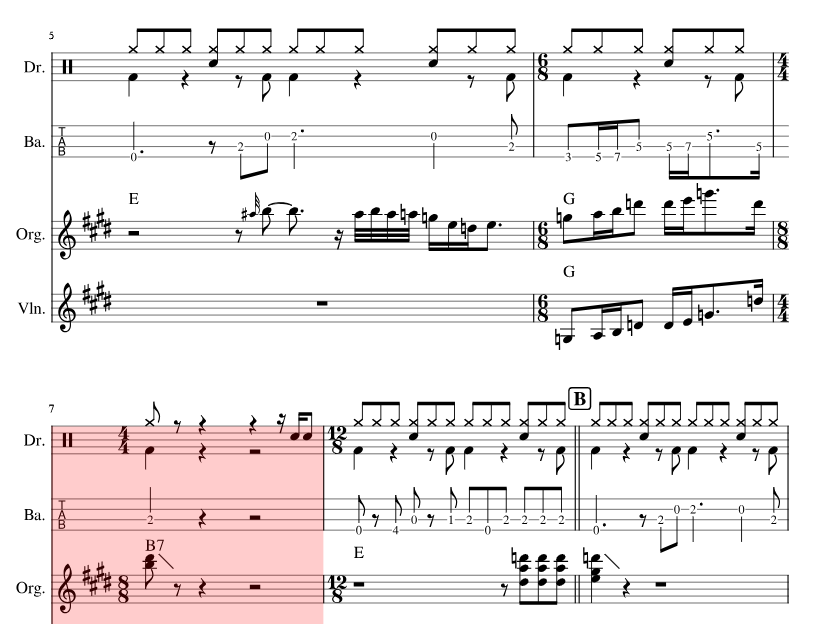

upload_2023-9-18_14-50-17.png


upload_2023-9-18_14-55-57.png
 
  • Like
Reactions: themickster
Rather like 7/8 and most other irregular signatures, there is no established convention for grouping in 8/8 - you can pretty much do what you want to convey your intent. 3-3-2 is just one possibility. The usual approach is to conform to the 'shape' (tension and resolution) in the melody, what ever that might be, case by case.
Most of the time in written music, time signatures with a denominator of 8 usually mean the beat is a dotted quarter note or a combination of quarter notes and dotted quarter notes (with the exception of 1/8–4/8), which is different from how /4 and /2 meters work where the denominator is representative of what note value the beat level is at (except sometimes 6/4, which historically means 2 beats of dotted half notes).
 
From a drummers perspective - 8th note pulse Its the first song in the video - it'll cost you 2 minutes :)
To me I hear the 12/8 bars as a slow 4 because of the strong backbeat. If you were going to dance to this song, what's the beat you would be dancing to: the kick/snare on every dotted quarter note or the ride cymbal on every eighth note?

Although in listening to the song, during that break I would totally notate the bar as 8/8, but with the beaming and rest groups notated as 3+2+3: counting through the bar, counting 4 quarter notes just doesn't "feel" right because John's melody after the guitar break "works" better if you count the last 3 eighths as one beat, and then the 3+2 during the guitar beak feels better to me than 2+3 because I hear those first two beats as a continuation of the ride cymbal, but with John's melody interrupting an eighth note early.
 
  • Like
Reactions: pmatz2
To me I hear the 12/8 bars as a slow 4 because of the strong backbeat. If you were going to dance to this song, what's the beat you would be dancing to: the kick/snare on every dotted quarter note or the ride cymbal on every eighth note?

Although in listening to the song, during that break I would totally notate the bar as 8/8, but with the beaming and rest groups notated as 3+2+3: counting through the bar, counting 4 quarter notes just doesn't "feel" right because John's melody after the guitar break "works" better if you count the last 3 eighths as one beat, and then the 3+2 during the guitar beak feels better to me than 2+3 because I hear those first two beats as a continuation of the ride cymbal, but with John's melody interrupting an eighth note early.

Thanks for the detailed analysis will need to go back and listen from your perspective.
 
Most of the time in written music, time signatures with a denominator of 8 usually mean the beat is a dotted quarter note or a combination of quarter notes and dotted quarter notes (with the exception of 1/8–4/8), which is different from how /4 and /2 meters work where the denominator is representative of what note value the beat level is at (except sometimes 6/4, which historically means 2 beats of dotted half notes).

We've already had that discussion back at post #12 :)
Why note this time signature?
 
As I said before, the original intent of a time signature was for the top number to indicate how many beats per measure, and the bottom number to indicate the type of note that receives one beat. But, as has been noted above, this can get confusing when it comes to a mixture of simple and compound time. This gave rise to some modern composers abandoning the numbers altogether for the bottom component of the time signature— writing them instead as note values, such as the following:
IMG_0161.jpeg
 
As I said before, the original intent of a time signature was for the top number to indicate how many beats per measure, and the bottom number to indicate the type of note that receives one beat. But, as has been noted above, this can get confusing when it comes to a mixture of simple and compound time. This gave rise to some modern composers abandoning the numbers altogether for the bottom component of the time signature— writing them instead as note values, such as the following:
View attachment 5196663
Something wrong with my math this morning.
I can't add properly.
3 + 2+2 = 7.
I need your help.
Thank you.