
Enjoy the benefits of a premium membership!
Upgrade Account
-
TalkBass has been independent since 1998. Add your voice.
Create a free account to reply to discussions, view embedded media, and browse with fewer display ads.
Join free Log in
Want zero display ads or expanded classifieds tools? Compare plans.
You are using an out of date browser. It may not display this or other websites correctly.
You should upgrade or use an alternative browser.
You should upgrade or use an alternative browser.
Why play a four string?
- Thread starter joel406
- Start date
More options
Who Replied?

I'm with the OP, I really don't need my 4s anymore, I'm happy as a clam with 5s.
I do keep and use 4s just because...
1. I love having a few basses around with different strings, active, passive... I mean, a P with flats is a very cool tool.
2. No matter what, I do play a 4 string from a slightly different viewpoint, more old school, if you will. It's like how you are when wearing work clothes vs non work clothes. It's a little different.
3. For one tribute band a passive 4 is all that is needed for the range and tones, and I have a specific bass for that project. For another cover band, a passive 4 and active 5 is the perfect set of tools for the job.
I do keep and use 4s just because...
1. I love having a few basses around with different strings, active, passive... I mean, a P with flats is a very cool tool.
2. No matter what, I do play a 4 string from a slightly different viewpoint, more old school, if you will. It's like how you are when wearing work clothes vs non work clothes. It's a little different.
3. For one tribute band a passive 4 is all that is needed for the range and tones, and I have a specific bass for that project. For another cover band, a passive 4 and active 5 is the perfect set of tools for the job.

I switched to a 5 stringer almost 20 years ago and have rarely owned or played a 4 stringer since. Why? It's really a feel thing at this point. I use the low B string as a finger rest, and I've just gotten comfortable finding notes on the E and A strings in relation to where they are compared to the B string. Take away the B string and I start playing everything on the wrong strings! Sure, I could get used to it, but as others said here, I see a 5 string as a 4 string with options. I don't have to play the B strings, but it's nice to have it when I want it.
Having said all this, I recently bought my first 6 string bass and love it! The transition from a 5 is a lot easier than the transition from the 4 - mainly because adding a string to the bottom of the neck doesn't really get in the way of what I'm already playing on the E and A (and sometimes B) strings. But having the extra strings makes it so much easier to stay in one position on the neck without having to move positions.
I get why some use and prefer a 4. But I play a lot of instruments, and keeping things consistent is important for me when I switch between them... once I got used to the low B there was no going back.
Having said all this, I recently bought my first 6 string bass and love it! The transition from a 5 is a lot easier than the transition from the 4 - mainly because adding a string to the bottom of the neck doesn't really get in the way of what I'm already playing on the E and A (and sometimes B) strings. But having the extra strings makes it so much easier to stay in one position on the neck without having to move positions.
I get why some use and prefer a 4. But I play a lot of instruments, and keeping things consistent is important for me when I switch between them... once I got used to the low B there was no going back.


Play what your comfortable with. I play a few 21 and 22 fret fours with EADG, a 22 fret BEAD, a 24 fret BEAD, and a 24 fret EADG. I'm not in a live band that needs a low B and a G. If I were, i'd probably buy a five. But i'm not a huge fan of 5's so I don't own one.

My $.02: A 4 and a 5 are, in some senses, different instruments. I have recently shifted back to a 4 J-style after a few years playing a Fender Jazz V exclusively, and I'm not advocating for either necessarily. What I have learned from the shift is: the main advantage of a V string is not the extended range (it's only 5 notes more), it is the way the V transforms HOW you play the bass. As you note, string crossing becomes more of an option, which transforms the functional possibilities across the fretboard. Play a low F on the sixth fret on the B rather than the first fret. A low F on the E and a low F on a B sound different - they are not equivalent - and the functional possibilities each position avails on the are different animals. Look at how Hadrien plays a V. Why does he choose a V rather than a 4? In my opinion it is because he can cover a broader range, quicker, than on a four, and ESPECIALLY because it opens a broader world of harmonic possibilities up high on the fret board (notice how he voices chords with the B on the bottom), where he does a tremendous amount of playing. I would argue a V is perhaps a more flexible instrument for playing dynamic lines and solos - not necessarily a better instrument because it has a lower range. If you want a lower range, get an octave pedal. That said, learning to shift positions in a functional manner on a 4 is also a great skill, whether or not you play a 4 or a V.
Last edited:

Sounds like you haven't played a quality 5 string.The clarity of an open low D, C# and C on a 4 string is far superior to a fretted D, C# and C on a 5 string, IMHO.
Hopefully that makes sense.

I wrestled with the title of this post.
I have been a four string player for a long time (longer than I’m going to tell anyone).
But as music has progressed, last year I found myself in need of the “even” lower register. A lot of music diving down to low D, C and even B.
So after a torrid affair with a cheapo fake Fender fiver I pulled the trigger on a quality fiver.
After a little acclimation I seem to have it well in hand now.
And besides the lower notes I have found the greater freedom of horizontal playing.
I still move up and down the board. You know some old habits will never die.
But I now see no reason to have a four string anymore. I can play everything on the five. Even if I never drop below the E it gives me many choices I didn’t have before. And I find that liberating.
My last four string I had for 7 years. And we had a bond. But when the fiver came into the picture it went into the case and sat for three months.
I don’t think anybody wants to sit a $1600 bass in its case for months let alone years.
I released it about a month ago. While I miss it I have new friends now. And have lost interest in four string entirely.
I understand fivers aren’t for everyone.
Some people have small hands. Same here. I tried them all. Well those I could afford. I’m sure Alembic make a very lovable fiver. But I love my house too.
No one was more surprised as I was that Fender made the five string bass I would love so much.
And after a great while playing only fives I wonder why anyone wouldn’t just play those and let the four just go extinct.
I’m sure the flamers are writhing their hands as they read this.
I think I just heard a MMBWAAAAHAHAHAHA in the distance.
My point is I moved away from fours and I don’t see any reason to ever go back.
So I doubled down.
View attachment 3714769
Any competent musician will say that necessity drives all decisions. I too have moved to 5 string for most of my music. However, I still like having a 4 stringer in the event that I wont need the 5 string. Different situations call for different tools. Sometimes a crescent wrench will do all you need. But sometimes you need pliers. I don't have a need for a 6 string bass....but who says i wont have one in 10 yrs?
I hear what you're saying but that being said why does "right" have to be so important? having the courage to do things a little differently is the beginning of innovation. And after all Bb is Bb.
Because it's a cover tune. As such, one hopes to emulate the original artist(s) as close as possible. Courage/different/innovation are topics that don't generally apply to cover tunes... unless your revamping the original tune to your own style.
Yeah...
I really didn’t think this through before opening this can of worms.
This place can be rough but I've noticed, most people have been fairly decent in their responses.
I have a Yamaha TRB6 that is one of the finest instruments I've ever owned. Over the past couple of years, I've been filling in with a band that plays 50's, 60's, 70's stuff. It should all be 4-string, except they transpose most of the songs to C or G. Playing some of those songs on a 4-string get too high (try playing All My Lovin' transposed to C on a 4-string). My main band is a 70's rock band -- Think ZZ Top, David Bowie, Rolling Stones, Aerosmith, Free, Beatles. The 4-strings get the job done without a lot of fuss.
A bunch of folks commented on muting unused strings on a 5 vs. a 4 -- in my case a 6 vs. a 4. Try playing the bass 'solo' in All Right Now on a 6-string. You can play the A-A-F#-E-F# part at the 5th fret on the E, and the 5th and 7th frets on the B. Then, you can play the high G-(A)-D-(A)-F#-(A)-D(A) at the 12th fret on the G and the 12th and 14th frets on the C... don't forget to hit the open A on the upbeats. That is a muting challenge on a 6-string; a little easier on a 5 string, playing the high part on at the D-string 16th & 17th frets and G-string 19th fret. I think it's easiest on a 4-string... you cover the entire range of a 19-fret 4-string instrument, from the low E (open) to the high D (G-string 19th fret).
If you want to cover Hey, Jeremy by Pearl Jam, you'll need a 12-string. If you want to hit some Cheap Trick stuff, you'll need an 8 string. Otherwise, you do you! I mean, really, can you ever have too many basses anyway?
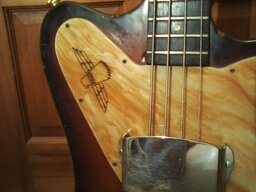
In 96, I decided I wanted a 5er. At that time, my 2 basses were both Gibsons-a 66 EB-3 and a 67 Thunderbird IV. Skinny necks which my short fingers are comfortable playing-no P basses for me. After trying a few, including a J5, nope. The ergos weren't right. Again, for me. I stumbled across a 95 Gibby LPB2/5(Les Paul Bass 2, 5 string)that fit my short fat fingers well. It has Barts from the factory. I like it though it is my heaviest bass. I rarely play it out since I've been playing 4's since 67 and there's a comfort level there, especially if I'm reading charts.I wrestled with the title of this post.
I have been a four string player for a long time (longer than I’m going to tell anyone).
But as music has progressed, last year I found myself in need of the “even” lower register. A lot of music diving down to low D, C and even B.
So after a torrid affair with a cheapo fake Fender fiver I pulled the trigger on a quality fiver.
After a little acclimation I seem to have it well in hand now.
And besides the lower notes I have found the greater freedom of horizontal playing.
I still move up and down the board. You know some old habits will never die.
But I now see no reason to have a four string anymore. I can play everything on the five. Even if I never drop below the E it gives me many choices I didn’t have before. And I find that liberating.
My last four string I had for 7 years. And we had a bond. But when the fiver came into the picture it went into the case and sat for three months.
I don’t think anybody wants to sit a $1600 bass in its case for months let alone years.
I released it about a month ago. While I miss it I have new friends now. And have lost interest in four string entirely.
I understand fivers aren’t for everyone.
Some people have small hands. Same here. I tried them all. Well those I could afford. I’m sure Alembic make a very lovable fiver. But I love my house too.
No one was more surprised as I was that Fender made the five string bass I would love so much.
And after a great while playing only fives I wonder why anyone wouldn’t just play those and let the four just go extinct.
I’m sure the flamers are writhing their hands as they read this.
I think I just heard a MMBWAAAAHAHAHAHA in the distance.
My point is I moved away from fours and I don’t see any reason to ever go back.
So I doubled down.
View attachment 3714769
All that being said, if I'd known about 'octavers' at the time, I coulda saved $1600. On the rare occasions I need low Eb or D, I 'stomp the box'.

Main reasons for 4 string in my case is ergonomics and simplicity. I just find it easier to play when you don't need the b string. It's just one less string you have to mute.
I love fives. I do own one and would not be without one for long. But for my music, 4 strings get me 90% of what I need.
I love fives. I do own one and would not be without one for long. But for my music, 4 strings get me 90% of what I need.

I think the OP is questioning the rationale for any instrument. Why play a bugle instead of a trumpet? Or an accordion instead of a synthesizer? it's because that's what you want to PLAY MUSIC ON.
There is no one-instrument-fits-all-music.
The reason you choose any instrument should be the music you want to play. If you want to play Hawaiian ballads, you'd choose a ukulele over a tuba.
If you want a Swiss Army Knife instrument, you could probably modify a four string to sound a fifth lower with a transposer and smack all those 5 stringers upside the haid... but the subwoofer will need to be awesome.
There is no one-instrument-fits-all-music.
The reason you choose any instrument should be the music you want to play. If you want to play Hawaiian ballads, you'd choose a ukulele over a tuba.
If you want a Swiss Army Knife instrument, you could probably modify a four string to sound a fifth lower with a transposer and smack all those 5 stringers upside the haid... but the subwoofer will need to be awesome.
I bought a Fendull 5 Jazz Bass and returned it after 3 hours. In my opinion it sucked. Crappy workmanship and a neck wide enough to land a small aircraft on. Wasn’t even worthy of sitting on the wall as wall art next to my 4 string Jazz Bass wall art.Cause I don't want a wider neck for 5 extra notes.
Went back to old reliable Ibanez and bought a 2006 Prestige SR1005 neck through and never looked back at playing 4 strings.
The neck was no wider than a Fendull 4 string and when the guitar players retuned for drop D, I’d just grab another swig of beer and wait for them to finish. LOL
Since then I’ve bought another Ibanez. This time a a 2015 SR1405TE neck through.
From my perspective, why would anyone not want to play a fiver? A 4 string is just 80% of a bass and having the option of a fretted E over an open E is nice.
I go back and forth from 4 to 5 when I need to play a tune with a Rickenbacker vibe, but that’s the only time. Easy enough to do but I’d rather play the 5...

Dragonetti only needed 3...
Interesting guy. According to Wikipedia: Dragonetti was known for his formidable strength and stamina. He had huge hands with strong, broad fingers, which allowed him to play with a taller bridge and strings twice as far from the fingerboard as the other bassists.
The physical quality is his huge hand: endowed, first of all, with prodigious strength so that its grip on the strings of the instrument is the equivalent of the grip of a blacksmith's vice... A hand endowed with five fingers so long, big and agile, that all five, including the bent thumb, go up and down the fingerboard each playing a note.
Interesting guy. According to Wikipedia: Dragonetti was known for his formidable strength and stamina. He had huge hands with strong, broad fingers, which allowed him to play with a taller bridge and strings twice as far from the fingerboard as the other bassists.
The physical quality is his huge hand: endowed, first of all, with prodigious strength so that its grip on the strings of the instrument is the equivalent of the grip of a blacksmith's vice... A hand endowed with five fingers so long, big and agile, that all five, including the bent thumb, go up and down the fingerboard each playing a note.
Yes, he was a monster (in the musical sense
 ). At a convent in Padua he stated that his bass was more powerful than the organ pipes there. To prove his point he awakened all in the middle of the night by simulating a thunderstorm with his bass.
I played only 4 strings for 20+ years. Not sure why I switched to 5 but I did. Once I became comfortable on a 5 string I was lost on my 4 so now I only own 5 strings. I love having a B string, especially on my Dingwalls. I also prefer playing more horizontally with the economy of motion and also better visualization of the scale.


